

Reading time
3
min
Need an App? Here’s How to Hire an App Development Factory
In 2016, one year after entering the market, Nubank published a note that left its users on edge.
Brazil’s most famous fintech would cease to exist if the Central Bank set a new settlement deadline for card machine companies: the 30-day process would drop to just two days—an outcome that would hurt “Nu,” which didn’t have the same working capital as the big banks.
In the end, the Central Bank reversed course and the “little purple” brand celebrated. But what makes Nubank so loved that people were worried about losing it?
We use the brand to illustrate a reality. While banking procedures—especially those involving credit cards—come with fees, rules, and endless complications, a fintech provides similar services in a simpler, faster, and more transparent way for the user.
The purple card, for example, became one of the most used options because it charges no annual fee and offers credit analysis and support entirely through an app. In other words: less bureaucracy and more convenience.
This shows that investing in user experience as a way to retain customers brings more results for fintechs in Brazil and abroad.
Exclusive Bradesco Browser: how the partnership with X-Apps generated more than 1.2 million accesses
For a fintech to have a place in the financial market, it needs, above all, what specialists call a “fintech culture”: user experience must come before all other priorities, through software development so simple that anyone—whether a heavy or light app user—can use it with confidence.
In other words, a fintech has to be everything a traditional bank is not, starting with bureaucracy.
Banks must serve well the customers who go to branches to pay bills and withdraw cash, those who want to do everything online, and, in between, those who can’t stand calling a customer service line to get information.
Because they have to serve every profile well, they often end up serving none of them particularly well.
Or are you so satisfied with your bank that you would pay extra for the same service?
A fintech moves in the opposite direction: it is based on niches. It doesn’t want to serve everyone—it wants to serve a specific portion of the population extremely well.
It emerges as an option for people with bad credit who can’t access credit, for those who want to improve their credit margin, and even for the so-called “unbanked”—individuals who have no bank account or whose account is so overdrawn that they deal only with cash to avoid depositing money and losing it to interest.
Nubank, again, is a good example of serving these profiles: it lets registered users choose their credit limit, quickly change statement closing and due dates, and pay their monthly balance via boleto (a Brazilian payment slip).
Fintechs are born with a lean concept: they’re lightweight, simple, and focused on specific consumer groups. Their apps must be intuitive, with user issues and doubts resolved in just a few taps.
For entrepreneurs who want to venture into the promising fintech world, the first step is certainly having a good development team.
After all, just because the final app culturally needs to be simple doesn’t mean the software development process will be.
Financial market startups have many regulatory and security details that must be followed strictly by professionals who understand the field.
When the topic comes up in online forums or events, an inevitable question is: who regulates the world of financial startups?
The field is no longer as lacking in requirements and information. According to the Central Bank, since 2018 fintechs have been regulated by the National Monetary Council (CMN), through Resolutions 456 and 457, which establish rules for opening and operating.
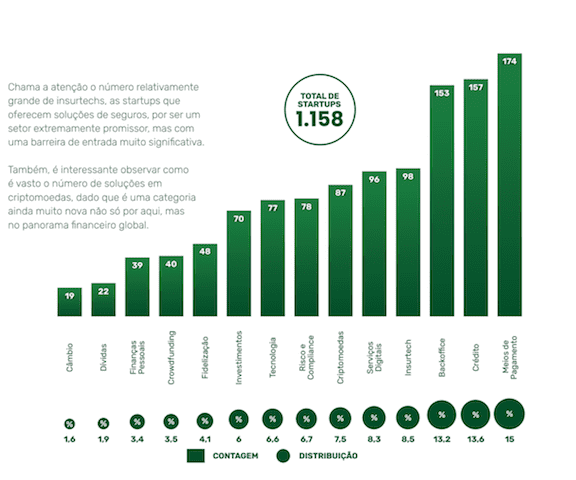
It’s long past time to have a clearer structure for how companies in this market emerge. According to Fintechlab, the number of fintechs in Brazil grew from just a few dozen to 771 by August 2020. And according to the Distrito Fintech Report, that number reached 1,158 fintechs in just the first four months of 2021.
Clear up all your questions about web software development or app development! Check out our e-book!
As in any hot market, this number tends to keep rising.
Some are already going through merger processes with major banks so the giants can provide better services through startups—such as XP Investimentos, recently acquired by Banco Itaú.
Even if there isn’t a specific regulation for every scenario, Brazilian fintechs can rely on Febraban’s rules to protect their business and their customers’ interests.
They just don’t need to copy the slowness of the Brazilian banking sector.
After all, everything indicates that the population that fell in love with Nubank is open-hearted toward new initiatives that simplify their financial lives.
- Facebook may be developing a Clubhouse rival app; understand
- App flaw leaves 120 million users exposed on the web
- Brazil’s Startup Legal Framework is approved and promises to heat up the IT market


