

Reading time
1
min
What We Learned at Insurance Day
In April 2017, Facebook held a conference called F8 where its founder, Mark Zuckerberg (known for being a big enthusiast of new technologies), stated that virtual reality glasses will be the next major computing platform.
And that his company is already investing in this new technology.
Yes, glasses—the centuries-old invention that, until a few years ago, was used only to improve eyesight or as a fashion accessory.
Lately, virtual reality glasses have been used for games and augmented reality apps—and have even become internet memes, like the person who thinks they are really on a roller coaster and makes exaggerated movements, or the one who plays a VR horror game and gets a big scare in real life.
Zuckerberg’s announcement, however, comes with an extra twist, because experts say that in 2022 these glasses will start replacing another technological icon we can’t imagine living without today: the smartphone.
For people like Michael Abrash, chief scientist at Oculus (a Facebook-owned company that develops virtual reality headsets), the glasses will be more than an entertainment gadget: they will become “the new indispensable gadget in people’s lives”.
This will happen because, according to the researcher, in the future the glasses will offer more than augmented reality: they will also give the user good access to virtual reality, making everything that’s possible to access today on a smartphone look trivial compared to what the glasses can do.
And with the ability to access and interact with multiple screens right in front of your eyes, there is no need to carry another screen in your pocket.
For him, the forecast is 20 to 30 years for people to completely replace their phones with glasses.
20 or 30 years sounds like a lot of time?
It’s worth remembering that this is the forecast for the total replacement of smartphones by glasses—the start of this movement is expected for 2022.
In other words, it’s right around the corner.
Research to make this movement real is still in its infancy, but the technology capable of bringing this into our daily lives already exists.
One example is HoloLens, a Microsoft headset that overlays the user’s view with three-dimensional images and is already used for many purposes. The idea is that it enables the user to perform tasks that would otherwise only be possible on a computer, phone, or tablet.
Because it is still in development, Microsoft’s team still needs to overcome obstacles to get the headset into consumers’ hands, such as the limited field of view and the size and weight of the hardware.
But the technology is there—it’s undeniable—and it only needs refinement to get closer to perfection.
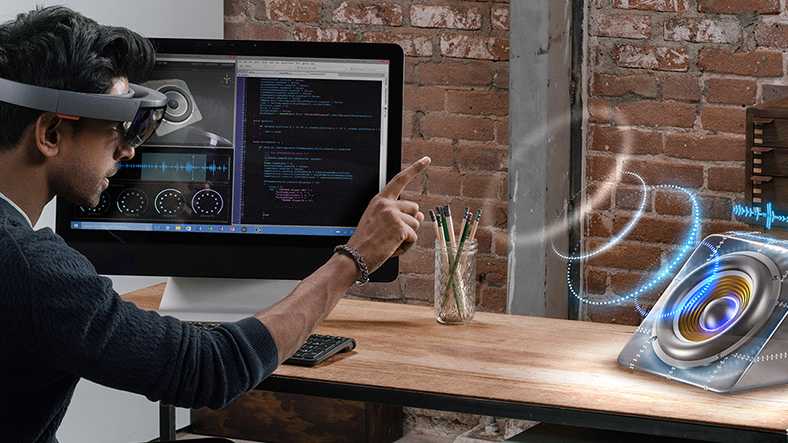
Another example, much more familiar to everyone, is Google Glass, which is also about augmented reality and only didn’t fully take off because of price, development limitations, and doubts about the security and privacy that the gadget (doesn’t) provide.
But even if it didn’t succeed, it is still another opportunity to study and refine the product Mark Zuckerberg wants to bring to market.
Augmented reality technology has been in Brazil for some time.
Recently, X-Apps developed a virtual reality app for Oculus Rift and Google Cardboard with the goal of delivering a virtual reality experience of IT Forum, an event that in April 2017 brought together, in Bahia, the largest IT investors in Brazil.
IT Forum is considered the most important event in the sector in Latin America and promotes discussions about the changes and transformations in the information technology field.
According to the organizers, this is a time of adaptation and fast understanding of the needs of IT professionals.
There’s nothing better than seeing cutting-edge technologies, like Oculus Rift, in the corridors of events like this to make it clear that there’s no fighting the future: either you adapt and grow with it or you’ll be left behind.
With the X-Apps app, participants put on the device and navigated the event environment as if they were walking through it, accessing talks, business meetings, booths, shows, and even happy hours.
The product was the most interactive way to showcase IT Forum, because it delivered a 360-degree experience of the whole structure, which fit on a phone.
The technology is still new and quite early-stage, but the glasses have everything it takes to become the great content manager of the future, creating fully virtual or hybrid experiences, where the real and the virtual mix in a single access.
And if we take into account all of Mark Zuckerberg’s boldness in helping the world develop new technologies (he recently created a foundation for that purpose), maybe we won’t even have to wait the 20 years experts talk about to see this reality happen—in every possible environment.
Want to know more about how X-Apps built the virtual reality glasses experience for IT Forum, or just have questions about app development? Leave a comment and let’s keep the conversation going!


