Índice do artigofaltam 23 min de leitura
Companies record almost everything and query almost nothing. What unlocks that archive isn't summarizing videos, it's being able to ask where the evidence is and getting back the moment.
A support person receives a video from a customer who recorded their screen while trying to place an order. It's eighteen minutes long. At some point the total shown was wrong, the customer hesitated, tried again and gave up. They didn't narrate any of this out loud, because they were alone and focused. The audio transcription of that recording is practically empty, and yet it's what most companies have today as their way of querying video.
The problem isn't a lack of transcription technology. It's that the question that matters, "at what moment did the screen show the wrong amount", is a question about image and about time. Neither is in the text of the speech.
That's the subject of this article, and it's worth saying right away what it isn't. It's not about generating video with AI, nor about producing automatic captions or summaries, which are old and reasonably solved capabilities. It's about turning an audiovisual archive into something queryable, with answers that point to the moment and can be checked by a person.
Article summary
- The real gain isn't summarizing, it's moment retrieval: asking where something happened and getting back the segment with a timestamp, for human checking.
- The chart circulating on the subject rests on a benchmark of 101 questions about 21 videos. The only static vs. agentic pair published with methodology separates the two modes by 0.7 percentage points.
- Reducing image tokens doesn't reduce cost in the same proportion, because navigation is counted as thinking tokens and thinking is charged at the output rate.
- The analysis interprets and recommends. Authorization, sequencing and effects on external systems remain the job of deterministic code, with their own policy.
Eight different things are called AI video
Before deciding anything, it's worth separating what the market bundles together. The eight approaches below solve distinct problems, and picking the wrong one is the most common way to spend money without solving anything.
| Approach | Answers well | Doesn't answer |
|---|---|---|
| Audio transcription | What was said, by whom, when | What appeared on screen without anyone commenting |
| Text in images (OCR) | Which characters were visible in a frame | In what order the states followed each other |
| Single-frame analysis | What's in a specific image | Anything that depends on before and after |
| Audiovisual and temporal understanding | Image, sound and order combined into one answer | Exhaustive precision across all the sampled material |
| Analysis with tools chosen by the model | Where to look first in a long video | A guarantee that nothing was skipped |
| Search across an archive | Which files the subject appears in | The fine detail inside one file |
| Live analysis | Reacting to something as it happens | Querying what has already been recorded |
| Video generation and editing | Producing new material | Finding anything in existing material |
The fifth row is the one that recently got a commercial name and the one this article pursues. And its name deserves care, because "agent" carries baggage that gets in the way.
The idea also wasn't born in a vendor's announcement. In March 2024, the academic paper VideoAgent already described exactly this loop: "an agent that iteratively identifies and compiles crucial information to answer a question, with vision-language foundation models serving as tools". The result the authors published is what matters most to whoever pays the bill: they reached 54.1% and 71.3% accuracy on two benchmarks using, on average, 8.4 and 8.2 frames. The point isn't using few frames to save money; it's that most of a video has nothing to do with the question.
VideoAgent, arXiv 2403.10517. Independent research evidence, not a vendor result.
What has changed since then is where the loop runs. Before, the integrator's application coordinated the tools: you had to write the loop, decide the cuts, call the vision model for each segment and combine the answers. Now, one vendor offers that loop built into the service itself. It's a shift of engineering responsibility, not an unprecedented capability, and it has consequences both ways, as the next sections show.
How the machine watches, without magic
A model doesn't watch a video. It receives a sequence of samples, and everything it can answer depends on which samples were taken.
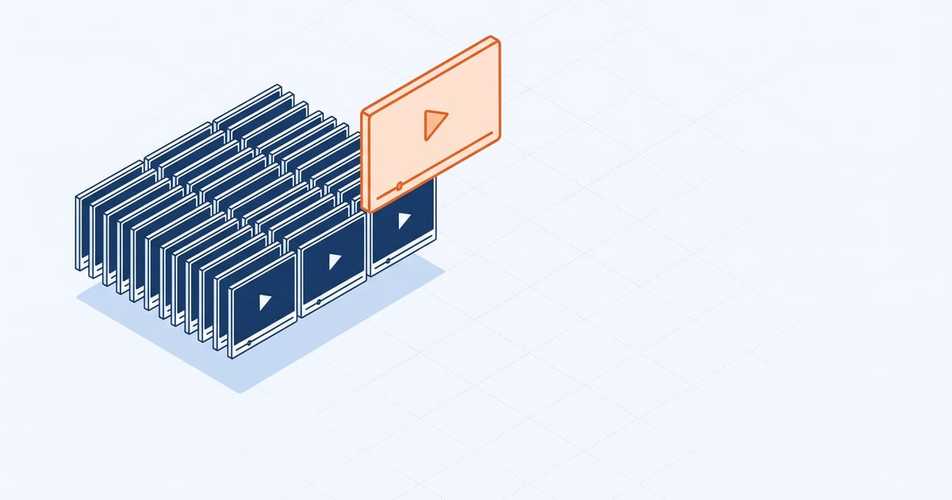
In the default mode documented by Gemini, called static, the video goes in sampled at one frame per second, adjustable through the API, and all those frames go into the context at once. One hour of footage at that rate produces 3,600 visual samples. That number is useful for understanding the order of magnitude and misleading if you stop there, because a sample isn't a token, and a token isn't a cost. A token is the unit these services use to count and charge for what goes in and out, and a video frame is worth many tokens, not one.
The declared tokenization is what lets you do the math. At low media resolution, each frame costs 66 tokens; at high, 258. Audio costs 32 tokens per second. The documentation itself rounds the total to about 100 tokens per second of video at low resolution and about 300 at high, which for an hour comes to something between 360,000 and one million tokens of input alone.
Static mode tokenization according to the Gemini Developer API video understanding documentation. Capability documented by the vendor.
That's the cost of looking at everything with the same attention. And looking at everything with the same attention is exactly what the question doesn't ask for.
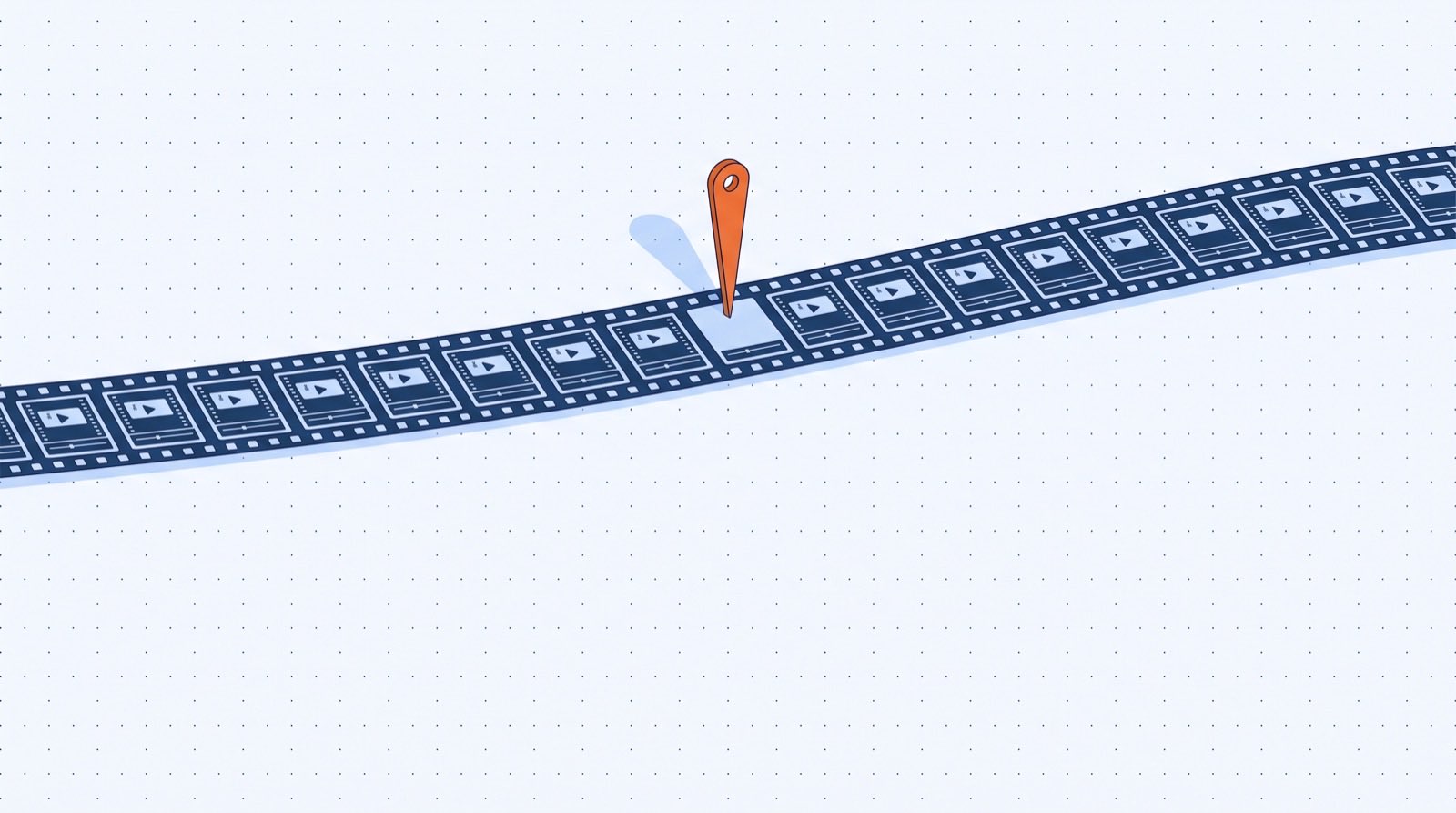
The question defines what's worth looking at. In an eighteen-minute recording, the answer about the wrong total lives in a few seconds, and the rest of the material is context that costs a lot and answers little.
It's this observation, not the model's sophistication, that explains why navigating is cheaper than reading everything.
The alternative mode reverses the order of operations. Instead of dumping the entire sampled video, the model explores the timeline and loads what it needs on demand. The documentation describes native tools that "search, scan and inspect video segments through frames, audio and transcripts", and mentions resampling time windows at a higher frame rate when the question requires it.
The flow below is educational. It helps understand the logic and does not describe the events the API returns, which are something else and are covered in the implementation section.
Where this goes wrong is predictable, and the list matters more than the mechanism: fast action between two samples, small text on a high-density screen, heavily compressed video, a screen scrolling while the content changes, a camera cut in the middle of an event, occlusion, overlapping speech, and the trickiest case of all, audio and image contradicting each other. In that last one, the system needs to say there's a contradiction, not silently pick a side.
And there's a distinction that decides whether the result can be used as proof of anything.
One more note on speed, because it's counterintuitive. Moment retrieval with sub-second precision concerns the granularity of the answer, not how long it takes to arrive. The documentation suggests using streaming or background execution precisely because, for long videos, processing with navigation "takes longer".
What the chart shows and what it doesn't measure
A chart is circulating with the headline that one model is the frontier in accuracy and cost, with a cost-per-query axis and the name of a benchmark. It's a reasonable evaluation hypothesis and not evidence that the technology fits your case. Three things explain why.
The first is what's on the axis. Cost per query is cost per question asked, on a specific set of questions. It's not cost per hour of video, not cost per document processed and not a project budget. An archive that receives one question a month and an archive that receives a thousand questions a day produce completely different bills from the same point on the chart. A Pareto frontier, in turn, only means no other measured point is better on both dimensions at once, and the announcement carries a qualifier that usually disappears when quoted: the position is "among the models tested".
The second is the size of the set. The benchmark cited in the chart, 1H-VideoQA, exists, is published by Google DeepMind itself, and the official repository describes what it is plainly: a set "hand-crafted" internally, with 101 multiple-choice questions about 21 YouTube videos, 40 to 90 minutes each, built to probe long-context capability. For comparison, LongVideoBench, an academic publication with open data, has 6,678 human-annotated questions about 3,763 videos. They're different orders of magnitude, and the difference doesn't disqualify the smaller one: it defines how much weight it can carry.
The third is that three official surfaces cite three different benchmarks. The September 1, 2026 announcement demonstrates the feature on LongVideoBench and doesn't use the term 1H-VideoQA anywhere in the text. The evaluation methodology document for a later model uses LVBench, and states the results were computed internally without tools, with 1,024 frames for the models from two companies and 300 for those of a third, "due to API limitations". None of these surfaces publishes the methodology of the specific chart.
Agentic video understanding announcement of September 1, 2026, google-deepmind/1h-videoqa repository, LongVideoBench (arXiv 2407.15754) and the evaluation methodology PDF, all read on September 10, 2026.
The announcement's own numbers also deserve a literal reading. It states that models with the feature enabled "reduce analysis costs by up to 66% and token consumption by up to 88%, while improving accuracy by up to 7%". Three words do heavy lifting there: "up to" marks the best case and not the expectation; "standard video analysis benchmarks" is the universe, which isn't your operation; and nothing in the text indicates the three maximums happened in the same case.
The fourth card is the one that changes the conversation, and it comes from the vendor's official results table.
None of this means the feature doesn't deliver. It means the available public evidence supports an evaluation hypothesis, not a purchase conclusion. If you want Google's feature described by name, with the dated model list and what it explicitly doesn't do, there's the piece dedicated to it. What closes the decision is a test with your videos, your questions and an acceptance criterion written in advance.
Where this is already ready and where it's still preview
Here the answer changes depending on the entry point, and mixing the two is the most likely implementation mistake. The same vendor offers the feature on two surfaces, with different parameter names and different API versions. On both, the default is static mode, and navigation needs to be switched on explicitly.
| Item | Gemini Developer API | Google Cloud, Gemini Enterprise Agent Platform |
|---|---|---|
| Parameter | "processing": "agentic" in the video part | "mediaProcessing": "AGENTIC" in videoMetadata |
| API version | Interactions API | Only v1beta1, not v1 |
| Default | Static at 1 FPS by default on all models; navigation recommended for long video, over 5 to 10 minutes (documentation read on November 11, 2026) | Static or off by default on all models |
| Upload | File API, Cloud Storage, inline data, YouTube URL | Clipping via videoMetadata and custom fps |
Documentation for both surfaces read on September 10, 2026. The cloud surface's video tokenization section is marked as Preview, subject to the terms for pre-general-availability offerings.
The difference in parameter and version isn't a syntax detail. A team that prototypes on one surface and takes the code to the other will rewrite the call, and a team that assumes the feature is on by default will measure the wrong mode without noticing. What's on v1beta1 also carries the usual message of those tiers: the contract is subject to change. The two request bodies side by side, the upload caps and what breaks on long videos are in the integration article.
The input caps call for the same attention, and one of them conflicts within the page itself. The upload methods table says inline data works for files under 100 MB, while the prose on the same page says that path is suitable for videos "under 20 MB of total request size" and recommends using the File API above 20 MB. Anyone sizing an ingestion needs to treat 20 MB as the practical limit and confirm it in writing, not choose the larger number because it's more convenient. It's also worth knowing that a YouTube video only goes in if it's public, with a maximum of ten videos per request, and that the free tier is capped at eight hours of YouTube per day.
On observing what happened, the documentation offers what matters for auditing and billing: consumption comes back separated into named counters, including input, output, thinking, cached content and tool use tokens. That's what lets you measure actual consumption instead of estimating it. And it's good to be clear about what auditing means in this context: recording authorized inputs, observable calls, versions, outputs and human decisions. Requiring the model to expose its internal reasoning as an auditing mechanism is trading proof for narrative.
Where the math works inside a company
The matrix below maps where this capability meets a problem someone pays to solve. It doesn't repeat "generate a summary" in any row, because summarizing is the application that seems useful and rarely changes a process.
| Application | Question that requires image or time | Usable output | Main risk |
|---|---|---|---|
| Investigating a software defect | At what moment did the screen show the wrong amount? | Timestamped segment attached to the ticket | Confusing sequence with cause |
| Querying recorded training | At which minute is the step demonstrated? | Link with a timestamp in the material | Outdated procedure in the video |
| Meeting with a shared screen | What number appeared when they talked about the target? | Capture of the moment plus the minutes | Confidential content in a broad archive |
| Support with the customer's screen | Did the customer actually see the error message? | Evidence attached to the history | Personal data in a third party's recording |
| Operational inspection | In which segment did the equipment stop? | Alert with a segment for human review | Sampling missing a fast event |
| Logistics and yard | When was the cargo damaged? | Segment attached to the incident | A conclusion about liability without proof |
| Media archive | In which videos does this product appear? | List of files with segments | The cost of indexing what will never be queried |
| Usability research | Where did the user hesitate before giving up? | Segments grouped by observed pattern | Inferring intention from behavior |
| Procedure compliance | Did the operator perform the safety step? | Segment for an auditor to check | Treating absence of evidence as failure |
| Accessibility | What appeared on screen that the audio doesn't mention? | Synchronized description | A wrong description slipping through without review |
Three of these rows deserve a closer look, because that's where the difference between observing, interpreting and acting becomes visible.
- Error in a screen recordingQuestion: at what moment does the displayed total differ from the sum of the items? Observation: at 11:42 the field shows one amount and the list shows another. Interpretation: there's a discrepancy between what the screen calculates and what it adds up. Action: open a ticket with the segment attached, for a person to decide whether it's a defect.
- Procedure demonstrated in trainingQuestion: at which minute is the seal check demonstrated? Observation: at 24:05 the step appears on screen and the instructor names it. Interpretation: it's the demonstration of the step being sought. Action: return the link with the timestamp, without claiming the recorded procedure is the current one.
- Evidence in operational videoQuestion: in which segment did the conveyor stop for more than thirty seconds? Observation: two intervals located. Interpretation: stops consistent with the criterion, subject to checking. Action: forward for human review, and never conclude there were no other stops outside the inspected segments.
In all three, the structure is the same and so is the discipline. Observation is what's in the material. Interpretation is the reading the system proposes. Action is what happens in another system, and it's never an automatic consequence of the first two. Two events appearing in sequence in a video doesn't establish causation between them, and observed behavior doesn't authorize conclusions about intention, personality, emotional state or any sensitive attribute of whoever appears in the recording. None of these cases was carried out by X-Apps: they're application hypotheses, written to show the structure of the decision.
The architecture that separates who interprets from who acts
The design that supports this in production has ten stages, and the most important is the second to last.
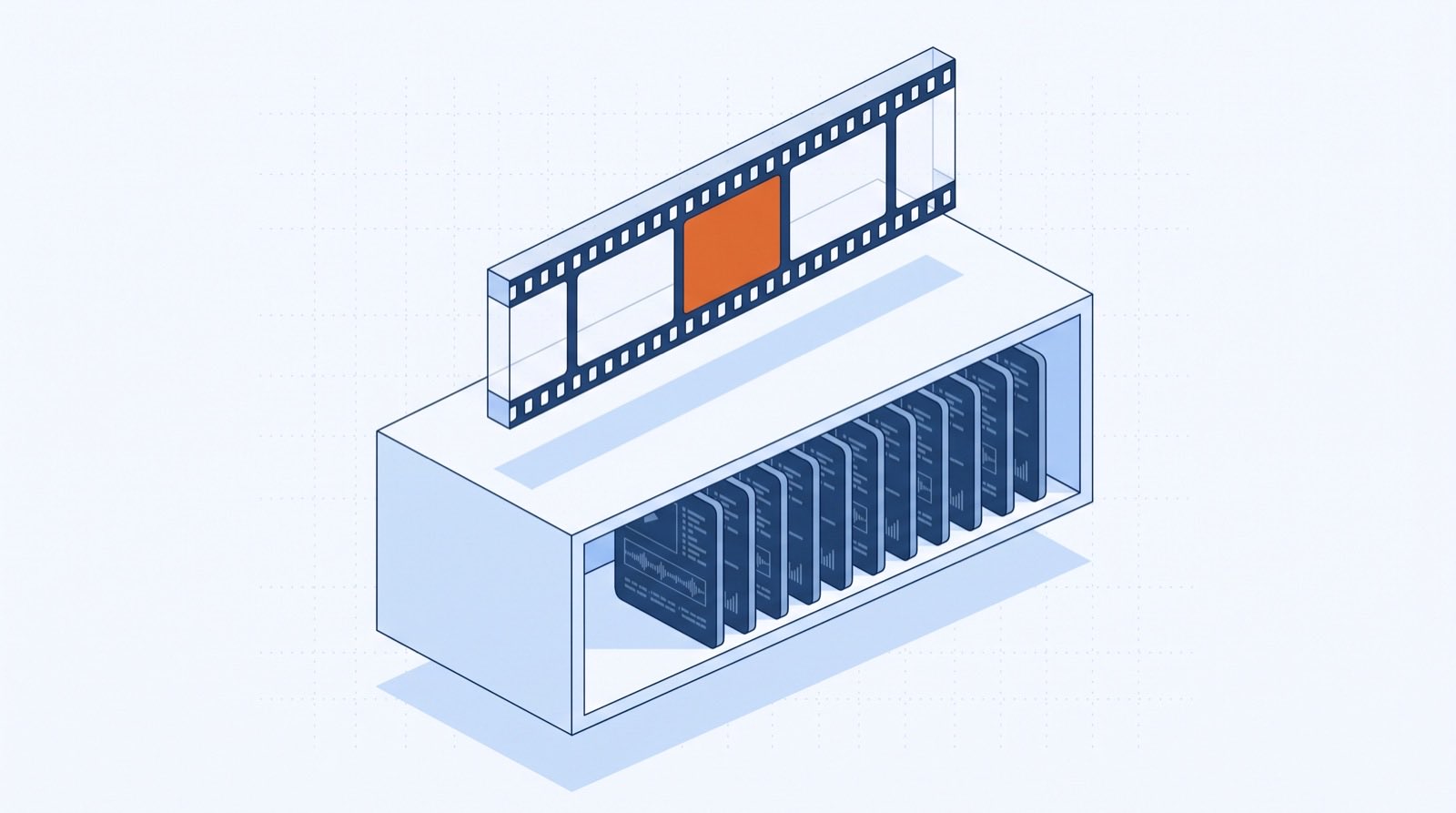
The sequence is authorized ingestion, protected storage, media validation and preparation, asynchronous processing, selection of the relevant material, analysis, output validation, human review when the risk requires it, integration with the work system, and monitoring with disposal according to the retention policy. Each of these stages is the application's responsibility, not the vendor's. What the vendor delivers is the analysis; the rest is the integrator's engineering.
The distinction between the two search layers is the one that causes the most frustration when it goes unnoticed. Sending a video for analysis doesn't create persistent enterprise search. Asking "in which of our eight hundred videos does this component appear" is another problem, and there are at least three paths for it, with different costs: indexing transcripts and searching by text, which is cheap and blind to visuals; maintaining a multimodal semantic index, which is what specialized platforms offer; or analyzing on demand, which answers well for one piece and doesn't scale to sweeping an archive.
It's worth knowing the lock-in the second option usually brings. Twelve Labs, a platform specialized in video search, organizes material into indexes, and its documentation explicitly says the model configuration chosen when creating the index applies to every video that goes into it and can't be changed later. That's an architecture decision with long-term effect, not an adjustable preference.
Twelve Labs index concepts documentation. Capability documented by the vendor, not a product evaluation.
On the output format, the schema below is illustrative and serves to show which fields avoid confusion between layers. It's nobody's API contract.
{
  "video_id": "rec-2026-09-03-4471",
  "start": "00:11:38",
  "end": "00:11:52",
  "observation": "The total field shows 1,240.00 and the sum of the listed items is 1,190.00",
  "interpretation": "Discrepancy between the displayed total and the sum of the items",
  "evidence": ["frame 00:11:42", "frame 00:11:47"],
  "missing_information": "The applied discount coupon could not be read",
  "requires_review": true
}
Notice what is not there: no confidence percentage. A confidence number only means something after empirical calibration against human labels on your own material, and an invented value is worse than none, because it authorizes automation nobody measured.
The principle that ties everything together is simple to write and hard to keep under deadline pressure: AI interprets and recommends; deterministic code controls authorization, sequence, state, idempotency and effect. Opening a ticket, changing the CRM, sending a message or triggering equipment are external effects, each with its own policy, and some with mandatory human confirmation. Having analyzed the video doesn't authorize any of them.
How much it costs to ask
The natural intuition is that fewer image tokens means proportionally less money. It's wrong for two documented reasons.
The first is that the savings and the expense fall into different price tiers. The frames navigation skips loading are input tokens. Navigation itself is counted as thinking tokens, and the service's price table prices output "including thinking tokens". In the table read on September 10, 2026, output cost five times input on 3.8 Flash and 3.6 Flash; on the November 11, 2026 re-read the ratio held and also applies to the two Gemini 4 models that started accepting the feature. On 3.5 Flash Lite the ratio is higher, about eight times ($0.30 input and $2.50 output per million tokens). Cutting a lot on one side and adding a little on the other can yield much smaller savings than the token reduction suggests.
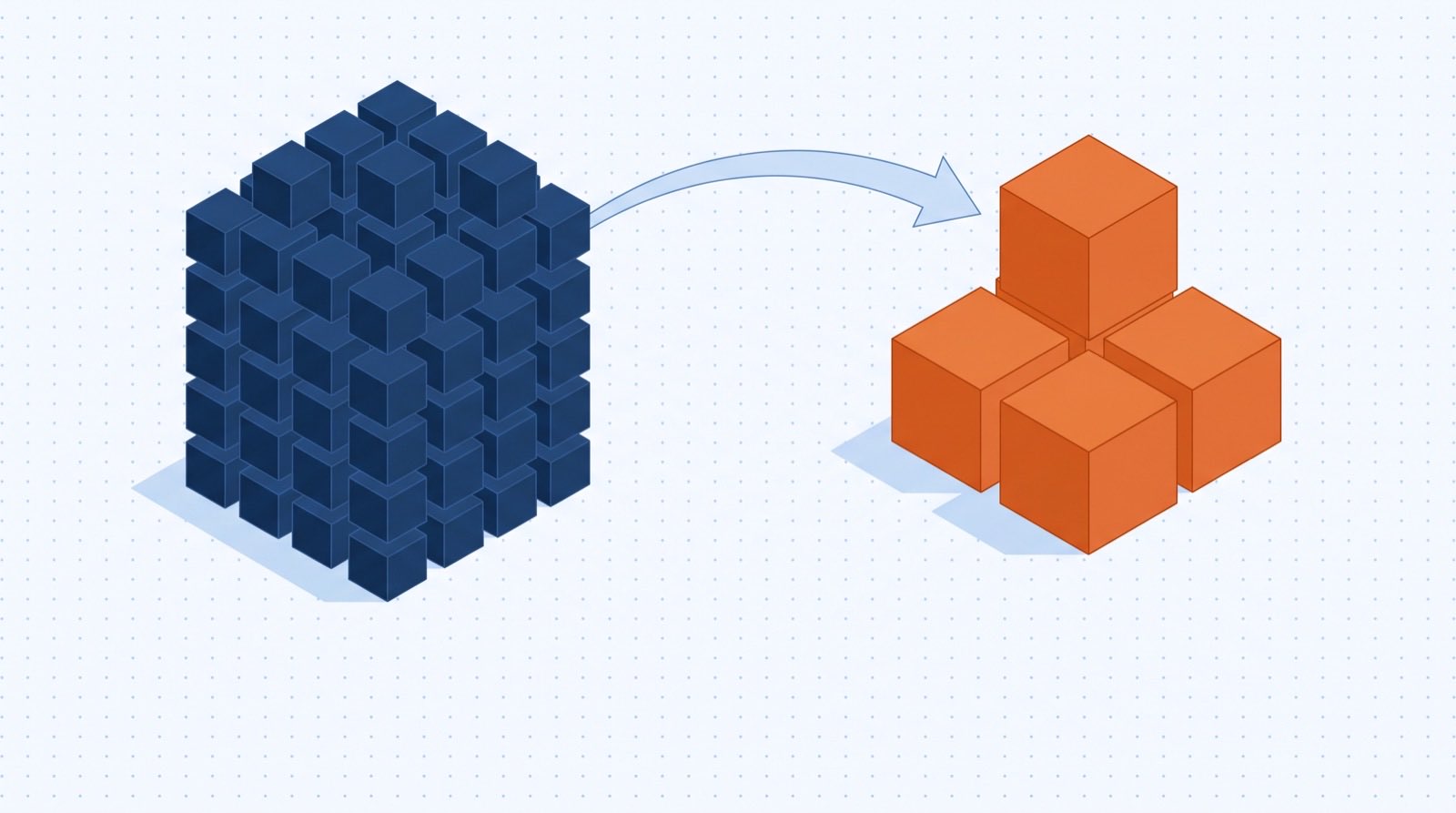
The frames navigation skips loading are input tokens. The navigation it adds is counted as thinking, and thinking is charged at the output rate.
Taking a lot from the cheap stack and putting a little on the expensive stack can return much smaller savings than the drop in tokens suggests.
The second is that the documentation simply doesn't publish a tokenization formula for the navigation mode, and states that consumption varies with content complexity and the model's navigation strategy. There's a published formula for static mode, and we found no equivalent for the other. Every cost estimate for navigation mode made without measuring your material is a simulation.
An honest cost breakdown separates categories that don't overlap, so the same token isn't counted twice:
- Media input, the frames, audio and transcript actually loaded.
- Thinking, navigation and reasoning, charged at the output rate.
- Output, the text of the answer.
- Cache, when the same material is re-queried within the window.
- Outside the API, storage, transcoding, transfer, indexing and the repeated calls a poorly worded question generates.
- Human, reviewing the answers and maintaining the system, which is usually the largest and least budgeted.
And there's a calendar trap that changes any twelve-month projection. On Gemini 3.8 Flash and 3.6 Flash, the input price of $0.75 per million tokens is valid until December 31, 2026 and goes to $1.50 on January 1, 2027, with output going from $3.75 to $7.50. The dates are written in the cells of the official table itself. A calculation made today for a project going into production next year is born with double the unit cost.
These numbers apply only to 3.8 Flash and 3.6 Flash; 3.5 Flash Lite, which also accepts navigation, has its own lower price with no change date in the table. The list of models with navigation has also changed. In the documentation read on September 10, 2026, the feature applied to 3.8 Flash, 3.7 Flash, 3.6 Flash and 3.5 Flash Lite. In the one read on November 11, 2026, Gemini 4 Carbon and Gemini 4 Argon were added, which aren't Flash, and 3.7 Flash had been dropped. According to the official changelog, Argon reached general availability on October 13, 2026 and Carbon on November 10, 2026. The two Gemini 4 models have their own, more expensive table, with input at $2.00 and output at $10.00 per million tokens until November 30, 2026, going to $4.00 and $20.00 on December 1, 2026. In other words, on Gemini 4 the price change comes a month earlier and starts from a higher level. The complete, dated list is in the piece dedicated to the feature.
Prices in US dollars per million tokens for the paid (Standard) tier of the Gemini Developer API, read on September 10, 2026 and re-read on November 11, 2026, with the price change dates written in the official table; list of models with navigation according to the video understanding documentation, read on November 11, 2026.
The full calculation, with the categories separated, the dates when the price doubles (at the turn of the year for 3.8 Flash and 3.6 Flash, on December 1, 2026 for Gemini 4) and the cache that charges by clock hour, is in the article on how much it costs. The metric that settles the discussion isn't price per query, it's cost per accepted answer: the total spent divided by the answers that survived human review. A cheap system that's wrong half the time costs more than an expensive one that's right, because the difference comes out of the reviewer's time. And the three usage regimes behave so differently that they deserve separate calculations: few questions about a specific video favor on-demand analysis; many questions about the same file favor caching and a structured extraction pass; recurring search across a large archive favors pre-indexing, and that's where on-demand analysis gets more expensive without getting better.
How to know if it's working, and what can go wrong
Evaluating this isn't watching a few answers and deciding it looks good. It's building a set that resembles your worst day.
- Representative videos in Brazilian Portuguese, with accents, noise and genuinely bad audio.
- Real screens of your product, with the information density they have.
- Fast events, which test the limit of the sampling.
- Questions whose answer isn't in the material, to measure whether the system admits the gap instead of inventing.
- Counterexamples similar to the right answer, to measure false positives.
- A simple baseline, transcription with search, measured on the same set.
The indicators that matter, in plain language: how many answers were factually correct; how many existing events were found; whether the timestamp points to the right moment; what the system does when there's no answer; how long it takes in the typical case and in the bad case; how many calls fail; the cost per accepted answer; and how much people-time the review consumes. Separate the material used to tune the application from the material used for the final measurement, otherwise you're measuring your own calibration. And size the sample to the risk, without announcing statistical validity nobody calculated.
On the security side, there's a risk specific to multimodal content that is usually underestimated. The analyzed video is data, not instruction. A recording can contain, on screen, in the audio or in overlaid text, something written for the model and not for the person. OWASP classifies this as indirect prompt injection and notes, about multimodal systems, that attackers can hide instructions in images accompanied by benign text, that cross-modal attacks are hard to detect with current techniques and that specific defenses are still an area of research. The same document states that, given the stochastic nature of these models, "it is unclear if there are fool-proof methods of prevention".
OWASP Gen AI Security Project, LLM01 Prompt Injection.
The practical consequence is that security here isn't solved with a sentence in the prompt. It's solved in layers: separating the analyzed content from any operational instruction, restricting what the output can trigger, validating the output against a schema, requiring human confirmation for external effects and recording everything that was decided.
On personal data, the point that changes the conversation most in Brazil is one of definition. The LGPD (Brazil's data protection law) classifies as sensitive personal data "genetic or biometric data, when linked to a natural person", and a recording with identifiable faces can fall into that. This matters because processing sensitive data doesn't follow the legal bases of art. 7, but those of art. 11, which are more restrictive. It's also worth correcting a common misconception: consent is not the only legal basis. Art. 7 lists ten bases, and consent is the first of them, not the rule; the controller's legitimate interest appears in item IX, with the express caveat of the data subject's fundamental rights and freedoms. The principles of art. 6, especially purpose, adequacy and necessity, are what prevent an archive captured for one thing from being used for another.
Add what the service terms say, and the summary is that "not used for training" doesn't mean "not stored". The API's additional terms state that, on paid services, prompts, including files such as images, videos and documents, are not used to improve products; and, in the same paragraph, that prompts and responses are logged for a limited period to detect policy violations and that this data may be stored or cached "in any country" in which the vendor maintains facilities. That last sentence speaks directly to the LGPD chapter on international transfer, whose art. 33 requires a country with an adequate level of protection or specific contractual guarantees. On the free tier the picture is different and more restrictive for business use: the terms state that content is used to develop products, that human reviewers may read inputs and outputs, and explicitly recommend not submitting sensitive, confidential or personal information.
None of this replaces legal analysis of the specific case, and it's precisely the kind of decision that needs to happen before the pilot.
When simple is better
There isn't one category of solution, there are five, and they compete for different cases.
When audiovisual analysis pays off
- The answer is in what appeared on screen, and nobody narrated it.
- The question depends on the order, duration or repetition of events.
- The material is long and the evidence is short.
- There's someone to review, and the output will feed a process.
When something simpler works better
- The questions are about what was said: transcription with search wins.
- The archive is large and queries are recurring: a dedicated index wins.
- The task is always the same and well defined: specialized computer vision wins.
- No human review is planned: no option is suitable yet.
The five categories, to name them: a multimodal service with native tools, which is the central subject of this text; a vision model fed with frames the application itself chooses, which gives more control and more work; a platform specialized in video and search, which solves the archive layer; open-weight models, a category in which Qwen3-VL announces in its official README a native context of 256,000 tokens, expandable to one million, and second-level indexing; and the classic stack of transcription, text recognition in images and computer vision trained for the task.
Two caveats prevent bad decisions here. Open weights don't mean free operation: they mean the cost shifts from subscription to infrastructure, engineering and operational responsibility. And you shouldn't assume every model maker handles video in every API: the "Images and vision" page of Anthropic's Claude documentation covers images and has a separate section on PDF, and doesn't mention video. That describes the page read, not what the company offers through other paths.
The adoption path that reduces waste has seven steps and none of them is technical at the start: delimit a specific problem, gather authorized data, measure the simple baseline, compare technically and economically, integrate into a single flow only, evaluate against the criterion written in advance, and decide whether to move forward or back. Any schedule someone presents for this is illustrative until there's measurement on your material.
And the most useful stopping criterion is a single question: if the answer comes back right, will someone do anything differently because of it? When the answer is no, the problem isn't video technology, it's process, and no amount of accuracy fixes it.
Technical appendix
Peripheral detail, gathered here so as not to interrupt the argument.
Declared static mode tokenization. A frame at 66 tokens at low media resolution and 258 at high; audio at 32 tokens per second; metadata included. The documentation's rounding is about 100 tokens per second at low and 300 at high. One hour sampled at one frame per second produces 3,600 visual samples, which gives 352,800 tokens by the detailed calculation at low resolution and 1,044,000 at high, consistent with the declared roundings.
Usage counters. The response exposes separate totals for input, output, thinking, cached content, tool use and total. Navigation appears under thinking and the material loaded on demand appears under tool use. The documentation read doesn't state how the tool-use total is billed, and the price table names input, output and cache, but not tool use. Anyone building a cost model needs to settle this point with the vendor.
Timestamp format on the cloud surface. For sampling of one frame per second or less, the format is MM:SS, with H:MM:SS above one hour. Above one frame per second, the format becomes MM:SS.sss. Confusing the two produces a time reference that doesn't resolve.
Integration sketch, in pseudocode. The snippet below wasn't executed and isn't production code. It exists to show the order of operations and where the failure points are.
upload file -> wait for state PROCESSING to become READY
create interaction with the video and the question, explicit processing mode
use streaming or background execution for long video
on receipt: validate the output against the schema before any use
record the usage counters and the model version alongside the result
if requires_review, queue for a person; never trigger an external effect directly
handle timeout and failure with an idempotent retry, with a cap on attempts
Credentials stay on the server, never on the client. Processing state needs a bounded wait. And every result stored without the version of the model that produced it becomes, months later, evidence nobody can reproduce.
Frequently asked questions
Transcription converts speech into text and answers questions about what was said. It doesn't see what appeared on screen, doesn't know in what order things happened and doesn't find anything nobody narrated out loud. Analyzing the video means combining image, audio and time to answer questions speech alone can't, and returning the moment where the answer is.
It depends on the mode. In the static processing documented by Gemini, the video goes in sampled at one frame per second, all at once. In agentic mode, the documentation describes the model navigating the timeline and loading only the segments it needs. In both cases there is sampling: neither reads every original frame, which is why very fast events remain the hard case.
There's no single answer, and be wary of anyone who gives one. Gemini's documentation publishes the static mode tokenization, about 100 tokens per second of video at low media resolution and about 300 at high, which gives an order of magnitude for an hour. For agentic mode the documentation itself says consumption varies with content complexity and navigation strategy, and publishes no formula. Any fixed number without measurement on your material is a simulation.
No, and this is the most expensive confusion on this subject. A selective search finds evidence when it exists and is reached by the sampling; not finding it means the evidence wasn't located in that search. Gemini's own documentation recommends static mode when frame-by-frame precision across the whole clip is needed, which is an admission that navigation mode is not exhaustive inspection.
It's a legal decision, not a technical one, and it moves to a different article of the LGPD, Brazil's data protection law. The law defines biometric data linked to a natural person as sensitive personal data, and processing sensitive data falls under art. 11, which is more restrictive than art. 7. Add what the service terms say about retention and about which countries data may pass through, and the conclusion is that this assessment needs legal counsel before the pilot, not after.
Yes, and it's a recognized risk. OWASP classifies this as indirect prompt injection and notes, about multimodal systems, that attackers can hide instructions in images that accompany benign text, and that multimodal-specific defenses are still an area of research. The document explicitly says it isn't known whether a foolproof prevention method exists. The practical consequence is to treat analyzed content as untrusted data and control effects in code, not in the prompt.
In many cases, yes, and the test is the very question you need to answer. If your questions are about what was said, transcription with search solves it cheaper, faster and with less risk surface. Audiovisual analysis wins when the answer is in what appeared on screen, in the order of events or in something nobody narrated. Measuring both on the same set of questions is the only honest way to decide.
Sources and method
This article is based on a direct reading of primary sources done on September 10, 2026: the announcement of the video analysis feature with navigation, of September 1, 2026; the video understanding, tokens, media resolution and pricing documentation of the Gemini Developer API; the equivalent documentation of the same vendor's cloud platform; the PDF document of evaluation methodology and results for a model of the same family; the official repository of the 1H-VideoQA benchmark; the academic papers on VideoAgent and LongVideoBench; the index concepts documentation of a platform specialized in video search; the official README of an open-weight model; the vision page of another vendor's documentation; the OWASP page on prompt injection; the API's additional terms; and the consolidated text of the LGPD on the Brazilian presidency's Planalto portal. On November 11, 2026 we re-read the video understanding documentation and the price table to update the list of models with navigation and per-model prices; the rest follows the September reading.
Nothing was executed. No API call was made, no video was processed, no latency was measured and no cost was verified on an invoice. What this text contains is a reading of documentation, arithmetic on published numbers and architecture recommendations, and each statement about a vendor is written so as to make clear which of these categories it comes from.
Three gaps were left open and it's worth recording them instead of filling them. The methodology of the specific chart that motivated this research wasn't found on any official surface: the announcement demonstrates the feature on another benchmark and the later model's methodology document uses a third. How tool-use tokens are billed isn't stated on the pages read. And the vision documentation of one of the vendors compared doesn't mention video, which describes the page consulted and not the company's catalog.
Prices, limits, release stages and parameter names change without notice in this market. Revalidate before using any number in this text as a contract criterion.