Índice do artigofaltam 18 min de leitura
AI agents can already open applications, read emails, look up documents, fill in forms and make some decisions. The problem is that doing parts of a process is not the same as delivering the whole process.
OSWorld 2.0, also published under the name OSWorld 2, was created to measure that difference. Instead of asking for a short action, the benchmark gathers professional workflows that cross applications, files, messages, rules and decisions over hundreds of steps.
The main conclusion is not that agents "fail at 79.4% of everything", as a hasty reading of the launch paper's 20.6% suggested, nor that they fail at 55.7%, as a reading of the top of the October ranking would suggest. It is that the distance between partial progress and reliable completion is still large, and that distance must guide architecture, cost, security and human oversight.
Article summary
- OSWorld 2 gathers 108 long professional tasks: the median requires about 1.6 hours of human work and agents perform, on average, 318 actions per attempt.
- At launch, the paper's best result combined a 54.8% partial score with 20.6% binary completion. On the leaderboard updated on October 15, 2026, the top of the model-alone category, on the full set, rose to 77.67% and 44.33% (Claude Opus 5, max effort, version 2.1), and the gap between the two columns remains large.
- Anthropic reports 70.57% Pass@1 for Claude Opus 5 under its own protocol; Anthropic later published numbers for Claude Fable 5.1, Opus 5.5 and Fable 5.2, almost all as partial scores (only the Fable 5.1 page also shows the strict metric, with 41.7% for it), and none of the three had an entry on the official ranking as of November 11, 2026.
- In the band of longest tasks, between 163 and 360 minutes, every model shown in the paper scored 0% binary completion.
Executive summary
| Indicator | What the number really means |
|---|---|
| 108 tasks | OSWorld 2 set with long, realistic professional workflows. |
| 1.6 hours | Median time for a qualified person to complete a task. |
| 318 actions | Average tool calls by the agents evaluated, versus about 30 on the original OSWorld. |
| 20.6% | Best binary completion in the launch paper: Claude Opus 4.8, max configuration and batch execution, on the first version of the tasks. |
| 54.8% | Partial score for the same configuration: there was plenty of progress, but not always a complete delivery. |
| 44.33% | Best model-alone binary completion, on the full set, on the official leaderboard updated on October 15, 2026: Claude Opus 5, max effort, version 2.1 of the tasks, with a 77.67% partial score. |
| 70.57% | Pass@1 reported by Anthropic for Claude Opus 5, under its own protocol described in the System Card. |
| 89.3% | Partial score Anthropic reports for Claude Fable 5.2 on the offline subset of version 2.1, on November 9, 2026. Vendor number, with no entry on the official ranking. |
These numbers answer different questions. Mixing them into a single ranking creates an attractive conclusion, but a methodologically incorrect one.
What OSWorld 2.0 is
OSWorld 2 evaluates agents that control a computer in environments with a browser, email, spreadsheets, documents, business systems, files and multimedia applications. The official paper describes three core principles:
- authentic workflows: the tasks are inspired by real professional work;
- long horizon: the agent must sustain context, state and constraints over hundreds of actions;
- verifiable evaluation: each task has objective checkpoints that make it possible to measure both the final result and intermediate progress.
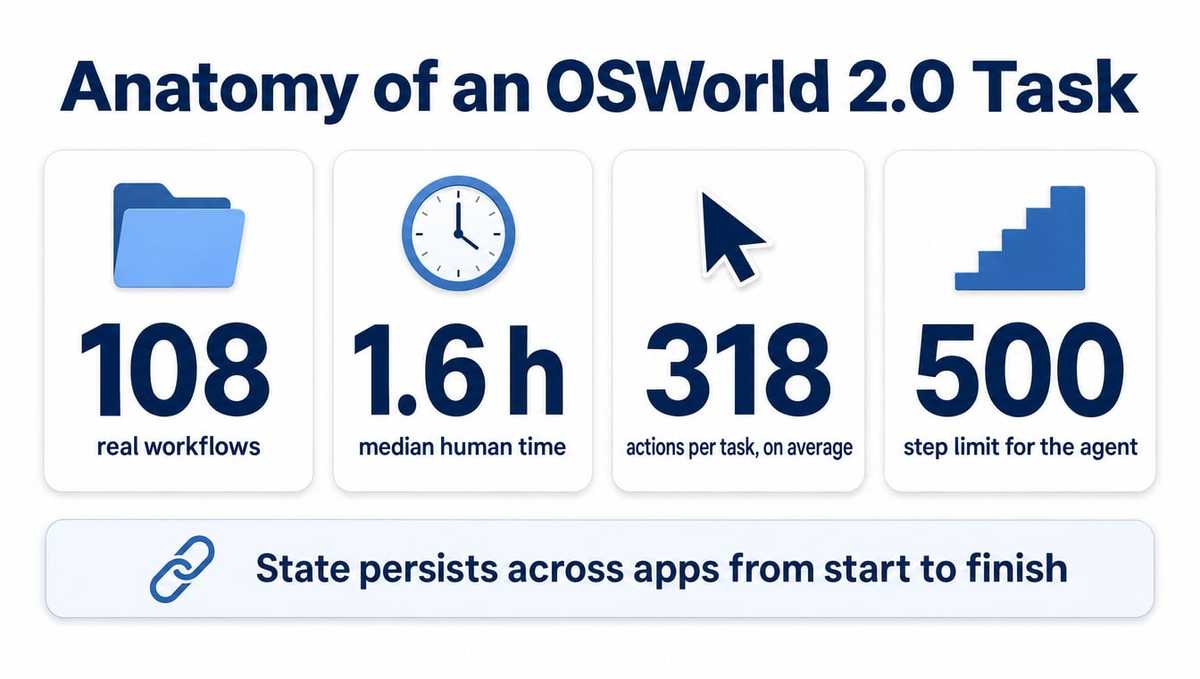
Almost 70% of the tasks require more than one hour of human work. Agents use, on average, 318 tool calls, and the main protocol allows up to 500 steps. That changes the nature of the test: the challenge is no longer "find the right button" but "preserve the user's intent throughout an entire process".
OSWorld, OSWorld-Verified and OSWorld 2.0: do not confuse them
The three names belong to the same family, but they do not represent the same difficulty.
| Benchmark | Focus | Typical horizon | How to interpret |
|---|---|---|---|
| OSWorld | General use of real applications across different operating systems. | Relatively short tasks, with about 30 agent actions in the comparison presented by the new paper. | Measures perception and interface operation skills. |
| OSWorld-Verified | Revised version of the previous set to reduce problematic tasks and evaluations. | Shorter, self-contained actions, rarely crossing more than one or two applications. | Better for comparing competence on well-bounded tasks. |
| OSWorld 2 | Connected professional workflows, with multiple sources, applications, state changes and decisions. | Human median of 1.6 hours and an average of 318 agent actions. | Measures resistance to accumulated errors and the ability to finish work end to end. |
The paper itself uses an important contrast: Claude Opus 4.8 reaches 83.5% on OSWorld-Verified, but 20.6% binary completion on OSWorld 2. There is no contradiction. The second evaluation measures a much longer horizon, in which small deviations add up.
How to read binary completion, partial progress and Pass@1
Binary completion
The binary metric answers the most demanding question: did the agent complete all the work?
If an expense report requires five correct expenses, attachments, cost center, approval and final submission, getting one critical step wrong results in zero on binary completion, even if much of the process was done.
This is the metric closest to a usable business delivery, although it still does not include all production risks.
Partial score
OSWorld 2 splits each task into objective checkpoints, on average 27.25 checkpoints per task. The partial score measures how many of those requirements were met.
A high partial score shows the agent made progress and may have saved work. It does not allow you to say the process was completed. In production, that progress can be useful when a human reviews and finishes; it can be dangerous when the automation publishes, pays, deletes or sends something without validation.
Pass@1
Pass@1 usually represents the chance of success in one attempt, under a specific protocol. In the Claude Opus 5 System Card, Anthropic describes the result as the first-attempt success rate, calculated as the average of five runs.
The metric name, environment, resolution, step limit, evaluator and the system around the model must accompany the number. That is why 70.57% Pass@1 should not be relabeled as a 70.57% partial score, nor should it be placed in the same column as the binary 20.6% without a comparable reproduction.
Official results from the paper and the leaderboard
This is the comparison published for the paper's three best batch configurations, on the first version of the tasks (v2026.06.24). The cost represents the approximate average per evaluated task, not the cost of a guaranteed completion.
| Model and configuration | Binary completion | Partial score | Average cost per task |
|---|---|---|---|
Claude Opus 4.8, max, batch | 20.6% | 54.8% | US$ 72.40 |
Claude Opus 4.7, max, batch | 18.2% | 48.91% | US$ 33.60 |
GPT-5.5, xhigh, batch | 13.0% | 49.5% | US$ 25.50 |
Source: OSWorld 2 paper and leaderboard maintained by the project. The highlighted row is the best binary completion published in the paper.
The most useful value is the difference between the two performance columns. For Opus 4.8, for example, 54.8% partial progress coexists with 20.6% full completion. The model often does correct parts, but still misses details, leaves requirements behind or does not check the final state.
What changed on the leaderboard through October 2026
After the paper, the authors published two new versions of the tasks: the August 8, 2026 version, with updated code, files and simulated sites, and version 2.1, from September 16, described in the official repository as bug fixes with updated agents and evaluation flows. The leaderboard started showing the version for each row and an offline subset of 82 tasks that run without internet.
As read on November 11, 2026 (data last updated on October 15, 2026), these are the main rows with max effort for each task version in the main category, with the model operating alone, 500 steps and the full set of 108 tasks:
| Model, effort and task version | Binary completion | Partial score |
|---|---|---|
Claude Opus 5, max, version 2.1 | 44.33% | 77.67% |
MuseSpark 1.3 (Meta), max, version 2.1 | 39.25% | 69.56% |
Claude Opus 5, max, August version | 31.43% | 68.31% |
GPT-5.6 Sol, max, August version | 27.34% | 62.72% |
Claude Opus 4.8, max, June version (paper) | 20.6% | 54.8% |
Source: official OSWorld 2 leaderboard, read on November 11, 2026. For the August version, the project reports an average of 7 runs for Claude Opus 5 and 2 for GPT-5.6 Sol. Rows from different versions use different task files and do not form a single ranking. The leaderboard also lists Claude Opus 5 at other effort levels; on version 2.1, the high level scores 36.89% binary completion, above the 33.33% for xhigh, although it falls below it on partial score (68.92% versus 73.11%); more effort does not guarantee more completed tasks. The MuseSpark 1.3 row is marked as the full set, but the trajectory published by the project covers 106 tasks.
Two points deserve attention. First, binary completion more than doubled since the paper, but part of the gain comes from corrected tasks, not only better models; that is why the leaderboard itself separates the versions. Second, even at the top, more than half of the tasks still end without a complete delivery, and the gap between partial and binary remains above 30 points.
On the tab that includes agent systems, a framework combined with Claude Opus 4.8 (Darwinx, from Salesforce AI Research, 450-step limit) shows 44.44% binary completion and a 75.97% partial score on version 2.1. The row itself records two differences: the task counts as completed once 99% of checkpoints are met, not by the strict criterion of the main category, and the model's extended reasoning was turned off. That is why this number is not directly comparable with the 44.33% for Claude Opus 5 alone. What it shows is that a well-designed framework can get a result in the same range out of a previous-generation model; in other words, the system around the model also weighs on the result.
Update: how to interpret Claude Opus 5's 70.57%
The Claude Opus 5 launch page states that the model beats the others on OSWorld 2 when considering performance and cost. The technical document provides the context needed to interpret the claim.
In the Claude Opus 5 System Card, Anthropic states:
- runs with the models' default settings;
- 1080p resolution;
- a limit of 500 actions per task;
- Claude Opus 4.8 used as a model-based evaluator when needed;
- results aggregated over five runs;
- metric presented as Pass@1 accuracy and first-attempt success rate.
| Model in Anthropic's chart | Reported Pass@1 |
|---|---|
| Claude Opus 5 | 70.6% (70.57% in the technical text) |
| Claude Fable 5 | 66.1% |
| GPT-5.6 Sol | 62.6% |
| Claude Opus 4.8 | 55.7% |
| Claude Sonnet 5 | 51.4% |
| Muse Spark 1.1 | 47.3% |
The result is relevant and indicates progress. But there are three important editorial limits:
- the chart is an evaluation published by Anthropic itself, not an entry on the independent leaderboard maintained by the OSWorld 2 authors;
- the metric is identified as Pass@1, not as partial score;
- when this section was written, in August 2026, Opus 5 did not yet appear on the official public ranking. It joined later: on the leaderboard updated on October 15, 2026, its best result on the full set is 44.33% binary completion and a 77.67% partial score (
maxeffort, version 2.1).
So the responsible wording is: Anthropic reports 70.57% Pass@1 for Claude Opus 5 under its OSWorld 2 protocol. The wording "Opus 5 completes seven out of ten tasks on the official ranking" goes beyond the available evidence, and the independent measurement confirmed this: on the authors' ranking, the model fully completes fewer than half of the tasks.
November update: the numbers vendors published afterwards
After Opus 5, Anthropic published OSWorld 2 rows in the announcements of three new models. None of them appeared on the official leaderboard as read on November 11, 2026, and each table uses a different version of the set.
| Anthropic publication | Version and metric | Reported results |
|---|---|---|
| Claude Fable 5.1, September 2026 | August version, partial and strict | Fable 5.1: 77.9% partial and 41.7% strict. Opus 5, re-run under the same conditions: 75.4% and 39.6%. |
| Claude Opus 5.5, September 22, 2026 | Version 2.1, partial | Opus 5.5: 81.8%. Fable 5.1: 80.7%. Opus 5: 74.0%. |
| Claude Fable 5.2, November 9, 2026 | Version 2.1, offline subset, partial | Fable 5.2: 89.3%. Opus 5.5: 87.2%. Gemini 4 Carbon: 81.5%. GPT-6 Astra: 79.5%. Fable 5.1: 83.5%. |
All values are reported by Anthropic. According to the Fable 5.1 and Fable 5.2 pages, the models launched on them (and Opus 5.5, in the Fable 5.2 table) were evaluated with production safeguards turned on. On the Fable 5.1 page, the company warns that the August version numbers are not directly comparable to results published earlier.
Three cautions when reading this table:
- almost everything is partial score. Only the Fable 5.1 page shows the strict metric, which is the one that measures complete delivery; there, Anthropic's best model sits at 41.7%;
- the same model changes number depending on version and subset. Fable 5.1 appears with 77.9%, 80.7% and 83.5% in three different publications. Only compare rows from the same table;
- GPT-6 Astra and Gemini 4 Carbon appear in a competitor's table. Anthropic's page does not detail how those two numbers were obtained, and neither of them is a reading of the official leaderboard.
On the independent yardstick, the best result went from a 54.8% partial score and 20.6% binary completion in the paper to 77.67% and 44.33% on the October leaderboard, with a change of task version in between. Anthropic's numbers, which are higher, use another subset and another protocol and do not continue that series. Where full completion is published, it remains well below partial.
In the AI model comparison we maintain, OSWorld 2 appears with both metrics on separate rows, partial score and binary completion, and the scoreboard published by the vendor itself never shares a table with the independent measurement.
A complete workflow: the reimbursement in ExpenseFlow
One of the trajectories described in the paper helps explain why the benchmark is hard. The agent has to prepare an expense report in the fictional ExpenseFlow system, and the sequence below shows why the partial percentage stays high while completion does not come.
-
Looks up a tutorial and a policy in PDF
Understands the required format before touching the system. This is the part any demo shows well.
-
Finds receipts in email and data in a previous report
Retrieves receipts, personal data and the cost center scattered across different applications.
-
Checks bank transactions and cross-references them
Reconciles dates, amounts, categories and accounting codes across sources that do not talk to each other.
-
Builds five expense lines and attaches receipts
Allocates amounts, selects the approver and links each attachment to its line.
-
New information and inconsistencies appear
This is where the agent should stop and ask the user. When it picks an interpretation instead of asking for clarification, everything after that runs on a wrong premise.
-
Report submitted, with a partial score of 0.76
There was a visible delivery, but discrepancies remained in per diem location and attachments. The system got far and would still need checking before producing a real financial effect.
Sequence reconstructed from the trajectory described in the paper. This is exactly the kind of situation a simplified ranking hides.
Performance collapses as the horizon grows
The paper groups tasks by the estimated duration of human work: from under 45 minutes up to a range between 163 and 360 minutes. In the longest band, every model shown scored 0% binary completion.
This happens because risk accumulates. If each step has a small chance of error, a process with hundreds of decisions becomes much less reliable than an isolated action. In addition, intermediate failures contaminate the rest of the trajectory: a misread value goes into the spreadsheet, drives a decision and reappears in the final form.
For a company, the unit of analysis should not be "can the model click?", but:
- how long it preserves constraints;
- how many states it has to track;
- how many applications and sources it has to reconcile;
- at which points it can detect and repair its own error;
- what the possible damage is if it completes something incorrectly.
Where agents fail most
The set's challenges overlap: a single task may require reasoning across sources, visual precision and tracking several items.
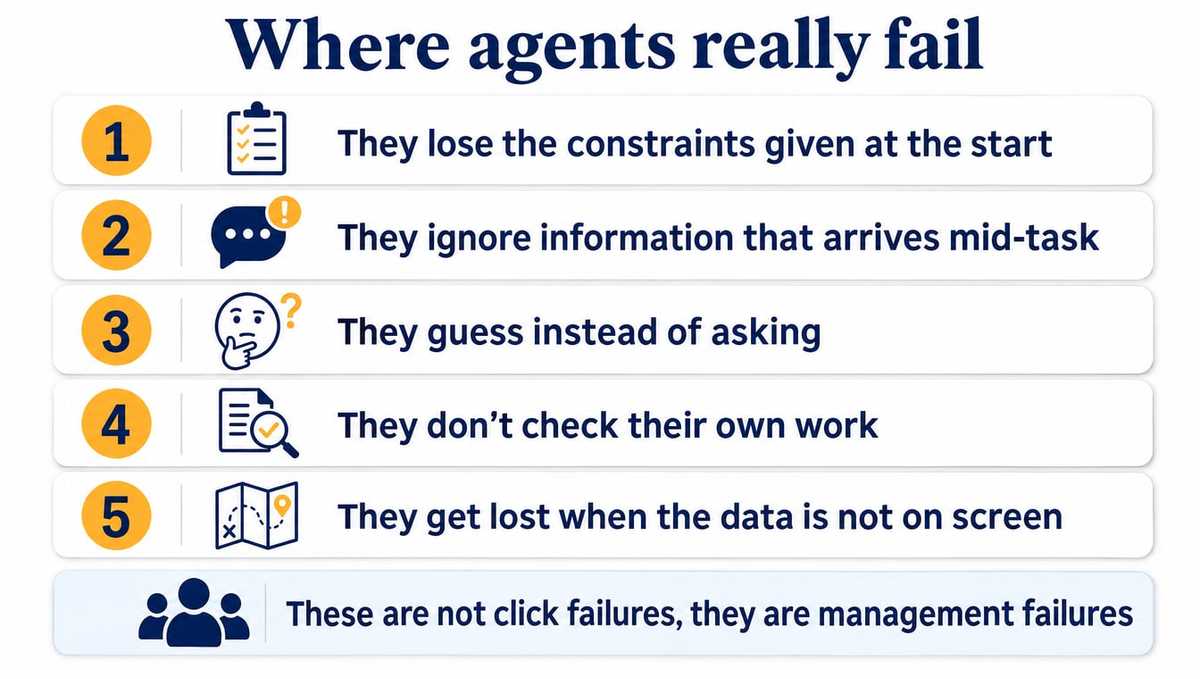
The trajectories analyzed show recurring patterns:
- the agent understands the rule at the start, but stops applying it dozens of steps later;
- it finds an update in the middle of the process and does not propagate the information;
- it picks an interpretation when it should ask for clarification;
- it produces a file or form, but does not check whether the result matches the request;
- it changes the interface through a technical path that ignores the state the user expects;
- it fixes the symptom of an error without restoring the consistency of the process.
The most worrying data point is operational: the agents studied spend less than 7% of their step budget detecting and repairing errors. They invest far more in moving forward than in confirming they are still on the right track.
From benchmark to production architecture
A more capable model helps, but it does not solve a high-risk workflow on its own. The architecture needs to turn each cause of failure into a verifiable control.
| Observed failure | Engineering countermeasure |
|---|---|
| Forgotten constraint | Structured state, persistent checklist and validation before each critical action. |
| Lost intermediate information | External memory with source, time, version and link to the affected item. |
| Assumption in an ambiguous scenario | Explicit policy to stop and ask the user. |
| Unverified result | Independent verifier, follow-up reading and comparison with acceptance criteria. |
| Error that contaminates later steps | Transactional checkpoints, idempotency and rollback capability. |
| Dangerous or out-of-scope action | Minimal permissions, tool allowlist and human approval. |
In practical terms, a business agent needs at least five layers:
This structure matters more than swapping the model while keeping the same fragile workflow.
How much a useful completion costs
The average cost per attempt does not tell the whole story. A simple approximation divides the average cost per task by the binary completion rate.
| Configuration | Cost per attempt | Binary rate | Expected cost per full completion |
|---|---|---|---|
Claude Opus 4.8, max, batch | US$ 72.40 | 20.6% | approximately US$ 351 |
Claude Opus 4.7, max, batch | US$ 33.60 | 18.2% | approximately US$ 185 |
GPT-5.5, xhigh, batch | US$ 25.50 | 13.0% | approximately US$ 196 |
This calculation is derived, not an official metric from the paper. It serves to show the order of magnitude, but it does not represent the price of a guarantee: attempts can fail in correlated ways, tasks vary in cost and a human review can take advantage of partial work without redoing everything.
The full business calculation should include:
- tokens and infrastructure;
- tool execution and isolated environments;
- repeated attempts;
- human review time;
- investigating and fixing errors;
- the impact of an incorrect action;
- savings obtained when partial progress is usable.
The system around the model matters
A computer-use benchmark evaluates a system, not just an abstract model. Screen resolution, navigation strategy, memory, tools, action limit, evaluator, error handling and the possibility of batch execution all change the result.
This also explains why a company should not copy a percentage and turn it directly into an ROI forecast. The agent in production will have different applications, real data, permissions, latency, exceptions and consequences that the benchmark environment does not fully reproduce.
What about local agents?
H Company is an example of a vendor of open models for computer-use agents. When this article came out, the reference was the Holo 3.1 family, with 0.8B, 4B, 9B and 35B-A3B variants and options for local execution on Windows and macOS. On September 28, 2026 the company launched Holo4, in two versions: a dense 27B model and a 35B-A3B (35B total parameters, 3B active), the latter with open weights under Apache 2.0. The weights come in formats such as FP8 and 4-bit GGUF, which makes it easier to run on your own machine. This can be interesting when privacy, latency, customization or recurring cost justify running the model on your own infrastructure.
Hybrid architecture of a local agent: the loop of screen capture, action and checking runs on the machine, and only the hardest step goes to a frontier model. The cloud models cited are lower-cost frontier options in November 2026 (OpenAI describes GPT-6.1 Sol as close to Astra at a lower cost); for the heaviest task, Anthropic and OpenAI also offer Claude Fable 5.2 and GPT-6 Astra, which are more expensive.
But there is an essential caveat: the OSWorld 2 results published by H Company were measured by the company itself, on its own harness and in a single run (61.7% partial score and 41.5% success for Holo4 27B), and they are not an entry on the official leaderboard. "Running locally" also does not mean "operating securely" by default. You still need isolation, tool control, credential protection, logs and validation of effects.
A hybrid architecture is usually more realistic: local models for classification, extraction and lower-risk sensitive tasks; frontier models for complex planning; and deterministic code for rules that should not depend on probabilistic interpretation.
Success rate is not security
OSWorld 2 includes checks for serious side effects that may not show up in the visible task score. Among them are credential leaks, improper disk use, document integrity, changes to privileged groups, unexpected processes, sandbox bypass, changes to sudoers and graphical permissions such as xhost.
The security appendix documents a decisive point: a task can get a main score of 1.0 and still fail a security check, as in the case of credential exposure. In other words, completing the interface is not enough.
Before allowing real actions, adopt:
- Temporary, least-privilege credentials
- Isolated environments per task
- Blocking the reading and sending of secrets
- Confirmation before paying, publishing, deleting or granting access
- A record of each action and its justification
- A detector for unexpected changes in the system
- Follow-up review of the state, not just the agent's final message
For specific threats, see also how to protect chatbots and agents against prompt injection.
What the benchmark does not prove
Even a high, reproduced score would not, on its own, demonstrate that:
- the agent can operate without oversight in any company;
- the same performance will hold with different systems, policies and data;
- the execution is secure, private or compliant with LGPD, Brazil's data protection law;
- a second attempt will fail independently of the first;
- the automation will have a positive ROI after review and correction;
- a model alone will replace deterministic tools, rules and integrations;
- results published by different organizations are comparable without aligning the protocol.
Benchmarks are decision tools, not certificates of production readiness.
How to decide where to use an agent in the company
Where to place an agent today: break the long workflow into short, checked steps and start with the lowest-risk quadrant.
A prudent path is to start with processes where the error is reversible and the partial result already has value. For example: preparing a draft, gathering evidence, classifying documents or pre-filling a form for review.
Use this roadmap:
- Map the complete task, including exceptions and approvals.
- Define what done means, with verifiable criteria.
- Separate reversible from irreversible actions before granting any write access.
- Measure binary completion and partial progress on your own set of cases.
- Start with human review and reduce oversight only after consistent evidence.
If the cost of error is high and a partial delivery has no use, prefer deterministic systems, controlled integrations and human approval. To go deeper into that choice, read AI agents or systems: which to choose? and agent orchestration with governance.
Frequently asked questions
It is a benchmark of 108 long professional tasks in computer environments. The median task requires about 1.6 hours of human work, and the agents evaluated perform, on average, 318 actions.
Binary scoring only counts success when the whole workflow is completed. Partial scoring gives credit for the correct checkpoints reached, even if the final result remains incomplete.
Not in the official ranking. Anthropic reports 70.57% Pass@1 under its own protocol. On the authors' leaderboard, updated on October 15, 2026, Opus 5's best result on the full set of 108 tasks is 44.33% binary completion and 77.67% partial score, on version 2.1 of the set and with max effort.
As read on November 11, 2026, the best model in the ranking's main category (model operating alone, without an agent framework) on the full set is Claude Opus 5 with max effort on version 2.1: 44.33% binary completion and 77.67% partial score. Newer models, such as Claude Opus 5.5 and Claude Fable 5.2, only have numbers published by Anthropic, and the GPT-6 Astra number cited here comes from Anthropic's table; none of them has an entry on the official ranking.
The sets measure different horizons. OSWorld-Verified gathers shorter, self-contained tasks; OSWorld 2 requires long, connected workflows with several applications, pieces of information and decisions.
No. The benchmark measures performance in a controlled environment. A real deployment still needs minimal permissions, validation, observability, cost limits, failure recovery and human approval.
Not automatically. Local execution can reduce data transit, but security also depends on isolation, permissions, credential protection, logs, tool policies and review of side effects.
Beyond the average cost per attempt, you need to consider the completion rate, retries, human review and the cost of fixing errors. Dividing cost per task by the binary rate gives only an approximation of the cost per useful completion.
Conclusion
OSWorld 2 does not show that computer-use agents are useless. It shows something more useful: they already produce relevant progress, but still lose reliability when the work gets longer, accumulates state and requires verification.
The paper's best result, 20.6% binary and 54.8% partial, revealed this gap, and the October 2026 leaderboard shows that it narrowed without closing: 44.33% binary completion versus a 77.67% partial score at the top of the model-alone category, on the full set. Claude Opus 5's 70.57% Pass@1 and the 89.3% partial score Anthropic reports for Claude Fable 5.2 sit outside that series: they come from the vendor's own protocol and subset and are only valid when tied to the source that produced them.
For companies, the right question is not "which model won?". It is: which combination of model, tools, state, validation and oversight can deliver this process at an acceptable cost and risk?
Sources and update history
Primary sources:
- OSWorld 2: official site and leaderboard
- OSWorld 2.0: A Benchmark for Long-Horizon Computer-Use Agents: paper
- Official OSWorld 2 repository
- Official OSWorld repository
- OSWorld-Verified: project announcement
- Claude Opus 5: Anthropic announcement
- Claude Opus 5 System Card
- Holo 3.1: official H Company page
- Holo4: H Company announcement
- Claude Fable 5.1: Anthropic announcement
- Claude Opus 5.5: Anthropic announcement
- Claude Fable 5.2: Anthropic announcement
History:
- August 4, 2026: article restructured to separate binary completion, partial score and Pass@1; added the Claude Opus 5 protocol, derived costs, security, limitations, FAQ and primary sources.
- November 11, 2026: added the new task versions (August and 2.1) and the results from the official leaderboard updated on October 15, 2026, with Claude Opus 5 at the top of the model-alone category, full set (44.33% binary); numbers reported by Anthropic for Claude Fable 5.1, Opus 5.5 and Fable 5.2; Holo4 in place of Holo 3.1 as the example of a local agent; hybrid architecture updated to Claude Opus 5.5 and GPT-6.1 Sol.