
Índice do artigofaltam 6 min de leitura
One-sentence summary: for transactional email in 2026, the largest recurring free tiers are SendPulse (12,000/month) and Brevo (300/day); among paid options, nothing comes close to Amazon SES (US$ 0.10 per thousand) and Zoho ZeptoMail (US$ 2.50 per ten thousand); and the two "famous freebies" of the past, SendGrid and SES, no longer have a free plan for new accounts.
Sign-up confirmation, password reset, access code, receipt, notification: every system sends transactional email, and almost every project budget underestimates this item. The good news is that email is still the cheapest channel there is; the bad news is that the comparisons you find out there are outdated, because 2025 and 2026 redrew the map of free tiers.
This guide consolidates the landscape as of August 1, 2026: who really has a recurring free plan, who only offers a trial, who charges least by volume and how to set up an operation that doesn't land in spam. Prices and tiers change; confirm them on the official pages linked.
First, the scope: transactional is not a newsletter
Transactional email is fired by your system, via API or SMTP, to one recipient at a time, in response to an action: created an account, forgot the password, placed an order. Newsletter platforms (Kit, beehiiv, EmailOctopus) advertise huge numbers, like "unlimited sends", but they don't work for one-time codes (OTP) and password recovery: they're a different product category, with their own audience and branding rules. This comparison only covers services with an API or SMTP for transactional sending.
The 2025/2026 alert: two giants left the free game
If your plan was "I'll use the SendGrid or SES free tier", update it:
- SendGrid: the permanent free plan was discontinued in May 2025. New accounts only get a 60-day trial (100 emails/day) and then stop sending without a paid plan. The sign-up path is in our SendGrid account guide.
- Amazon SES: the specific allowance of 3,000 messages/month for 12 months stopped applying to new customers on July 21, 2026. New AWS accounts receive up to US$ 200 in general credits for 6 months, usable on SES, but that is not a permanent email allowance.
Many rankings online still list both as "free". For new accounts, they no longer are.
The recurring free tiers that remain
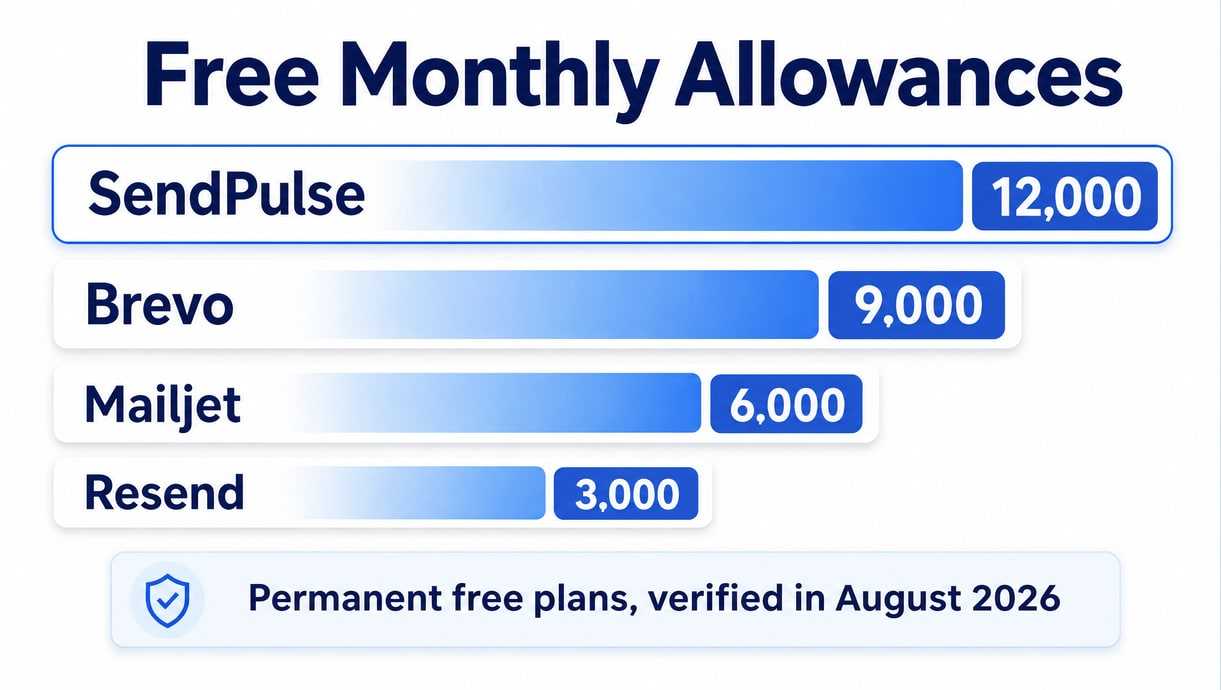
All the options below have a free plan with no time limit, with API or SMTP, verified in August 2026:
| Provider | Allowance | Daily limit | Notes that matter |
|---|---|---|---|
| Sender.net | 15,000/month | depends on usage | Cap of 2,500 unique recipients; great for a small base, bad for many users |
| SendPulse SMTP | 12,000/month | 400/day | Initial limit of 50/hour can queue up OTP spikes |
| Brevo | ~9,000/month | 300/day | Quota renews daily and doesn't accumulate; Brevo branding on the free plan |
| Mailjet | 6,000/month | 200/day | API, SMTP and webhooks; up to 1,000 contacts |
| Mailtrap | 4,000/month | 150/day | Excellent observability; logs kept for 3 days on free |
| Loops | 4,000/month | depends on usage | 1,000 contacts; Loops branding on free emails |
| Resend | 3,000/month | 100/day | Very simple integration (Node, Next.js, React Email); 1 domain |
| Elastic Email | 3,000/month | 100/day | No credit card |
| Mailgun | ~3,000/month | 100/day | Logs kept for only 1 day on free |
| SMTP2GO | 1,000/month | 200/day | Hourly limit goes away after verifying the domain |
| MailerSend | 500/month | depends on usage | Requires account approval |
| Postmark | 100/month | depends on usage | Perfect for testing; too small for production |
How to choose within the table:
- Want the largest transactional quota without a recipient catch? SendPulse (12,000/month), accepting the 50/hour limit.
- Traffic well spread across the month? Brevo, for its generous daily quota.
- Developer experience above all? Resend: the simplest API on the list for modern stacks.
- Sender.net's 15,000 are only worth it if your base will stay below 2,500 unique recipients; for authentication in an app with many users, you hit the recipient cap before you use up the allowance.
The cheapest paid options: SES and ZeptoMail in another league
When volume goes beyond the free tiers, two services set the price floor:
| Monthly volume | Amazon SES (à la carte) | Zoho ZeptoMail | SMTP2GO Starter | Postmark |
|---|---|---|---|---|
| 10,000 | US$ 1.00 | US$ 2.50 | US$ 10 | US$ 15 |
| 50,000 | US$ 5.00 | US$ 12.50 | depends on plan | depends on plan |
| 100,000 | US$ 10.00 | US$ 25.00 | depends on plan | depends on plan |
| 1 million | US$ 100 | US$ 250 | depends on plan | depends on plan |
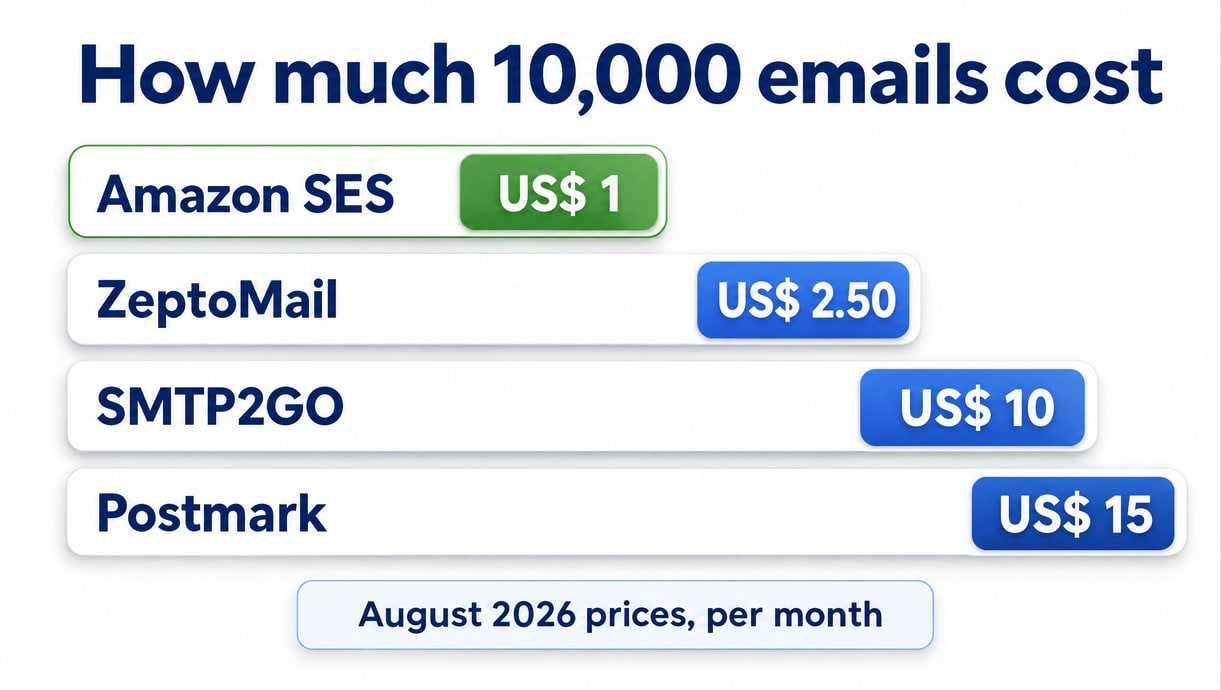
- Amazon SES is unbeatable on price: US$ 0.10 per thousand in the à la carte model (new accounts start on Essentials, US$ 0.16 per thousand, and can switch). The real cost is in the setup: leaving the sandbox, verifying the domain, handling bounces and complaints, building queues. It's the right choice for teams with engineering capacity.
- Zoho ZeptoMail is the "almost SES without AWS": credits of US$ 2.50 per 10,000 emails, no monthly fee, valid for 6 months. For a system sending 2,000 emails/month, a single credit lasts 5 months (~US$ 0.50/month). The first credit is free, but only once; don't confuse it with a recurring allowance.
- Among entry-level monthly plans, the best costs per tier: MailerSend (US$ 7 for 5,000), Mailjet (US$ 9 for 8,000), SMTP2GO (US$ 10 for 10,000), Elastic Email (US$ 19 for 50,000), SendGrid Essentials (from US$ 19.95) and Resend Pro (US$ 20 for 50,000). Postmark and Mailgun (US$ 15 for 10,000) charge a premium justified by top-tier deliverability and support.
The right choice by volume
| Your monthly volume | Recommendation | Cost |
|---|---|---|
| Up to 2,000 | Resend (DX) or Brevo (roomy quota); don't pay | US$ 0 |
| Up to 10,000 | SendPulse free; SES (~US$ 1) or ZeptoMail (US$ 2.50) to escape the limits | US$ 0 to ~US$ 3 |
| ~50,000 | SES (~US$ 5), ZeptoMail (US$ 12.50) or Elastic/SendGrid/Resend (~US$ 20) with more features | US$ 5 to 20 |
| Critical, any volume | Postmark or Mailgun, paying the premium for reliability | from US$ 15 |
Deliverability: what separates "sent" from "in the inbox"
Switching providers doesn't fix email landing in spam; configuration does. The minimum in 2026, required by Gmail, Yahoo and Outlook for bulk senders:
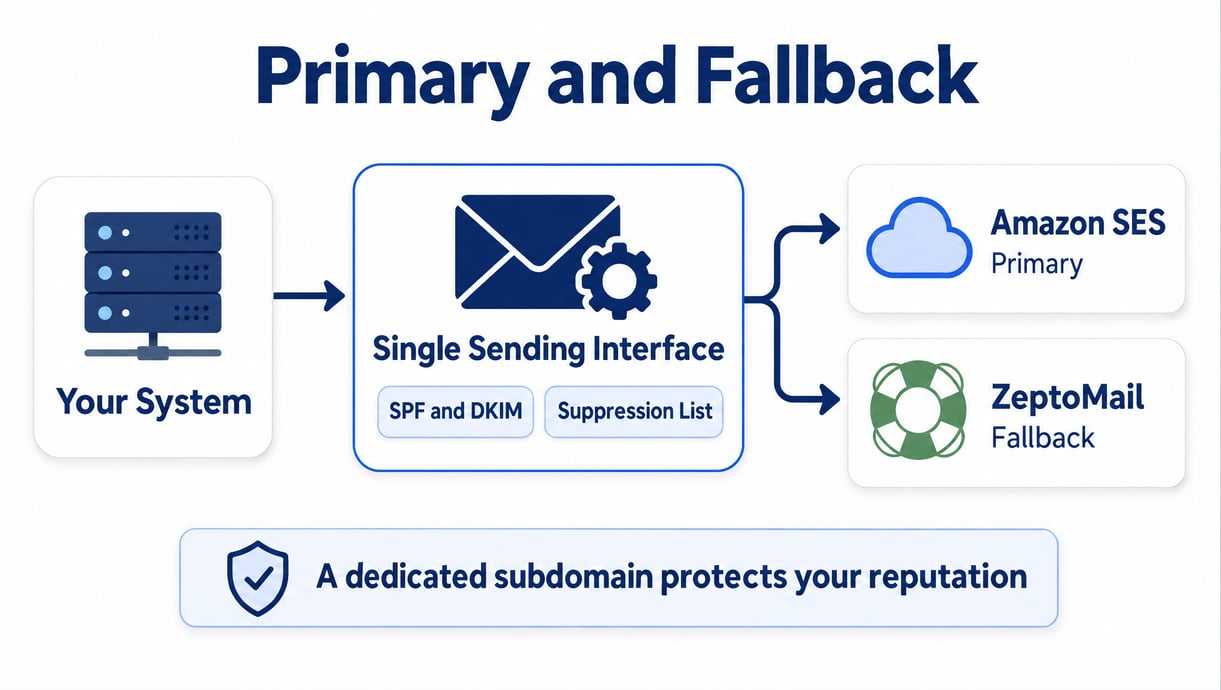
- Domain authenticated with SPF and DKIM, always. A sender from a free provider (Gmail, Hotmail) in a system is a recipe for spam.
- DMARC published, at least
p=none, tightening later. The DNS basics are in our DNS pointing guide. - A subdomain dedicated to transactional email (
mail.yourcompany.comorauth.yourcompany.com): it protects the main domain's reputation. - A centralized suppression list: bounces, complaints and unsubscribes respected across every provider you use.
- One main provider and one backup, each with its own DKIM, behind a single interface in your code. Don't spread sends across five providers to add up quotas: sending reputation is built with consistency.
What about authentication codes by email?
Email OTP deserves its own note, because it's the natural substitute for SMS in low-risk operations, costing cents. Two paths:
- Your application generates the code and the provider only delivers it: any service in the free table works; Resend and Brevo are the most practical.
- Managed authentication platform: Descope includes 1,000 emails per day on the free plan with ready-made OTP and magic links, by far the largest allowance in the category, limited to 7,500 active users.
The full authentication hierarchy (passkeys, TOTP, email, SMS) is in the MFA and 2FA guide, and the SMS channel cost comparison is in the guide to verification SMS in Brazil.
Frequently asked questions about transactional email
What is the best free email provider in 2026?
It depends on the criterion: SendPulse has the largest recurring transactional allowance (12,000/month), Brevo has the best daily quota (300/day) and Resend has the best integration experience (3,000/month). Sender.net advertises 15,000/month, but caps it at 2,500 unique recipients.
Is SendGrid still free?
No. The permanent free plan ended in May 2025; new accounts only get a 60-day trial. After that, Essentials starts at US$ 19.95/month.
Does Amazon SES still have a free tier?
For new accounts, no: the 3,000 emails/month allowance ended on July 21, 2026, replaced by general AWS welcome credits. SES remains the cheapest paid option on the market.
How much does it cost to send 10,000 emails a month?
From US$ 1 (SES à la carte) to US$ 15 (Postmark, Mailgun), with US$ 2.50 on ZeptoMail and US$ 10 on SMTP2GO in between. With SendPulse, that volume fits in the free allowance, respecting 400/day.
Can I use Gmail to send my system's emails?
You shouldn't. Personal accounts have low limits, no SPF/DKIM for your domain, and they hurt delivery. Use a transactional provider with your authenticated domain.
Why do my emails land in spam?
Almost always: a domain without SPF/DKIM/DMARC, a sender from a free provider, a shared IP with a bad reputation or a list with many bounces. Set up domain authentication and use a dedicated subdomain before blaming the provider.
Is it worth using several providers to add up free tiers?
Not as a routine. Each provider adds its own DKIM, webhooks and suppression list, and reputation gets diluted. The professional standard is one main provider, one backup and a single interface in the code.
Which combination should a new project use?
The one we recommend most often: Resend for development and the MVP, Amazon SES as the main provider in production and ZeptoMail as a cheap backup. Three simple integrations, near-zero cost and no critical dependency on a single vendor.
Conclusion
Transactional email in 2026 has a price floor so low that cost should rarely decide the project: SES and ZeptoMail deliver millions of messages for tens of dollars, and the SendPulse, Brevo and Resend tiers cover entire small operations for free. What decides it is operations: authenticated domain, DMARC, a dedicated subdomain, centralized suppression and a plan B configured before you need it. Teams that treat email as infrastructure, not as a commodity, don't find out about the problem on the day the customer says the code never arrived.
Need emails that actually arrive?
X-Apps implements the complete transactional email layer of your system: choosing and configuring the provider, domain authentication, queues, delivery webhooks, backup and monitoring.
Sources and official pricing pages
- Amazon SES Pricing
- Zoho ZeptoMail Pricing
- SendPulse SMTP Pricing
- Brevo Help Center: free plan
- Mailjet Pricing
- Mailtrap Pricing
- Resend Pricing
- Elastic Email Pricing
- Mailgun Pricing
- SMTP2GO Pricing
- MailerSend Pricing
- Postmark Pricing
- Sender.net Pricing
- Loops Pricing
- Descope Pricing
- Twilio Changelog: end of the SendGrid free plan