Índice do artigofaltam 5 min de leitura
In recent years, the market has been flooded with hundreds of tools based on Artificial Intelligence. It's common to find lists like "the best AIs for coding", "GPT vs Claude" comparisons or "Cursor vs Copilot".
Although these comparisons are useful, they fail to answer a much more important question: which technologies actually make up a modern architecture for speeding up software development?
The reality is that no single tool solves the whole problem. Just as a web application depends on a database, back end, front end and infrastructure, a modern AI-accelerated development platform is also made up of different responsibilities, each covering a part of the process.
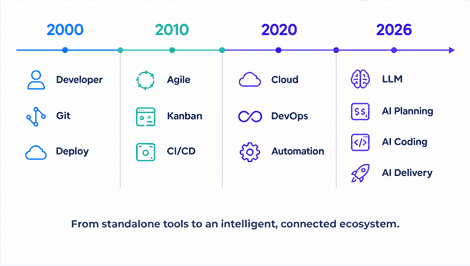
This question came to us recently, in a conversation with a client: with so many technologies on the market, when should I use each one? Do they compete with each other or work together?
In the video below, we walk through the document that gave rise to this article and show how each responsibility fits into the development flow:
Quick summary
For those in a hurry, the key points:
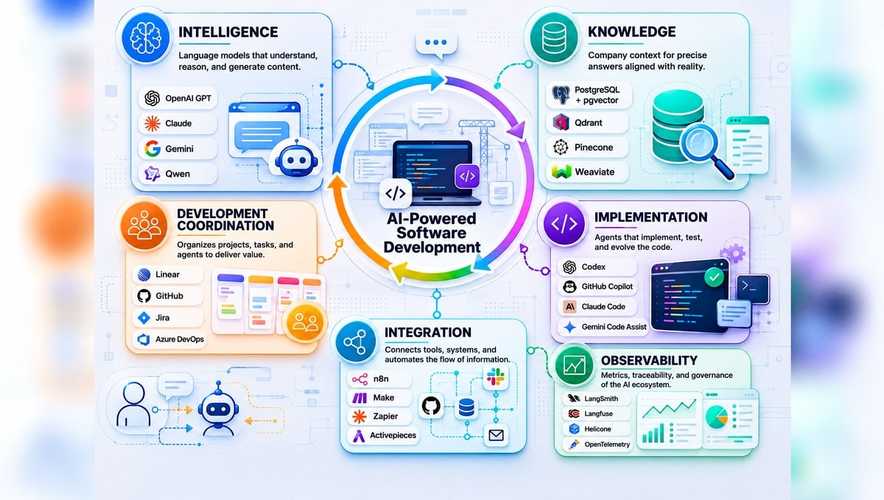
- The ecosystem is organized into six responsibilities: intelligence, knowledge, coordination, implementation, integration and observability, cut across by a governance and security layer.
- The technologies don't compete with each other. Each one solves a different problem, and the greatest potential appears when they collaborate.
- LLMs provide reasoning, but they don't know your company. RAG and vector databases add the missing context.
- Platforms like Linear, GitHub and Jira are no longer just task managers and now coordinate work between people and AI agents.
- Implementation agents turn planning into code, with tests, pull requests (proposed changes submitted for review) and human approval before integration.
- Without observability and governance, the ecosystem becomes a black box. Metrics, costs, permissions and auditing are what make it possible to scale with confidence.
The AI ecosystem for software development
Artificial Intelligence is no longer a single technology; it is now a complete ecosystem geared toward software development.
Language models, knowledge bases, coordination platforms, implementation agents, integration solutions and observability tools have taken on specific responsibilities throughout the development cycle.
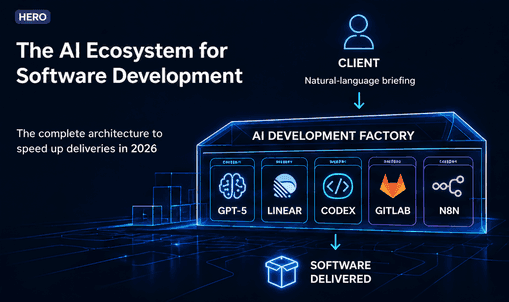
Although they are usually presented independently, these components don't compete with each other. Each technology solves a different problem, and its greatest potential appears precisely when it starts collaborating with the others.
Understanding these responsibilities matters more than knowing specific tools. This view is what lets you understand how the market is evolving and how these technologies complement each other to form a new generation of AI-driven Software Factories.
In this post, we organize this ecosystem into six main technology responsibilities, cut across by an essential layer of governance and security.
Intelligence: language models
Language models (LLMs) represent the cognitive capacity of Artificial Intelligence.
They are responsible for interpreting natural language, understanding requirements, generating documentation, producing code, reviewing implementations, summarizing information and supporting decision-making. Practically every interaction between people and Artificial Intelligence starts in this domain.
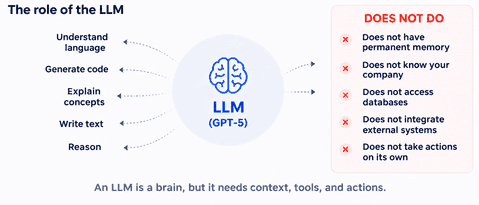
Although extremely powerful, these models work with general knowledge. They know programming languages, architectural patterns and technical concepts, but they have no access to each organization's specific context, such as business rules, internal documentation or proprietary code.
This limitation makes a second domain necessary, one responsible for providing context during execution.
Representative platforms: OpenAI GPT, Anthropic Claude, Google Gemini and Alibaba Qwen.
Knowledge: RAG and vector databases
As language models began to be used in corporate environments, it became necessary to complement their knowledge with each organization's specific information.
Technical documentation, source code, APIs, business rules, internal processes and architectural decisions became part of the context used in answers.
This role is played by Retrieval-Augmented Generation (RAG) solutions and vector databases. In practice, documents are split into smaller pieces (chunks), converted into numerical representations (embeddings) and stored in a vector database. Through a semantic search, the most relevant pieces feed the model when it generates the answer.
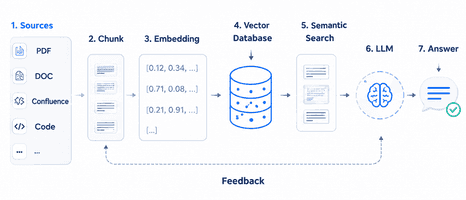
Instead of replacing language models, these technologies expand their analytical capacity using up-to-date, company-specific knowledge, reducing hallucinations and making answers significantly more accurate.
Representative platforms: PostgreSQL with pgvector, Qdrant, Pinecone and Weaviate.
Development coordination
With models able to understand requirements and access the organization's knowledge, it became possible to use Artificial Intelligence in a stage that, until recently, was exclusively human: coordinating development.
A new generation of platforms began turning business goals into structured projects, organizing the backlog, features, tasks and dependencies, and continuously tracking how deliveries evolve.
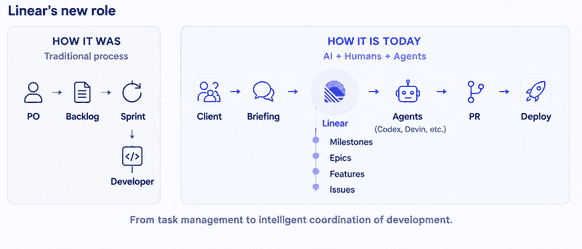
Besides supporting human teams, these platforms also coordinate specialized agents responsible for different development activities, bringing planning and implementation into the same workflow.
This domain represents one of the biggest recent transformations in software engineering. Artificial Intelligence moves beyond the role of a simple assistant and starts actively taking part in organizing the process, a shift we detail in orchestrating AI agents with governance.
Representative platforms: Linear, GitHub, Jira and Azure DevOps.
Implementation: agents that produce software
Once the work is organized, agents specialized in software development come into play.
These technologies analyze the repository, understand the application's context, implement features, fix defects, run automated tests and prepare changes for review before they're merged into the main code.
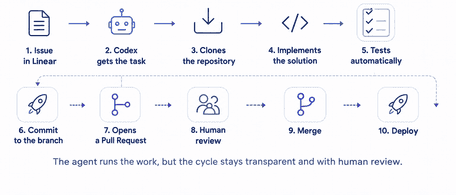
While coordination platforms organize development, implementation agents focus their efforts on actually producing the software, taking on repetitive activities and significantly speeding up the delivery cycle. This is the dynamic that defines the third era of programming with AI and cloud agents.
This collaboration lets developers direct their time to architecture, validation and higher-value technical decisions.
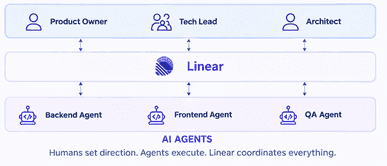
Representative platforms: OpenAI Codex, GitHub Copilot, Claude Code and Gemini Code Assist.
Integration: connecting the whole ecosystem
This entire ecosystem depends on continuous communication between different technologies.
Language models query knowledge bases, agents access repositories, coordination platforms track projects, and external services need to be integrated so that messages are sent, pipelines run, automations fire and information flows naturally between all the systems involved.
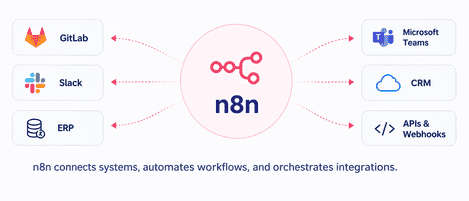
Integration platforms act as the connecting element between these technologies, allowing different components to work in a coordinated way and share information throughout the development cycle. Standards like MCP (Model Context Protocol) reinforce this role by standardizing how models and agents access tools and data.
As the number of tools grows, this responsibility becomes more and more important for keeping a consistent, automated flow.
Representative platforms: n8n, Make, Zapier and Activepieces.
Observability: tracking AI while it runs
The evolution of this ecosystem also brought a new responsibility for engineering teams: understanding how Artificial Intelligence is behaving while it carries out its tasks.
Observability platforms consolidate metrics on language model usage, agent execution, token consumption (the units of text that measure model usage), operating costs, performance, context used, decision traceability and other indicators that let you continuously monitor the entire AI-based environment.
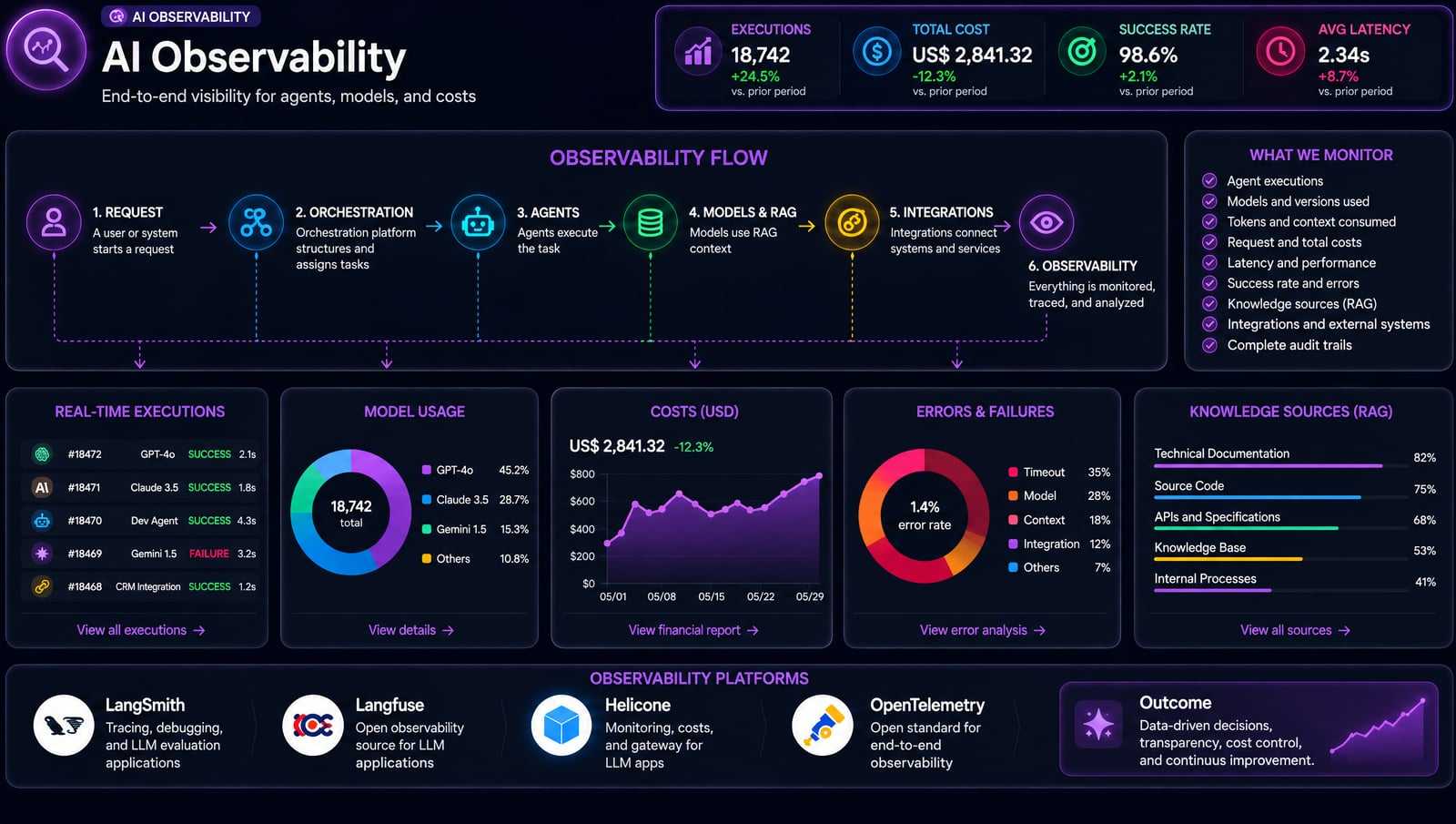
More than identifying failures, this domain provides information that supports optimization, reduces costs, increases predictability and strengthens governance over the whole development cycle.
Just as monitoring applications, infrastructure and pipelines became an indispensable practice in modern engineering, tracking the behavior of Artificial Intelligence becomes an essential component of AI-driven Software Factories. Those already working with orchestration frameworks, as we showed in the LangChain vs LangGraph comparison, will find these platforms the natural complement for traceability.
Representative platforms: LangSmith, Langfuse, Helicone and OpenTelemetry.
Governance and security: the cross-cutting layer
When Artificial Intelligence starts taking part directly in software development, new governance responsibilities also appear.
You need to define which data can be used, which repositories can be accessed, which actions require human approval, how secrets and sensitive information are protected, and which policies guide the use of models and agents.
This layer also involves permission control, auditing, code review, regulatory compliance, risk management and mechanisms to prevent automations from taking actions beyond expected limits. It's the same boundary between agent and system that we explore in AI agents or traditional systems: the agent proposes, the system validates, executes and records.
In corporate environments, governance is not an operational detail. It's what allows AI adoption to scale securely, predictably and with confidence.
Representative platforms and practices: IAM (identity and access management), secret management, mandatory code review, internal AI usage policies, auditing and approval trails.
How these technologies work together
Each of these responsibilities represents only one part of the ecosystem.
Language models provide reasoning capacity. Knowledge solutions add context. Coordination platforms organize the work between people and agents. Implementation agents turn planning into software. Integration platforms connect the whole environment, and observability solutions continuously track how this ecosystem is working.
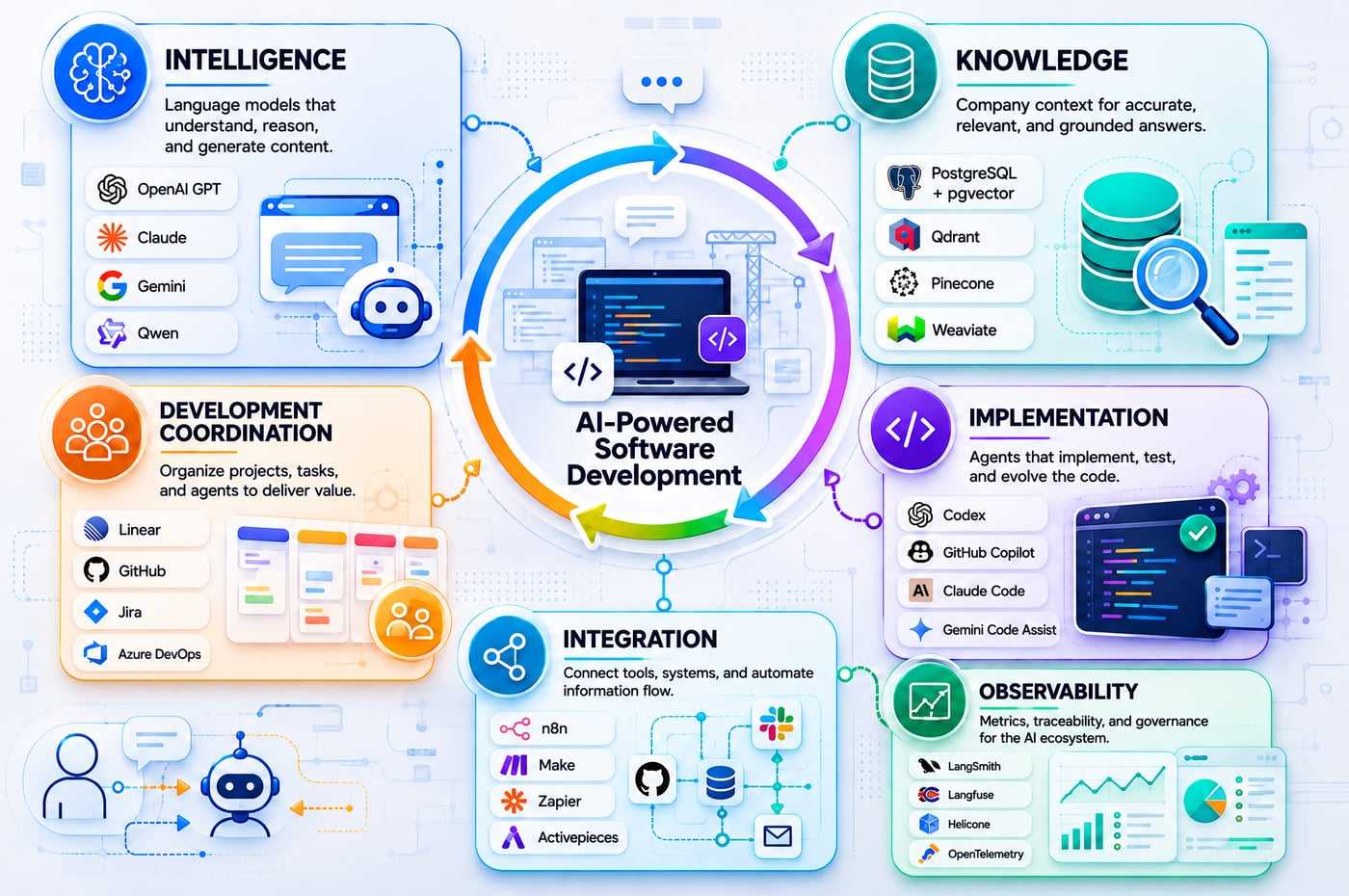
Governance and security act as a cross-cutting layer, defining limits, permissions and controls so this entire ecosystem operates with confidence.
The result is not a collection of independent tools, but a collaborative environment where different technologies work together to support every stage of software development.
More than a technological evolution, this shift represents a new way of structuring Software Factories, distributing responsibilities among specialized platforms that continuously collaborate to turn business goals into software delivered with more speed, quality and predictability. It's the foundation of the AI software development, AI agents for companies and AI agent factory projects we set up with our clients.