Índice do artigofaltam 6 min de leitura
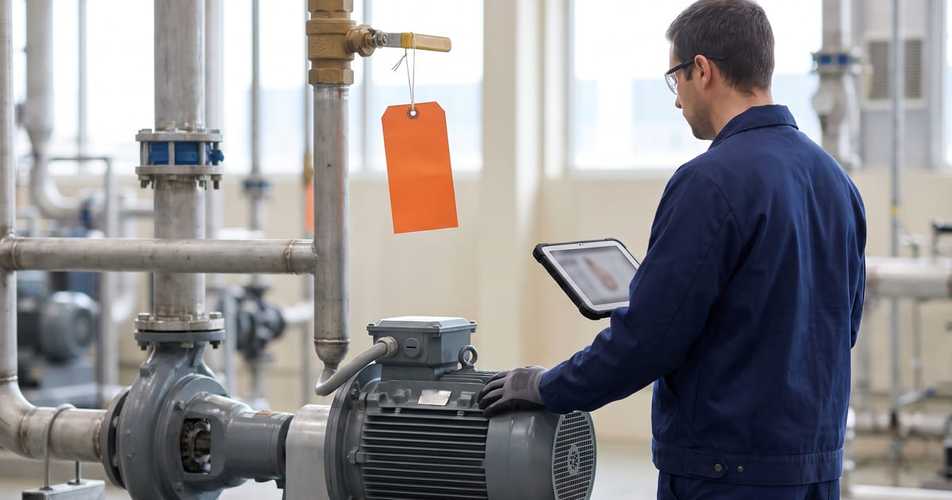
"Parb.- Dryer elevator brg chng". That is how, in a short 40-character text field, a work order records the replacement of a dryer elevator bearing at a parboiled rice plant, inside SAP PM, SAP's maintenance module. In the notes field, the technician added a mix of English and Hindi: "grease nahi tha, brg jam". No grease, the bearing seized. The example opens an October 2026 study on what to do with this kind of record.
Change the language and the scene could be any Brazilian factory. An equivalent invented here, just to illustrate: "TR ROL ELEV SEC L2" (Portuguese shorthand for "replace bearing, dryer elevator, line 2"), with "s/ graxa, travou" ("no grease, seized") in the notes and the cause field blank. Whoever wrote it knew what they meant, and so did the colleague on the next shift. The text was written for the two of them, not for an analyst, and even less for a language model.
When leadership asks for "AI in maintenance", the conversation usually turns to sensors and predictive maintenance. The subject here is different: the text the technician writes, not the vibration the sensor measures. That text holds the factory's failure history, the one that today lives in the head of the most senior technician. And that is where AI stalls.
AI came into the factory through the office
The number leadership cites comes from IBGE, Brazil's national statistics institute. In 2024, 41.9% of industrial companies with 100 or more employees used artificial intelligence, compared with 16.9% in 2022: a 25-percentage-point rise in two years. The data comes from PINTEC Semestral, a survey run in partnership with ABDI (Brazil's Industrial Development Agency) and UFRJ (the Federal University of Rio de Janeiro), covering a universe of 10,167 companies in the extractive and manufacturing industries.
The same survey asks in which area AI is used, and the answer changes the reading. Among companies that use it, 87.9% apply it in Administration, 75.2% in Sales and 73.1% in product, process and service development projects. Production shows up at 52.0% and has fallen: it was 56.4% in 2022, a drop of 4.4 points.
The survey has no separate line for maintenance; Production is the closest area. Even so, the picture is clear: AI arrived in industry through office areas, where the text looks like that of any other company. On the factory floor, the text is of a different kind.
What a work order contains that the model does not understand
The rice plant study, a preprint (a paper not yet peer reviewed) called Plant Memory, defines maintenance orders as the largest written record of how industrial equipment fails. And it says that, in most plants, this record is nearly useless for analysis, because of four defects any maintenance planner will recognize.
The text is short, abbreviated and full of typos. The equipment's identity is buried in free text instead of sitting in a field. The type of work marked contradicts the work described. And the symptom, root cause and action taken fields are almost always empty.
Other researchers describe the same material. MaintNorm, a dataset of 12,000 short maintenance texts published in 2024, lists engineering jargon, trade-specific vocabulary, random spelling errors and lack of grammatical structure as obstacles. In 2020, researchers in a publication from NIST, the United States standards institute, had already written that "off-the-shelf" language processing tools were designed with non-technical language in mind and need to be rethought for engineering. The same paper notes that deployments in industry suffer from a lack of verification, validation and operator trust.
What this costs the manager: the failure history exists, with years of orders, and nobody can query it. Knowing which failure mode stops the line most often, or which part to keep in stock, requires someone reading order by order. Diagnostic knowledge stays with the senior technicians and leaves with them.
How wrong a generic model gets this text
In 2023, three researchers gave a language model the task a planner does in their head: read the notes on an order and say what the failure mode was, choosing from a restricted list of codes. The measure used was F1, a score from 0 to 1 that combines how much of what the model marks is right and how much of what it should find it actually finds.
The generic model, without fine-tuning, came in behind a conventional text classifier trained on the same annotated set. With the model adjusted using the annotated data, what the market calls fine-tuning, the same model beat both.
The 0.46 has a date. It is from GPT-3.5, in 2023, in English, on a single dataset, and does not measure 2026 models. What the study supports is the distance between the bars: the same model, with and without annotated domain data. The authors conclude that the work reinforces the need for high-quality fine-tuning datasets for domain-specific tasks. For the manager, the message is about the order of investments. The difference came from the labeled data, which is the factory's work, not from switching models.
Where AI fits in: opening, triage and history
There are three points in the routine, and the first one decides the other two.
Opening. Maintenance data is born structured when the record is made on the spot, in the app, with the equipment identified by scanning a code and the fields chosen from a list, instead of retyped later from paper. Here AI plays a supporting role: it transcribes the technician's speech, reads the photo, suggests how to fill in the fields. The foundation is a record-keeping system, and that is what X-Apps builds for industry. For Suzano, the Brazilian pulp and paper producer, and its biotech unit FuturaGene, we built three forest biotechnology systems and two for operations, with a field app and traceability by barcode and QR code, and 87% of activities digitized, according to the case study. For Transpetro, the logistics arm of the Brazilian oil company Petrobras, an app that supports field professionals in inspecting equipment and recording the conditions found, with 93% less rework in records, according to the case study. Neither is an AI project: they are field record-keeping systems, the stage that comes before.
Triage. This is the task from the 2023 study: classifying the order under a failure code. It works with a closed list of codes, the AI suggesting and the technician or planner confirming. The confirmation is what produces the labeled orders the generic model lacked, and every shift starts speaking the same language, which allows comparing one with another.
History. This is the question only the senior technician can answer today: has this happened before, and what fixed it? The Plant Memory design is a useful reference because it treats AI with suspicion. Facts are extracted first by rules. The language model is an optional second reader, and its disagreement does not overwrite anything: it raises the review priority for that fact. Technicians check the facts in a queue that starts with the lowest-confidence ones, answer questions about failures that repeat with no recorded cause and approve or reject new vocabulary terms. Every answer cites the source work orders. The goal is for the diagnosis to stay in the factory when the technician retires.
In the author's test, the right root cause came up first in about eight out of ten diagnostic questions, compared with just over half using the system's cause column as it was. The test ran on 400 synthetic orders, generated to simulate a plant, in a single-author paper. He himself writes that the language model, used as an independent extractor, was less precise than the rules and added value by filling gaps and flagging disagreements, and that the effectiveness of the review queue has not yet been measured. It is worth copying as an architecture, not promising as a result.
What AI does not decide in maintenance
Releasing a piece of equipment back into operation and stopping a line remain with whoever signs off. The AI suggests a code and points to similar orders; technical responsibility does not change hands.
It also does not invent what was never written down. If the cause field was left empty for years, searching the history returns what was replaced, not why. The system's honest answer, in that case, is a question for the technician, while they are still at the factory.
And the right role is that of a second reader. A model that misreads "brg" answers with the same confidence as when it reads it correctly. That is why every answer needs to point to the order it came from, so someone can check before acting.
What to fix before hiring
Three things, all on the factory's side.
The plant dictionary: the abbreviations, the nicknames for equipment and the closed list of failure modes, causes and actions. It is smaller than it looks. The Plant Memory vocabulary has 26 components, 20 failure modes, 13 root causes, 10 actions and 9 symptoms, each with its synonyms.
A hand-labeled sample. The preprint's author writes that a credible evaluation calls for 50 to 100 orders from a real plant, classified by someone who knows the work. This is the sample you use to measure any AI proposal before signing, on the factory's own work orders and not on the vendor's demo.
And the export of the history, from the maintenance system into a format that can be read outside it.
Dictionary, sample and history are assets of the factory, not the vendor, and that goes into the contract: who keeps the reviewed vocabulary and the labeled orders if the vendor changes. Whoever fixes the records first has something for the AI to read. Whoever buys the AI first buys confident answers about misread abbreviations.
Sources and method. IBGE News Agency, PINTEC Semestral (in partnership with ABDI and UFRJ), September 24, 2025: AI use in industrial companies with 100 or more employees and areas of use; the survey has no separate line for maintenance. Stewart, Hodkiewicz and Li, "Large Language Models for Failure Mode Classification: An Investigation", arXiv:2309.08181, September 15, 2023. Brundage, Sexton, Hodkiewicz, Dima and Lukens, "Technical Language Processing: Unlocking Maintenance Knowledge", NIST, December 11, 2020. Bikaun et al., "MaintNorm", W-NUT workshop, ACL Anthology, 2024. Akash Raj, "Plant Memory", arXiv:2610.19131, October 13, 2026, preprint not peer reviewed, evaluated on synthetic data. The studies we read are in English. The Portuguese work order example is illustrative. Accessed on November 12, 2026.