Índice do artigofaltam 6 min de leitura
"We can't send our documents to OpenAI." The sentence comes up in the meeting, someone agrees, and the AI project goes back in the drawer. It looks like a single objection. It is three, with different answers and different prices:
- the AI will learn from our documents and hand the content to another company;
- someone at the vendor will read what we send;
- the document will leave Brazil.
In our projects, the sentence usually arrives before anyone has read the vendor's contract. Separating the three fears changes the conversation, because the first two are solved with contracts and settings, without changing the price per token. Only the third decides the architecture.
The policies cited below were checked on the official pages on October 5, 2026. On November 11, 2026, we reread OpenAI's and Anthropic's data residency and regional pricing rules and Bedrock's regional table: those rules have not changed, and the list of models on Bedrock was updated in the section about São Paulo. The other policy points keep the date of the October check.
Will the AI learn from our documents?
Through the API, no. It is the easiest part to answer and the most repeated as an objection.
OpenAI states that, since March 1, 2023, what comes in through the API is not used to train or improve its models, unless the customer opts in to share. Anthropic writes that retained data is "never used to train a model" without express permission. Microsoft, for the models it sells through Foundry (including OpenAI models hosted on Azure), says prompts and responses are not available to OpenAI and do not train foundation models without the customer's instruction. On Amazon Bedrock, models run in accounts operated by AWS itself, and the model makers have no access to the logs or the content of the calls.
The fear has a basis elsewhere: the consumer plan. An employee pasting a contract into the free chat, with a personal account, is outside all of these guarantees. The problem there is not the AI; it is the channel. The answer is to give the team an official tool through the corporate account, which costs its subscription and nothing more.
Can someone at the vendor read what we send?
Here the answer is "it depends on what you asked for in the contract".
By default, OpenAI keeps abuse monitoring logs for up to 30 days, and those logs may contain the prompt and the response. There are two controls to remove the content from these logs, Zero Data Retention and modified abuse monitoring, and both require prior approval from OpenAI. Anthropic, on the API, does not retain conversations by default, except for some models that require 30 days; zero retention is requested from the sales team and enabled per organization. On Azure, samples flagged as possible abuse may go through human review by authorized Microsoft employees, and the customer can request modified abuse monitoring; once approved, the resource shows ContentLogging as false, which you can check in the portal.
The cost of this answer is not on the price list. It is in the process: a request to the vendor, approval and, in OpenAI's case, acceptance of additional requirements. It is worth requesting before the first real document goes in, not after the pilot has run with production data.
Does the document leave Brazil?
This is the objection with a technical basis, and the only one that costs extra tokens to solve.
Neither OpenAI nor Anthropic processes in Brazil through their own APIs. OpenAI's list of data residency regions has ten locations: the United States, Europe, Australia, Canada, Japan, India, Singapore, South Korea, the United Kingdom and the United Arab Emirates. None in South America. At Anthropic, the geography parameter accepts only "global" and "us". And choosing a geography costs money: OpenAI charges 10% more on residency endpoints for models launched from March 2026 onward, and Anthropic applies 1.1x to every token when inference stays in the United States.
For a Brazilian reader, this means that through the direct API the choice is between "anywhere" and "another specific country". If your contract with your client or a rule in your industry requires data to stay in Brazil, the model maker's direct API does not meet that today, and the conversation moves to the cloud.
In São Paulo, almost every closed model runs in global mode
The natural way out is to contract the model through the cloud the company already uses, in the São Paulo region. That is where the surprise lives.
On September 30, we checked Amazon Bedrock's availability-by-region table for the models in the X-Apps AI model comparison. Of the 11 models we checked on Bedrock, 10 have only global inference marked in São Paulo: the call comes in through the Brazilian region and may be processed outside it. This group includes the Claude and GPT-5.6 models we checked, plus Grok 4.6. The only one with in-region inference is Mistral Large 3, which has open weights.
On November 11, 2026, we redid the count on the same AWS table, with the models the comparison lists today. There are 15 models with a São Paulo row on Bedrock, and 14 of them have only the global column marked. Mistral Large 3 is still the only one with in-region inference.
The list changed since September because the comparison changed. Previous generations left: Claude Fable 5, Opus 5, Sonnet 5 and Mythos 5.1, GPT-5.6 Sol and Grok 4.6. Added to the count, either because they launched later or because they were not in the September check, were Claude Opus 5.5, Sonnet 5.5 and Haiku 5.5, GPT-6 Astra, GPT-6 Luna, GPT-6.1 Sol and GPT-6.1 Terra, plus Grok 4.7, Kimi K3 and GLM 5.3, all with only the global column. Remaining from the previous group are Claude Fable 5.1, Haiku 4.5 and GPT-5.6 Luna and Terra. Claude Fable 5.2, which appeared on the Bedrock table after this list, is also global-only.
Kimi K3 and GLM 5.3 publish open weights, and even so, on Bedrock in São Paulo they only appear in global mode: having open weights does not guarantee that the provider offers inference in Brazil.
Azure has the same split under other names. The standard deployment processes in the geography chosen by the customer. The "Global" deployment may process in any geography where the model is available, and "DataZone" anywhere in the zone, such as the United States or the European Union. In both cases, stored data (files, history) stays in the customer's geography; what changes is where the model thinks.
Two practical consequences. Selecting "São Paulo" in the console is not enough: you need to look at the inference type of each model, and check again when you switch models. And when a regional endpoint exists, it may cost more: Anthropic documents a 10% surcharge over global on the regional endpoints of Bedrock and Google Cloud.
What RAG changes: the knowledge base stays with you, the excerpt goes out
Much of the fear comes from imagining the entire file being shipped to the vendor. In a well-built assistant, that is not what happens.
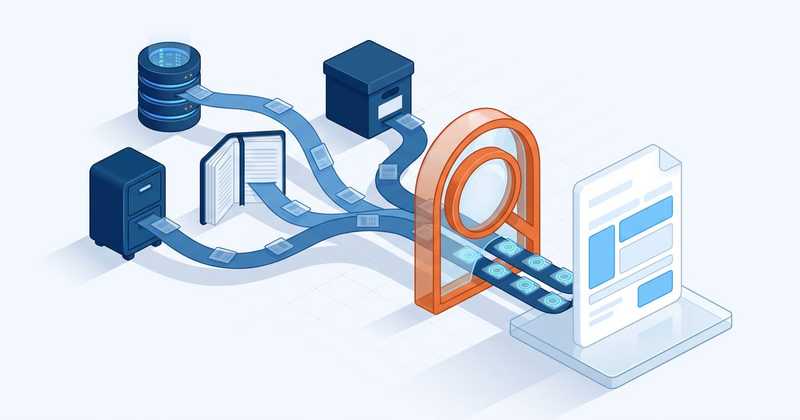
In a RAG system, the document base lives in a company database. When someone asks a question, the system searches for the relevant passages and sends the model only those passages, along with the question. Microsoft describes its equivalent feature this way: the data stays in the source the customer designated and the service does not create a copy. The 80-page contract does not travel; the three paragraphs that answer the question travel, at the moment of the question.
This does not eliminate sending data, but it changes the size of the problem. What goes out becomes controllable: you can filter by permission before the search, mask CPF numbers (Brazil's individual taxpayer ID) and names before sending and log what was sent. This work is detailed in the guide on sensitive data in RAG, and it is what turns "we send documents to the AI" into "we send an authorized excerpt with no personal data".
When the honest answer is an open model on your own infrastructure
Then there is the case where none of the options above is enough: the data cannot leave the country by contract, or cannot leave the company network by industry rule. The answer, then, is an open-weight model running on a server the company controls, in a cloud in São Paulo or in its own server room.
The trade-off changes the nature of the cost. The price per token disappears, and in comes the cost of a machine that stays on, with a graphics card, plus operations: updating the model, measuring quality, keeping the queue running in the middle of the night. What we see in projects: the open model that fits this budget lags behind the latest closed models on hard tasks, which forces you to choose carefully what it will do. In extraction, classification and search over internal documents, the difference matters little; in long reasoning, it matters more.
It is the option X-Apps designs when that is the requirement, in our local and private AI practice. It is not the starting point. It is what is left when question three has the answer "it cannot leave", in writing.
Which question to take to legal
| The fear | The right question | What solves it | How much extra it costs |
|---|---|---|---|
| The AI learns from the document | Are we using the API or a corporate plan, or a personal account? | An official channel; through the API, the vendors cited do not train on the data | Nothing beyond the subscription |
| Someone at the vendor reads it | Did we request zero retention or modified abuse monitoring? | Vendor approval, before the first submission | A commercial process, not tokens |
| The data leaves Brazil | Does any contract or rule of ours require processing in the country? | A model with in-region inference, or an open model on your own infrastructure | From 10% on tokens to your own machines and operations |
The third row deserves the question in writing, because a "yes" changes the architecture and a "no" frees up almost everything. If the data is personal, transfer outside the country has its own rules under LGPD, Brazil's data protection law, explained in what LGPD already requires before the AI legal framework.
In the meetings where the sentence comes up, it is common for the answer to the third question to be "nobody knows". Finding out costs one conversation with legal, and it is the cheapest conversation of the entire project.