Índice do artigofaltam 13 min de leitura
A two-hour meeting with six people produces about 18 thousand words of transcript, and inside them are three decisions, seven tasks with owners, two risks, a scope change and a commercial commitment nobody wrote down. The work of pulling that out and putting it in the CRM is expensive when a person does it, and has become cheap now that a machine can do it. The question that remains is how cheap exactly, and what changes when you ask the machine to think harder.
This article answers the second part. The generic math of the reasoning dial is in the reasoning effort math; here it is applied to a meeting pipeline, with eight architectures compared and a projection from 10,000 to 100,000 meetings.
Article summary
- With GPT-6.1 Sol, a one-hour meeting costs between US$ 0.10 and US$ 0.83 to process, depending only on the reasoning level chosen.
- Reading the transcript accounts for 3% to 29% of the bill. The rest is the model thinking, billed as output, at US$ 10 per million tokens.
- At 10 thousand meetings a month, switching from high to medium reasoning saves US$ 13.0 thousand a year; moving up to max costs US$ 70.5 thousand more.
- For high-volume extraction, GPT-6 Luna charges 1/20 of the GPT-6.1 Sol price and is the option OpenAI itself recommends for this kind of task.
- Splitting the transcript into chunks came out 31% more expensive than reading everything at once, and it also breaks the references that span the meeting.
What this pipeline needs to extract, and why it is not a summary
Summary and extraction are different tasks, and confusing the two is the mistake that gets the project off on the wrong foot. A summary compresses and can choose what to discard. Extraction needs to find everything and cannot invent anything, because each field becomes an action in another system.
- DecisionsWhat was decided, separate from what was merely suggested.
- Tasks and ownersWho took it on, with a deadline, and not who was mentioned.
- CommitmentsWhat was promised to a client, with the amount said out loud.
- Scope changeA new request separate from a requirement that already existed.
- Risks and objectionsWhat got stuck, who blocked it and what would solve it.
- DependenciesWhat is waiting on what, and on whom.
- Open itemsWhat was left without an owner at the end of the conversation.
- CRM structureFields ready to update the deal and contact records.
The metric that matters is recall with faithfulness: find every item and add none. Eloquence does not count. A beautiful summary that lost a task is worse than a dry list that found them all, because the error is silent and becomes an undelivered item three weeks later.
Does reasoning effort matter for organizing meetings?
The short answer is that it matters much less than intuition suggests, and the public evidence available points in the opposite direction from common sense.
The real difficulties of meeting minutes are about reading, not deduction: finding a fact said at minute 12 and picked up again at minute 96, resolving who "that client" refers to, distinguishing who made a commitment from who merely agreed, noticing that the decision at the start was contradicted at the end. It is tempting to think this calls for more deliberation. What the data show is that it calls for more attention to the document, and that is not the same thing.
The closest measurement to this case comes from Observe.ai, which tested effort levels on tasks over call transcripts. In entity extraction, going from low to medium changed the result from 87.5% to 87.6%. In abstractive generation, the high level came in at 89.0% against 90.5% for low. Only summarization rose consistently, from 94.6% to 96.1%, at the cost of latency going from 2 or 3 seconds to 32.6 seconds.
The literature reinforces this. A 2025 study compared eight reasoning strategies and three reasoning models across eight summarization datasets and concluded that increasing the internal reasoning budget does not reliably improve summarization and can reduce factual consistency, with faithfulness falling as reasoning capacity increases.
The opposite hypothesis has more evidence in its favor
The hypothesis that long-context retrieval and prompt structure matter more than effort, for this task, is the one best supported by public data.
At the time of the August research, GPT-5.6 Sol scored 91.5% on MRCR, the long-context retrieval test reported by OpenAI. The GPT-6.1 Sol page does not publish that number, and both have a 1.05-million-token window. A three-hour meeting takes up about 36 thousand tokens. In other words, the whole task fits with more than twenty-five times to spare, and the bottleneck of finding a scattered fact is a matter of retrieval, which is already solved at a high level, and not of deliberation, which is what effort buys.
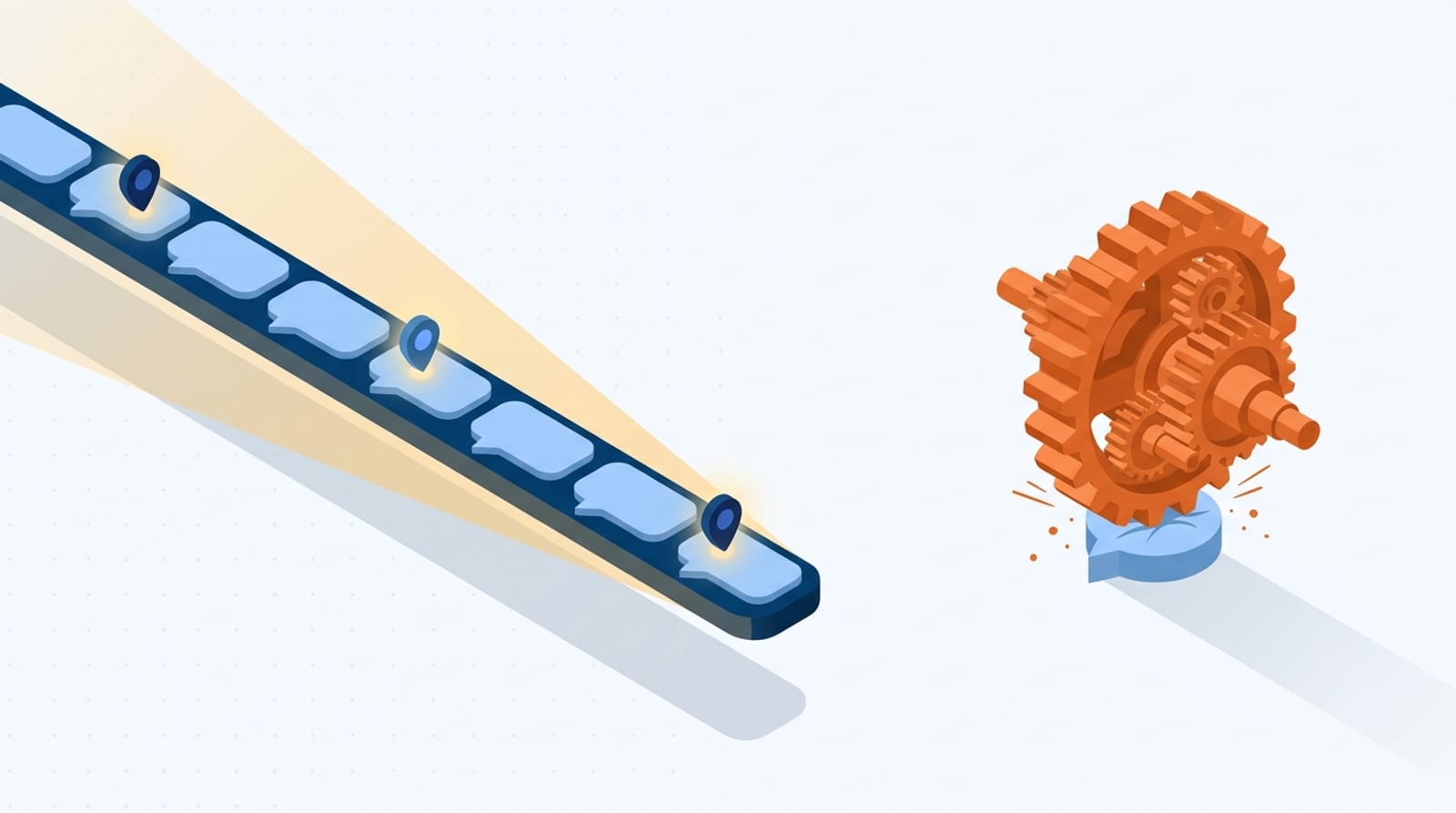
There is also a documented perverse effect: in tasks anchored in a document, more deliberation opens room for the model to elaborate beyond what is in the source. In meeting minutes, elaborating is exactly the defect, because a plausible inference becomes a task nobody asked for inside HubSpot.
What really changes the result in these tasks is the output schema, the instruction to cite the source passage for each item and the explicit separation between what was decided and what was only considered.
Where effort still pays off here is in a small, identifiable subset: contradictions between distant moments of the meeting, negotiation with amounts and conditions, and legal or architecture passages where the consequence of getting it wrong is high. Keep that list, because the policy at the end of the article comes from it.
You do not pay for the transcript, you pay for the thinking
This is the inversion that changes the system design. Reading the document is cheap; thinking about it is expensive. On GPT-6.1 Sol, input costs US$ 2 per million and reasoning is billed as output, at US$ 10 per million. The 1-to-5 ratio is the same as on GPT-5.6 Sol, so the percentages in this section apply to both.
In a three-hour meeting processed on max, the entire transcript accounts for 3.7% of the cost. The other 96.3% is the model thinking. The cheaper the effort, the more the transcript weighs: on low, it reaches 29% of the bill for a three-hour meeting.
This has two design consequences. The first is that optimizing transcript size yields little while effort is high, because you are cutting the smallest share. The second is that caching changes its role: since each transcript is unique and never repeats across meetings, it generates no reuse in a single-pass pipeline. Worse: caching is on by default and, in implicit mode, OpenAI writes to the cache on every call with 1,024 tokens or more, charging 1.25 times the input for that write, even if nothing is re-read. In a single pass, it is worth using explicit mode with no cache point, which writes nothing. In a two-pass architecture, on the other hand, caching pays for itself: the first pass pays 1.25 times the input to write the transcript, and the second read comes from the cache at 5% of the input price on GPT-6.1 Sol (10% on GPT-5.6 Sol).
How much a meeting costs at each level
| Effort | 30 min | 1 hour | 2 hours | 3 hours |
|---|---|---|---|---|
low | US$ 0.058 | US$ 0.101 | US$ 0.176 | US$ 0.250 |
medium | US$ 0.096 | US$ 0.163 | US$ 0.280 | US$ 0.396 |
high | US$ 0.158 | US$ 0.267 | US$ 0.453 | US$ 0.638 |
xhigh | US$ 0.255 | US$ 0.428 | US$ 0.722 | US$ 1.015 |
max | US$ 0.497 | US$ 0.832 | US$ 1.395 | US$ 1.957 |
Our own calculation with the gpt-6.1-sol list price on November 11, 2026 (US$ 2 input and US$ 10 output per million tokens). Assumptions: 12 thousand transcript tokens per hour with diarization, 2 thousand tokens of prompt and schema, and visible output of 1,800 to 7,000 tokens depending on duration. The ratio between reasoning and visible response per level was derived, in August, from the output tokens published by Artificial Analysis for GPT-5.6 Sol and kept here; OpenAI itself warns that effort levels are not exactly equivalent across generations. GPT-6.1 Sol does not offer the none level. The table assumes explicit caching with no write point; in implicit mode, which is the default, the input of each call with 1,024 tokens or more is charged at 1.25 times, which adds about US$ 0.007 per one-hour meeting (close to 7% on low and 2.6% on high). On GPT-5.6 Sol, at the promotional price, each cell doubles.
Two cells in this table come with a caveat that is, in itself, an argument against the maximum level. In the two- and three-hour meetings, the model projects more output tokens for max than the 128 thousand that Sol can emit in a single response (the same limit on GPT-5.6 Sol and GPT-6.1 Sol), which in practice means a truncated call. The maximum level on long transcripts is not just expensive, it is fragile, and those two numbers should be read as a theoretical ceiling and not as an invoice.
The strongest assumption in this model is the reasoning intensity on the extraction task, derived from a benchmark of hard problems. We tested what happens if it is much lower: varying the tokens per hour of transcript between 8 thousand and 20 thousand and cutting the reasoning intensity in half, the step from medium to high stays between 41% and 67% additional cost across the six scenarios. The qualitative conclusion survives the assumption and, since GPT-6.1 Sol keeps the 1-to-5 ratio between input and output, the math still holds for it if the new model spends similar reasoning tokens at each level, which has not yet been measured.
There is also an option that did not exist in the first version of this article. GPT-6 Luna costs US$ 0.10 input and US$ 0.50 output per million tokens, 1/20 of GPT-6.1 Sol, and OpenAI describes it as the model for focused, high-volume tasks, citing summarization and extraction. If it consumed the same tokens as the assumptions above, a one-hour meeting on low would cost about US$ 0.005, and even on high it would be close to US$ 0.013. We did not measure how many reasoning tokens Luna spends on this task or the quality of its extraction, so treat these numbers as an order of magnitude and validate with a sample of your meetings before switching models.
Eight architectures, one bill
Comparing the cost of processing the same one-hour meeting through different paths:
Three results deserve attention. The first is that deterministic chunking, inherited from the time when context windows were small, now costs 31% more than simply reading everything at once, because you pay for reasoning once per chunk. And it also destroys precisely the information the case needs: a reference made in the first third and resolved in the last does not survive the cut.

The cut is the problem. Someone says "we closed with that client from the old contract" at minute 8 and the name only appears at minute 94. Neither chunk contains the whole information, and the consolidation receives two fragments that have already lost the link.
The second is that auditing is cheap. The second pass re-reads the transcript from the cache at 5% of the input price on GPT-6.1 Sol, so a cheap-extraction architecture with a high-reasoning audit over every item costs about US$ 0.213, already counting the cache write, still about 20% below simply running everything on high.
The third is that selective audit dominates. Extracting cheaply on every meeting and escalating to high only on ambiguous items costs US$ 0.134, already counting the cache write on every meeting, about half of high, and puts expensive reasoning exactly at the points the evidence indicates benefit from it.
From 10,000 to 100,000 meetings
With a mix of 40% 30-minute meetings, 35% one-hour, 20% two-hour and 5% three-hour meetings, the average cost per meeting and the annual projection:
| Configuration | Average cost | 1,000/month, per year | 10,000/month, per year | 100,000/month, per year |
|---|---|---|---|---|
low | US$ 0.106 | US$ 1,273 | US$ 12,726 | US$ 127,258 |
| Selective audit | US$ 0.141 | US$ 1,694 | US$ 16,938 | US$ 169,378 |
medium | US$ 0.171 | US$ 2,052 | US$ 20,514 | US$ 205,133 |
high | US$ 0.279 | US$ 3,347 | US$ 33,468 | US$ 334,675 |
xhigh | US$ 0.447 | US$ 5,361 | US$ 53,610 | US$ 536,103 |
max | US$ 0.867 | US$ 10,401 | US$ 104,005 | US$ 1,040,045 |
Our own calculation, same assumptions as the previous table, with the gpt-6.1-sol list price on November 11, 2026. On GPT-5.6 Sol, at the promotional price (valid until November 30, 2026), each value doubles. The selective audit row includes writing the input to the cache on the first pass of every meeting (0.25 times the input above the normal price, about US$ 0.008 per meeting in the mix), needed so that flagged meetings can re-read the transcript. Volumes of 10 and 100 meetings a month were omitted because they are irrelevant to the decision: in that range the difference between the cheapest and the most expensive level is a few dollars a month, and the criterion should be quality, not cost.
The operational reading is this. Below a few hundred meetings a month, the effort discussion is a waste of time: use the level that gives the best result, because the annual difference would barely cover a lunch. From a few thousand upward, it becomes a budget line: at 10 thousand meetings a month, switching from high to medium saves US$ 13.0 thousand a year, and selective audit saves about US$ 16.5 thousand while keeping high reasoning where it matters. Moving from high to max costs an additional US$ 70.5 thousand a year. With GPT-6 Luna on extraction, if token consumption holds, the same range of 10 thousand meetings a month would be between about US$ 640 a year on low and US$ 1.7 thousand on high.
Two levers outside effort are worth more than they seem in this range. Batch mode charges half the list price (US$ 1 and US$ 5 per million on GPT-6.1 Sol), and a meeting-minutes pipeline is asynchronous by nature, which makes it a natural candidate. And processing the transcript a single time, instead of reprocessing it for each new question from the team, is the difference between paying for the input once and paying for it indefinitely.
The adaptive policy that comes out of the data
The policy below does not start from the premise that medium is best. It starts from two conclusions of the research: document-anchored extraction saturates early, and expensive reasoning pays off where there is conflict, money or legal consequence.
low, with a strict schema and a citation of the source passage per itemhigh reading the transcript from the cache, written by the first pass
The point that is usually forgotten is the last one. When the auditor finds a real contradiction, raising the effort is not the right answer, because the model has no way of knowing which of the two statements prevailed if the meeting did not make it clear. This is an escalation to a human, and designing the system for that costs less than paying for max on every meeting hoping it will guess.
Sources, method and limitations
Original research from August 31, 2026, with prices and caching rules reviewed on November 11, 2026. Price, caching rules, available effort levels, reasoning token accounting and context window come from OpenAI's official documentation (API pricing page, prompt caching guide and the gpt-6.1-sol, gpt-6-luna and gpt-5.6-sol model pages). The output tokens per effort level, used to derive the ratio between reasoning and visible response, come from the Artificial Analysis Intelligence Index v4.1.1. The evidence on extraction and summarization comes from Observe.ai's evaluation with GPT-5 and from Yuan and Zhang's study on reasoning in abstractive summarization, both labeled in the text as indirect.
All costs in this article are our own calculation on a model with stated assumptions, not measurements of a pipeline in production. The three assumptions that most influence the result are the volume of tokens per hour of transcript, the size of the structured output and the reasoning intensity of the extraction task. The last is the most fragile, because it was derived from a benchmark of hard problems and applied to an extraction task; the sensitivity analysis in the costs section shows that the conclusion about the step from medium to high holds even when cutting this assumption in half.
In the November review, costs were recalculated with GPT-6.1 Sol keeping the same token counts as the original version. That is an additional assumption: OpenAI warns that effort levels are not exactly equivalent across generations, so GPT-6.1 Sol may spend more or less reasoning than GPT-5.6 Sol at the same level.
There is no public evidence comparing reasoning effort levels of GPT-5.6 Sol or GPT-6.1 Sol specifically on meeting-minute extraction. Any team running this pipeline at volume has, in its own usage, a better dataset for this decision than any public benchmark.
Frequently asked questions
Under this article's model, with GPT-6.1 Sol at its November 2026 list price, between US$ 0.10 at low reasoning and US$ 0.83 at maximum reasoning. On GPT-5.6 Sol, at its promotional price, the bill is double. Reading the transcript accounts for less than 10% of that in most configurations.
The public evidence available suggests not. In entity extraction on transcripts, going from low to medium changed the result by 0.1 percentage point, and in abstractive generation the high level came in below low.
About US$ 33.5 thousand per year at high reasoning, US$ 20.5 thousand at medium and US$ 12.7 thousand at low, assuming a mix of durations and the GPT-6.1 Sol list price in November 2026. On GPT-5.6 Sol, at its promotional price, each value doubles. With GPT-6 Luna, if it consumes the same tokens, the bill falls to a fraction of that.
Not with a 1-million-token context window. In our model, chunking with consolidation comes out 31% more expensive than reading everything at once, because you pay for reasoning several times, and you also lose the references that cross the chunks.
No. On GPT-6.1 Sol, the second read comes from the cache at 5% of the input price (10% on GPT-5.6 Sol), as long as caching is active on the call and the re-read happens within the default 30-minute window. Writing to the cache costs 1.25 times the input. A second audit pass costs much less than intuition suggests.
Cheap extraction on every meeting, with a high-reasoning audit only on ambiguous items or on meetings flagged as critical. In the model, this costs about half of reading at high reasoning and concentrates effort where it actually changes the decision.