
Índice do artigofaltam 11 min de leitura
Listing the tax invoices that arrived is easy. Listing the ones that were issued against the company's CNPJ (Brazil's company tax ID) and never arrived requires asking somewhere else.
The difference between these two lists costs money at both ends, and it shows up whenever the intake process has a single origin: the supplier's email. What they sent gets in. What they forgot, sent to the inbox of someone who left, or never had any interest in sending is invisible.
The tax authority sees the whole set. Part of it is available to the company itself, in public services authenticated by digital certificate, with no monthly fee, each with its own window and role rules. What follows is what you can get, for how long, with which authorization, and why the hard part starts after the download.
Article summary
- Issuing and receiving tax documents are different services, each with its own endpoint, authorization, deadline and limit. Contracting issuance tells you nothing about receipt.
- The window is short and the past doesn't come back: the NF-e only generates sequence numbers for those who used the service in the last 60 days, with no retroactivity for those turning on capture today.
- Silence counts as acceptance. After 90 days from authorization with no record from the recipient, the rule deems the transaction to have taken place.
- Coverage needs a denominator. A service responding successfully proves the connection works, not that nothing was missed.
Issuing an invoice and receiving an invoice are two different services
Issuing is producing a document and requesting authorization for it. Receiving is asking the National Environment what exists against your CNPJ. They are distinct services, with their own endpoints, authorizations, deadlines and limits, and covering one does not imply covering the other.
When someone says the system already does tax invoices, the sentence may mean issuance only. The next question needs to be specific: receipt as well, for which document model, through which service, and with what evidence.

There are three official tracks, one per document model, each with its own service, window and access rule. Email still exists as an auxiliary channel: it carries part of what exists, never the whole set.
Reversing the order is the whole change: instead of booking what arrived, the company compares what exists against what was booked and goes after the difference.
The invoice nobody sent is invisible by design
There is an entire category of document that never arrives by email: the one nobody has an interest in sending. There are three common origins. Simple forgetfulness, which is the most frequent. A purchase made directly between a department and the supplier, without going through whoever books it. And an invoice issued against the company's CNPJ by someone who shouldn't have, due to a registration error at the carrier or fraud.
In the first two, the loss is the tax credit embedded in the document, which evaporates when nobody books it. In the third it is worse. And the worst of all shows up on service invoices: if the law required withholding at source and the invoice didn't arrive, the company didn't just miss out on a credit, it took on a debt that belonged to the service provider.
Three documents, three services, three clocks
NF-e (Brazil's electronic invoice for goods), CT-e (the electronic freight document) and NFS-e (the electronic service invoice) share no service, deadline, batch size or access rule. Contracting coverage for all three means contracting three different integrations, and the price of one does not predict the other.
| Criterion | NF-e, goods | CT-e, freight | National NFS-e, services |
|---|---|---|---|
| Service | NF-e DF-e distribution | CT-e DF-e distribution | National Data Environment (ADN) APIs |
| Availability window | 90 days from receipt in the National Environment | 3 months from receipt in the National Environment | Not stated in the taxpayer manual |
| Batch size | Up to 50 documents, and only in sequence mode | Up to 50 documents | The manual describes the return in the singular |
| What reaches the recipient | A summary, until the company responds to the invoice | Depends on the role and document type | Documents in which the taxpayer is issuer, service taker or intermediary |
| Service scope | NF-e and its events | CT-e, CT-e OS and GTV-e | NFS-e and events linked to the access key |
Sources: NF-e Technical Note 2014.002 v1.40, published on July 3, 2026; CT-e Technical Note 2015.002 v1.05, from November 2024; ADN API Taxpayer Manual, version 1.0 of February 12, 2026.
People who approach the subject through the NF-e tend to project its behavior onto the other two, and get it wrong: for the CT-e, delivery depends on a matrix by document type, and for the national NFS-e the role logic is different.
The 60-day rule that erases newcomers' history
The NF-e only generates sequence numbers for those who used the service in the last 60 days. Whoever turns on capture today has no past to recover this way, and whoever goes more than two months without querying sees generation stop, resuming only from the next call, also with no retroactivity.
That sequence number is the position marker of your CNPJ's queue: it says how far the company has already read and only moves forward. The second clock is the 90-day window, which governs how long each document stays available for download after reaching the National Environment. The two don't stack.
Sources: NT 2014.002 v1.40 and NT 2015.002 v1.05.
A proposal that promises to recover the last few years of documents is not talking about this service: history is another problem, with another source and another contract.
Your company's silence is acceptance, and it is written in the rule
After 90 days from NF-e authorization with no record from the recipient, the rule deems the transaction to have taken place, with the same effects as an express confirmation. This is not an auditor's interpretation: it is paragraph 6 of clause fifteen-C of Ajuste SINIEF 07/05 (an agreement of CONFAZ, the council of Brazil's state tax authorities).
Recipient acknowledgment (manifestação do destinatário) is the name the rule gives to the record in which the company states what happened with an invoice issued against it. There are four events, and three of them release the download of the full file.
-
The invoice is authorized and reaches the National Environment
The acknowledgment deadline and the 90-day download window start running together.
-
Awareness of Issuance
Code 210210. Records that the company became aware of the invoice, without committing to the transaction, and already releases the file.
-
Confirmation, Transaction Not Performed or Unknown Transaction
Codes 210200, 210240 and 210220, counted from authorization. The first two release the file; Unknown Transaction does not. Corrections have 30 days from the first acknowledgment.
-
Those in Annex II have less time
In intrastate transactions, 20, 20 and 10 days; in interstate ones, 35, 35 and 15; and 70, 70 and 15 for those bound for an incentive zone.
-
Without a record, the transaction is deemed to have taken place
And the download window has already closed: it counted from receipt in the National Environment, not from the acknowledgment.
Source: Ajuste SINIEF 07/05, clause fifteen-C, as worded by Ajuste SINIEF 14/26; NT 2020.001 v1.60, dated April 23, 2026.
Anyone who wrote an integration before June 2026 needs to check this deadline: it was 180 days between December 2020 and May 2026, and went back to 90 under Ajuste SINIEF 14/26. Check it in the rule itself, not in support material: version 1.00 of the technical note on the subject is still published on the national portal with the old deadline, and the one SVRS (the Rio Grande do Sul state tax authority's shared service) distributes does too. Since the two clocks run together, whoever acknowledges on day 85 has about five days of window left to download, not 90.
The role decides what arrives, and it doesn't always arrive whole
The same document arrives differently for each party, and the difference is not subtle. It decides whether your system receives a complete file, a summary with amount and CNPJ, or a file with fields blanked out.
| Role | What the service delivers |
|---|---|
| Recipient | For the NF-e, only the summary until acknowledging. After Awareness, Confirmation or Transaction Not Performed, the whole file. Cancellations arrive even without acknowledgment. |
| Carrier and authorized third party | For the NF-e, the full file, without depending on any acknowledgment. An authorized third party is the CNPJ the issuer included in the invoice as authorized to download it, in the group the layout calls autXML. |
| Issuer | Does not receive its own invoice or its summary. Only the events, mainly acknowledgment events. |
| Freight payer | On the CT-e, a party to the document in its own right, without being sender or recipient. It is whoever buys FOB and pays the freight. |
| Third party on the CT-e | Receives the file with the referenced access keys replaced by 44 nines, by decision of ENCAT (the national forum of state tax administrators). The other parties receive the original. |
Sources: NT 2014.002 v1.40 and NT 2015.002 v1.05.
The blanking of referenced keys on the CT-e is invisible until someone opens the file, and it is what most often trips up a real project. Those keys link the freight to the goods invoices that truck carried: whoever comes in as an authorized third party receives the document and loses precisely the link that would allow allocating freight cost per product. The CT-e matrix is not uniform either. On the Simplified CT-e, sender, recipient, receiver and shipper receive nothing: only the freight payer and authorized third parties do.
A CNPJ is not a company
For the NF-e and CT-e, authentication is done by the CNPJ root (the first eight positions), and the same certificate can query any establishment under that root. That is not aggregation: each full CNPJ has its own queue and its own marker, and queries are made one at a time.
For the national NFS-e the rule is similar and recent: the National Data Environment taxpayer manual, version 1.0 of February 12, 2026, started accepting a certificate with the same root as the queried taxpayer, with explicit validation between the CNPJ provided and the certificate's.
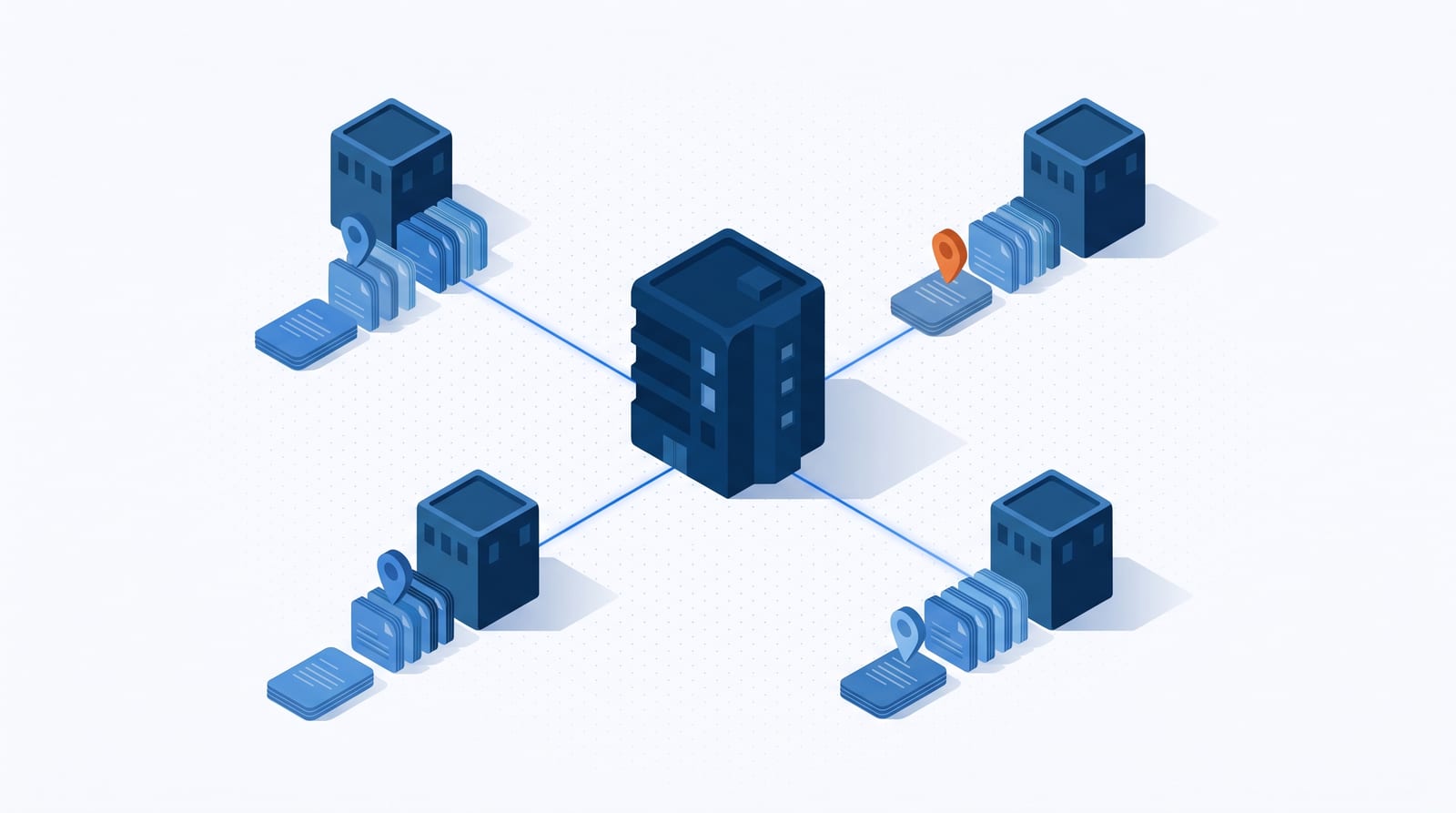
A centralized contract and a single headquarters dashboard bring establishments together on screen, not the documents: each CNPJ remains the owner of its own queue. And different roots are different identities: a group contract does not grant cross tax access.
The alphanumeric CNPJ is already in production, not just on paper. It keeps 14 positions, with the first 12 alphanumeric and two numeric check digits. For the NF-e, NT 2026.004 set July 1, 2026 as the date to switch the CNPJ fields and the access key to alphanumeric, and the National NF-e Portal notices record no postponement of that date. In the distribution service, version 1.40 of NT 2014.002, which exists only to change the CNPJ field type from numeric to character, went into production on July 8, 2026. And on July 31, 2026, the Receita Federal (Brazil's federal tax authority) generated the country's first CNPJ with a letter.
For those already operating, the time to prepare has passed. The Receita issues the new numbers gradually and may still issue digits-only CNPJs, so the first invoice with a letter may take a while to appear in your queue. But it can arrive at any moment, from a recently opened supplier or a new branch. Databases, indexes, input masks, imports and searches need to accept letters today, or a valid document will be rejected by your own system. Old CNPJs remain valid and do not need to be replaced.
Two collectors on the same CNPJ get in each other's way
Different applications querying the same CNPJ need to follow the same ascending sequence. When they don't, the service returns rejection 656, improper consumption, and blocks the CNPJ for one hour.
The detail that turns a small incident into a long one is in the technical note itself: if the application resumes querying before the hour is up, the timer is reset and the count starts over. An HTTP client configured to retry on its own turns a one-hour block into a block that never ends.
The first-day trap follows the same logic: the initial access of a new CNPJ returns code 137, no document found, and forces a one-hour wait before the next attempt. The CT-e has an equivalent rule after the queue empties.
Before any line of code, ask the accountant, the ERP vendor and the previous platform who already queries this CNPJ. Turning on a second collector without mapping the first is what leads, three months later, to someone saying a whole month of invoices disappeared.
Coverage without a denominator is not coverage
A service responding successfully and the marker moving forward proves the connection works. It doesn't prove nothing was missed. The question that separates a serious proof of concept from a demo is simple: captured out of what?
The denominator must come from outside the vendor being evaluated. If the reference list is the one the vendor itself returned, the documents it didn't find remain invisible, which is exactly the original problem. The reference set is built from the union of accounts payable, procurement, the email inbox, authorized exports from portals, the accountant's records and physical receipts.
- The result is published by stratum: full CNPJ, municipality, model and tax period, not as a single number
- The independent inventory was built before the test, not from the vendor's output
- Unsupported documents appear in the report as unsupported, and don't disappear from the denominator
- The observation period separates the recent window from groups prior to any municipal transition
- Capture delay is measured against availability at the source, not just against the issue date
A rate of 100% on twenty invoices is twenty out of twenty in that set: a useful result, and not a measure of national coverage.
From captured invoice to booking
Capturing is the part that has a manual. What comes after doesn't, and that is where projects get stuck.
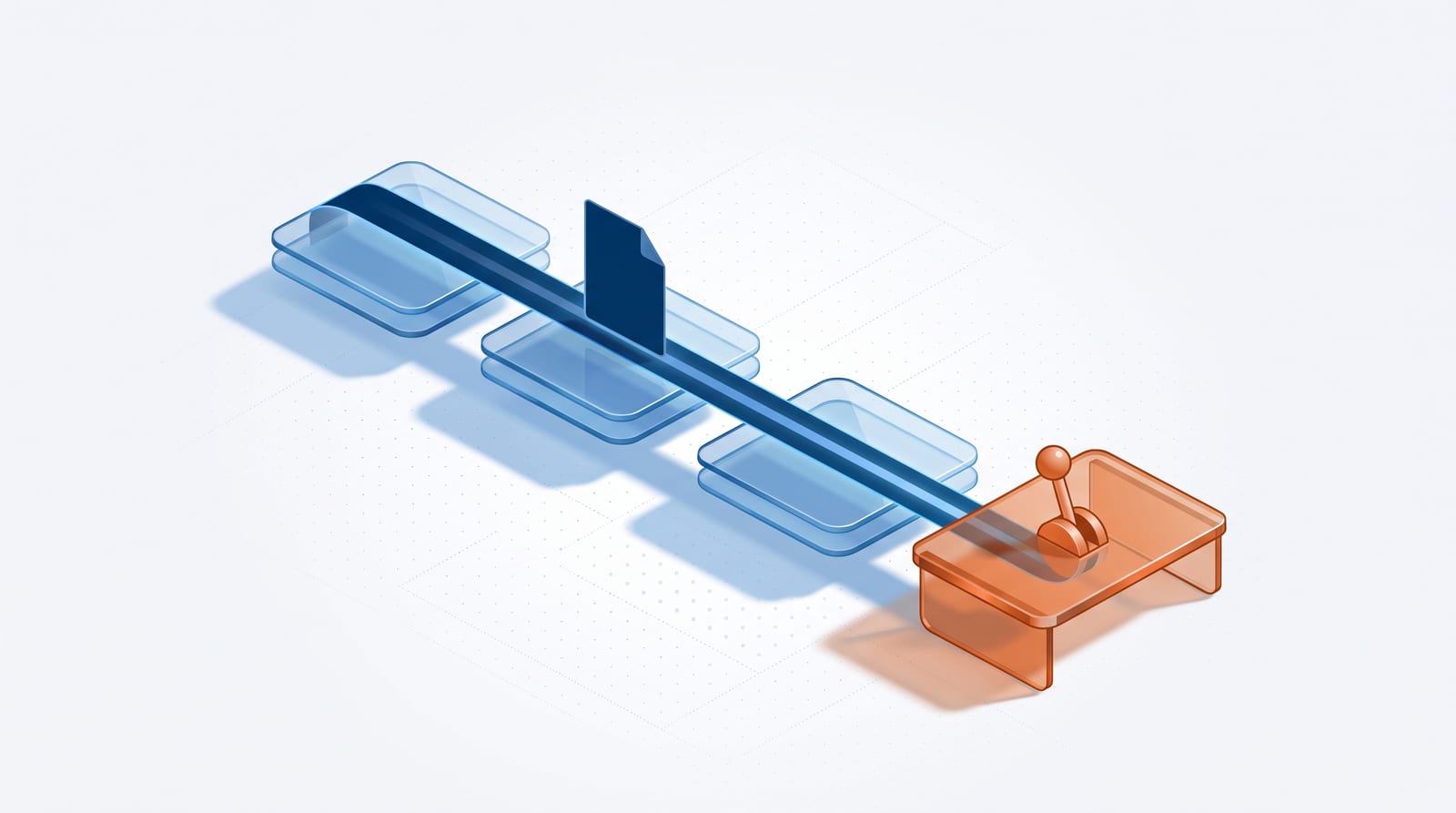
Acquisition, tax validation, commercial reconciliation and financial authorization are four distinct states, and a document can pass one and fail the next. Checking the tax status does not attest that the goods arrived, nor that they match the purchase order.
Automatic extraction and language model triage fit in the first three states. Payment authorization stays outside, with its own approval limits, permissions and trail.
One practice runs through all four steps and costs little: keeping track of which document, in which version and on which date validated each behavior. Outdated official documents are a common occurrence here, and that trail is what lets you reconstruct, months later, why the integration accepts something it rejects today.
What comes next depends on which ERP is on the other side, and inbound invoice integration in SAP Business One is the case with the most documented pitfalls. The municipal part of the NFS-e has its own rules, the math that decides between building, contracting and buying off the shelf has a dedicated article, and what each capture vendor documents is compared with each one's literal wording.
Frequently asked questions
Through the official distribution services, with a digital certificate: one for the NF-e, another for the CT-e and the National Data Environment APIs for the NFS-e. They list what exists against the CNPJ, including what no supplier sent. They have no monthly fee, which is not the same as having no cost.
Not through this service. For the NF-e, sequence numbers are only generated for those who used the service in the last 60 days, and there is no retroactivity for those starting now. Recovering history is a different problem, with another source and another cost.
There are two risks. The first is losing the tax credit embedded in that document. The second, more expensive, is not having made the withholding due on a service invoice: then the company doesn't lose a credit, it takes on a debt that belonged to the service provider.
No. Issuing and receiving are different services, with different authorizations, deadlines and limits. A vendor may cover both, only one, or charge for each differently: it is a contract question, and the answer must be in writing before signing.
The obligation depends on industry and product, as listed in Annex II of Ajuste SINIEF 07/05, and each Brazilian state can extend it. But there is an effect that reaches everyone: after 90 days from authorization with no record at all, the rule deems the transaction to have taken place.
Sources and method
This article is based on a direct reading of official documentation, done on September 8, 2026. The primary sources are NF-e Technical Note 2014.002 v1.40, published on July 3, 2026; CT-e Technical Note 2015.002 v1.05, from November 2024; Technical Note 2020.001 v1.60, dated April 23, 2026; Ajuste SINIEF 07/05 as consolidated by CONFAZ, as worded by Ajuste SINIEF 14/26; the National Data Environment API Taxpayer Manual, version 1.0 of February 12, 2026; and the municipal manuals and notices cited in the text.
Update on November 11, 2026: the section on the alphanumeric CNPJ was rewritten to record that the change is already in force, based on NF-e Technical Note 2026.004 v1.01, the National NF-e Portal notices consulted on this date and the Receita Federal announcement of July 31, 2026 on the first alphanumeric CNPJ. On the same portal, NT 2014.002 v1.40 and NT 2020.001 v1.60 remain the latest published versions, and the 90-day acknowledgment deadline has applied since June 1, 2026.
No authenticated call to the tax services was made for this article, and no vendor product was tested. That is why the text contains no performance comparison, observed coverage rate or vendor recommendation: those claims require a proof of concept with an independent inventory, which is what the denominator section describes.