Índice do artigofaltam 7 min de leitura
This guide started in March as a comparison of GPT-5.4, GPT-5.3-Codex and Spark. None of the three is available in Codex anymore for people who sign in with a ChatGPT account, and GPT-5.5, which came later, was also removed on October 14. The November 10, 2026 version shows what replaced each one and which combination of model, effort and mode to use for each kind of task, in Codex and in Claude Code.
What to do now: if any script, configuration or agent still calls gpt-5.5, gpt-5.4, gpt-5.4-mini or gpt-5.3-codex-spark with a ChatGPT login, switch it to the replacement in the table below before the next scheduled task fails.
What replaced GPT-5.4, GPT-5.5 and Spark in Codex
OpenAI retired the 5-series models in Codex on three dates. The rules below apply to people who sign in with a ChatGPT account; people who use Codex with an API key keep the API catalog, where GPT-5.5 is still available.
| Old model | Removed from Codex on | Replacement recommended by OpenAI |
|---|---|---|
| GPT-5.4 | 08/31/2026 | GPT-6 Sol |
| GPT-5.4 mini | 08/31/2026 | GPT-6 Luna |
| GPT-5.3-Codex-Spark | 09/14/2026 | A model available on your plan (no named replacement) |
| GPT-5.5 | 10/14/2026 | GPT-6.1 Sol (Plus, Pro, Business, Enterprise and Edu) or GPT-6 Luna (Free and Go) |
| GPT-5.3-Codex and GPT-5.2 | Already deprecated earlier | A model from the current lineup |
To pin the model in Codex, the line in config.toml looks like this: model = "gpt-6.1-sol". The same file applies to the app, the CLI and the IDE extension.
Model, effort and mode are not the same thing
Both selectors mix three different decisions, and many wrong choices come from treating all three as "the model":
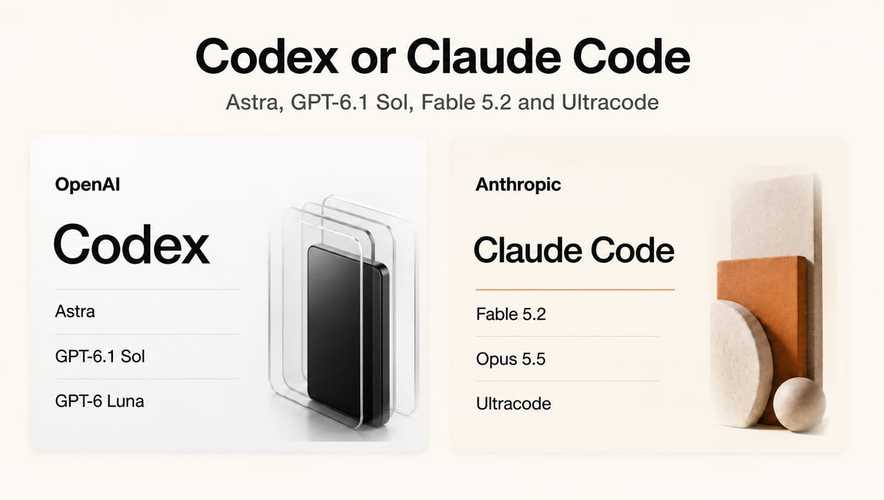
- Model: who runs the task. In Codex, Astra, GPT-6.1 Sol, GPT-6.1 Terra and GPT-6 Luna. In Claude Code, Fable 5.2, Opus 5.5, Sonnet 5.5 and Haiku 5.5.
- Reasoning effort: how much the model thinks before acting. In Codex it goes from Light (Low in the CLI) to Extra High, plus Max. In Claude Code it goes from low to max, through xhigh.
- Execution mode: how the session works. Fast mode and Ultrafast trade cost for speed. Ultra, in Codex, splits the task among subagents running in parallel; Ultracode, in Claude Code, makes Claude build a workflow for each large task.
Changing the effort or turning on a mode does not change the model. It is the same model working in a different way, with different consumption.
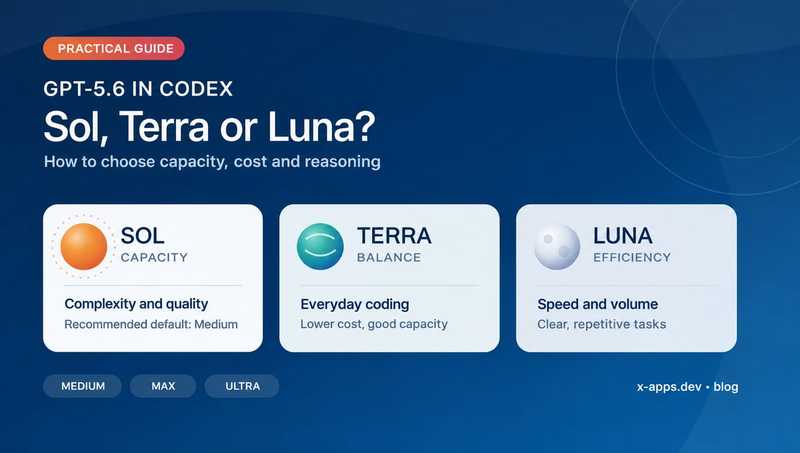
The four Codex models
OpenAI positions the current Codex models like this:
| Model | What it is for | Note |
|---|---|---|
| Astra | The most demanding end-to-end work in code, apps and research | The most capable, and more expensive than Sol. Start at Light |
| GPT-6.1 Sol | Complex, repeated and long work, when cost matters | Performance close to Astra for less; default window of 500,000 tokens |
| GPT-6.1 Terra | Writing, reading images and screens, computer use | Fast and efficient; OpenAI does not list it in the IDE extension |
| GPT-6 Luna | Focused, high-volume tasks: extraction, classification, structured summaries, well-scoped code | The most efficient. Start at High; accepts Max, but not Ultra |
In practice, GPT-6.1 Sol is the starting point for people who code every day: it is the official replacement for GPT-5.5 and delivers close to Astra at a lower cost. Save Astra for problems where a mistake is expensive, such as investigating a failure with no clues or a change that cuts across several systems. Use Luna when you know exactly what a good result looks like and need to repeat the task many times, including in subagents that only read code and summarize it.
GPT-6 Sol, from the generation before 6.1, is still in Codex: it is the replacement OpenAI recommends for GPT-5.4 and it supports Fast mode. If you are choosing today, GPT-6.1 Sol is the recommended version.
Spark's old role, near-instant answers for small tweaks, is now handled in two ways: a smaller model at low effort, or a larger model with Fast mode on.
Fast mode, Ultrafast, Max and Ultra in Codex
| Control | What it does | How much extra it costs |
|---|---|---|
| Fast mode | Speeds up the same model (Astra, GPT-6.1 Sol, GPT-6.1 Terra, GPT-6 Sol and GPT-6 Luna) | Uses the plan allowance at 2.5x the standard rate; purchased credits at 2x |
| Ultrafast | Generates tokens up to 8x faster on Astra; also works with GPT-6.1 Sol | Allowance at 8x; credits at 6x. Only on the US$ 500 Pro plan and on eligible Enterprise and Edu |
| Max | Gives a single task more reasoning time | Consumes more, because the model reasons for longer |
| Ultra | Splits the task among subagents in parallel | Each subagent works on its own, so consumption tends to grow with the number of workstreams |
OpenAI's own documentation warns that most tasks need neither Max nor Ultra. Max is for the hard, sequential problem, where depth is worth more than time. Ultra is for work that splits into parts that run on their own, such as migrating several independent modules. If the task does not split, Ultra tends to increase consumption with no gain. The detailed credit math per model and effort is in our guide to Codex credits, and what changes with the US$ 500 plan is in ChatGPT Pro 500 and Ultrafast.
The Claude Code models
In Claude Code, the aliases point to the newest version of each family when you use the Anthropic API. On other providers, such as Amazon Bedrock and Microsoft Foundry, some aliases still point to earlier versions.
| Model | Alias | What it is for | Default effort |
|---|---|---|---|
| Fable 5.2 | fable | Tasks bigger than one sitting: root cause investigation, production failure, architecture decision | medium |
| Opus 5.5 | opus | Complex reasoning: broad refactoring, hard debugging | medium |
| Sonnet 5.5 | sonnet | Everyday programming | medium |
| Haiku 5.5 | haiku | Simple tasks, fast and efficient | medium |
Fable 5.2, released on November 9, is never the default model: you have to choose it with /model fable, and it requires Claude Code version 2.1.321 or later. Depending on the plan, Fable usage comes out of usage credits rather than the subscription allowance; in that case the selector shows the notice "Requires usage credits" on the Fable line. On the API, it costs US$ 8 per million input tokens and US$ 40 per million output tokens, 20% below Fable 5.1. What this changes for pay-as-you-go users is in our analysis of Fable 5.2.
For Opus 5.5, Anthropic states that the medium level matches or beats Opus 5 at high in coding tests. If you are migrating from Opus 5, start at medium instead of repeating the level you used before.
Effort, Ultracode and Fast mode in Claude Code
The Claude Code documentation describes each level like this:
- low: quick exchanges where you review each result, like a draft or a rename.
- medium: the default for current models; fits everyday work with a clear scope, like implementing a feature.
- high: when verification matters and edge cases are likely, like fixing a bug in an existing codebase.
- xhigh: deeper reasoning, with more tokens.
- max: hard problems you want Claude to solve without you, like hunting for vulnerabilities. Anthropic itself warns that the gains shrink and that the model tends to overthink.
Ultracode is not an effort level. It is a setting that makes Claude build a workflow for each large task, at any level. Turned on with claude --effort ultracode, it starts at xhigh. For a one-off question that needs more reasoning, just write ultrathink in the prompt, without changing the whole session. The cost and quality curve for each level, measured on Opus 5, is in our article on Claude's effort levels.
Fast mode makes the model up to 2.5x faster, with the same result and a higher price per token. It is available on Fable 5.2 and Opus 5.5, and does not exist on Sonnet or Haiku. On subscription plans, it only runs on usage credits, outside the plan allowance.
| Model in Fast mode | Input (US$ per million tokens) | Output (US$ per million tokens) |
|---|---|---|
| Fable 5.2 | 16 | 80 |
| Opus 5.5 | 8 | 40 |
| Opus 5 and Opus 4.8 | 10 | 50 |
If you still use Opus 4.8 with Fast mode, you need to switch by November 30, 2026, when Anthropic removes that combination and starts rejecting the calls.
Which setup to choose for each task
| Situation | In Codex | In Claude Code |
|---|---|---|
| Everyday programming | GPT-6.1 Sol at default effort | Sonnet 5.5 or Opus 5.5 at medium |
| Bug in an existing codebase | GPT-6.1 Sol at High | Opus 5.5 at high |
| Failure with no clues, architecture decision | Astra, raising the effort if needed | Opus 5.5 at high; Fable 5.2 if the result falls short |
| Hard, sequential problem | Max on the chosen model | xhigh or max |
| Large task that splits into stages or workstreams | Ultra | Ultracode |
| Reading a repository, summaries, simple tasks | GPT-6 Luna | Haiku 5.5 |
| Small tweak with a fast answer | Smaller model at low effort, or Fast mode | Sonnet 5.5 at low, or Fast mode on Opus 5.5 |
Neither tool wins at everything. The result depends more on the repository, the tests, the instructions saved in the project and the clarity of the request than on choosing between OpenAI and Anthropic. For a team, the test that counts is running three or four real tasks from its own code on the two candidate setups and comparing results and consumption.
Checklist to avoid mistakes in the selector
- Configuration, script or agent with
gpt-5.5,gpt-5.4orgpt-5.4-mini: switch to the replacement in the first table. Withgpt-5.3-codex-spark: choose a model available on your plan. - Codex for everyday work: GPT-6.1 Sol.
- Repetitive task with a well-defined result: GPT-6 Luna.
- Claude Code for everyday work: Sonnet 5.5 or Opus 5.5 at medium.
- Long, ambiguous task in Claude Code: Opus 5.5 first; Fable 5.2 if the result falls short, checking whether your plan charges it to usage credits.
- Opus 4.8 with Fast mode: switch to Opus 5.5 by 11/30/2026.
- Max, Ultra and Ultracode only when the task calls for them; most of the time, it does not.
References
- Models, ChatGPT Learn (OpenAI), accessed on 11/10/2026
- Speed, ChatGPT Learn (OpenAI), accessed on 11/10/2026
- Model configuration, Claude Code Docs, accessed on 11/10/2026
- Speed up responses with fast mode, Claude Code Docs, accessed on 11/10/2026