
Índice do artigofaltam 9 min de leitura
The language model has become a rental. Any competitor can subscribe to the same one, on the same day, at the same price. What they cannot subscribe to is what your company has written over the last ten years.
There is a conversation that repeats itself in almost every company that sells knowledge: which AI tool to buy. It is the wrong question, and you can prove it with an invoice.
In August 2026 Thomson Reuters launched its own language model, named Thomson. The disclosed investment was US$ 40 million over two years. The part that matters: the model's final training cost US$ 450,000. Just over 1% of the total. Everything else was archive, curation and people who know how to read that material.
This article is about that "everything else". About what your company already has stored, why it is the only AI asset a competitor cannot buy, and what needs to happen before you plug any model into it.
And to get ahead of the lazy reading: an archive is not a backup. It is not the shared folder. And the result is not a chatbot that reads PDFs.
Article summary
- Thomson Reuters spent US$ 40 million building its own model, and the final training came to US$ 450,000. The money went into the archive, not the computing.
- The model is a rentable commodity. The archive is what differentiates two companies in the same industry using exactly the same AI.
- A raw archive does not work. Before plugging AI into it, you need to remove confidential information, identify the document type and define who can access what.
- Permissions come before content. Reorganizing access after everything is already indexed is the most expensive mistake on this journey.
The Thomson Reuters bill shows where the value is
When a company with decades of legal content decides to build its own model, it exposes the cost structure the rest of the market does not see. And that structure is uncomfortable for anyone who thinks AI is a question of computing power.
Three details reinforce the point. The model started from an open foundation, not from research from scratch: according to LawSites coverage, the most recent base was Qwen 3.5, and the team switched starting points about six times as better models appeared. In other words, the piece everyone thinks is the product was the disposable piece.
The second detail: the model was trained on less than 10% of the company's own content. Technology was not lacking. What was lacking was a curated archive, which is slow work.
The third is in what the company's chief technology officer, Joel Hron, said at the announcement: start from a good foundation, specialize deeply for the work that matters, and you build something capable, more efficient and under your control. The word that carries the argument is "specialize". Specialization comes from accumulated material, not from a subscription.
Source: Thomson Reuters press release and LawSites coverage, August 24, 2026.
What this unlocks for you: if most of the cost of a specialized model is the corpus, then the company that already has a corpus is closer to the result than it imagines, and the one that only has a subscription is further away than it would like.
What counts as an archive in your company
An archive is completed work plus the judgment embedded in it. It is not the file folder: it is the set of documents that prove how your firm solves a problem, with the choices nobody wrote in the manual.
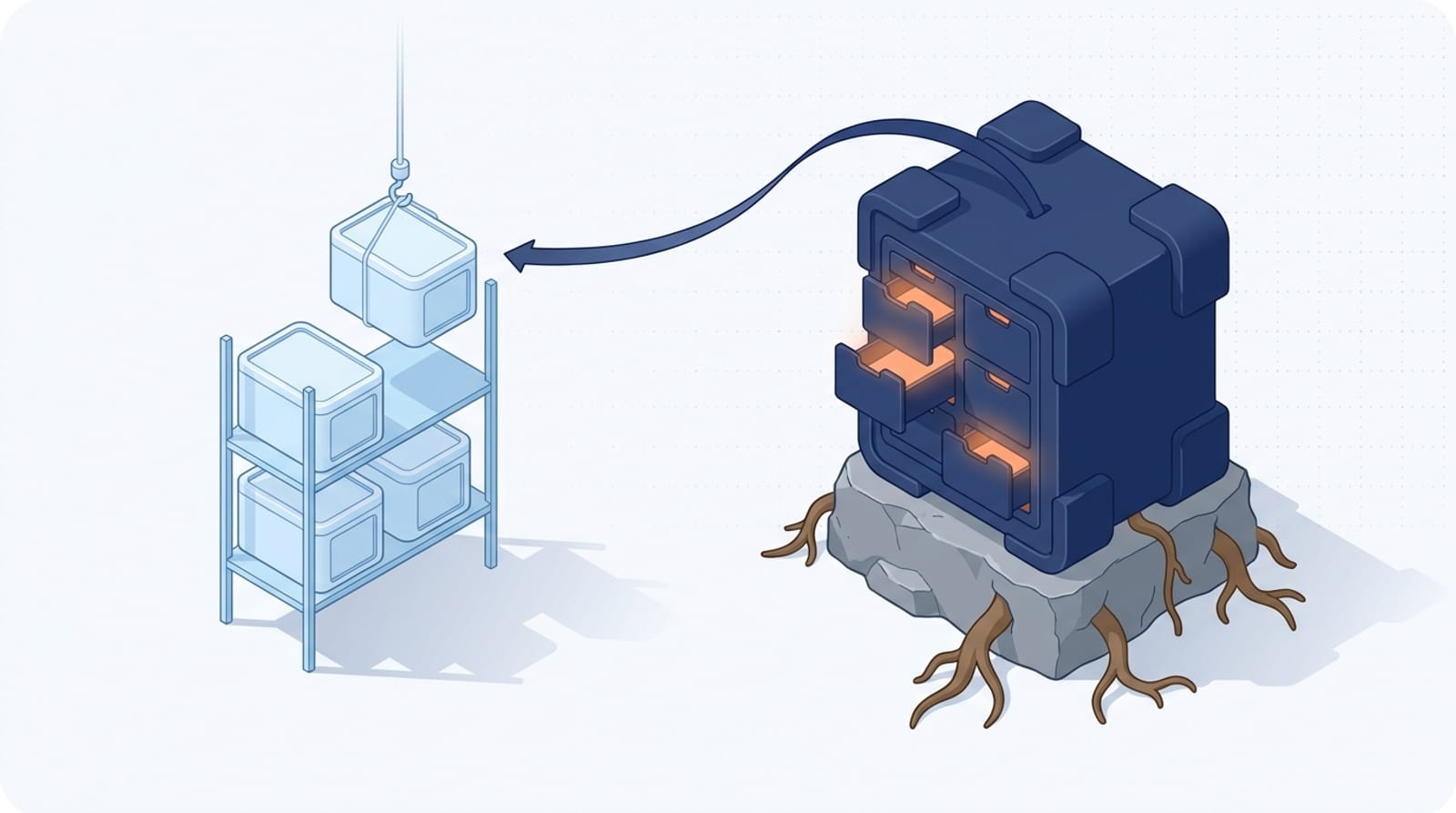
The practical difference between the two sides shows up in what happens when you cancel. Cancel the model subscription and everything is back to normal within a week, because your competitor uses the same one. Lose the archive and you lose the reason the client chose you.
That is why the question "which AI should we buy" yields little. It treats the rentable part as if it were the strategic decision.
The format changes by industry, the nature does not:
- Law firmsDrafts, filed petitions and the history of how the authority ruled.
- AccountingOpinions, tax positions defended and what was accepted in practice.
- ConsultingPrevious diagnoses, proprietary methodology and what went wrong.
- Engineering and architectureTechnical specifications, inspection reports and projects that passed approval.
- Insurance and creditClaims adjustment, committee opinions and decision criteria.
- Agencies and studiosBriefs, approved scripts and the result each piece delivered.
- ManufacturingProcedures, nonconformities and maintenance history.
- Human resourcesEvaluations, career paths and what makes a good hire there.
Notice what they all have in common: they are decisions made by experienced people, recorded in documents, about concrete cases. That is exactly the material a generic model does not have and cannot invent without getting it wrong.
A warning comes with it: turning the archive into production reduces the time of each delivery, and less time only becomes margin if the pricing model is not hourly. Otherwise the whole gain goes to the client, in the form of a smaller invoice.
Why the newest model is not a differentiator
Because it reaches everyone on the same day. When a lab releases a better version, your competitor upgrades the subscription the same afternoon you do, at the same list price.
That changes what "being ahead" means. Being ahead is no longer about having access to the technology; it is about having something to put inside it. And the Future of Professionals 2026 report, from the Thomson Reuters Institute, with more than 1,800 professionals from 62 countries, shows that the tool has arrived and the plan has not: 74% use AI several times a week. And, according to the Thomson Reuters press release that accompanied the report, almost one in five say their organization still has no clear strategy on the subject.
Source: Thomson Reuters Institute, Future of Professionals 2026, and Thomson Reuters press release, both from June 22, 2026.
The full picture is worse than the first sentence suggests. Even where the company or department has a declared AI strategy, 35% of professionals say day-to-day practice does not match it. And 34% admit to using AI tools that the organization has not approved and cannot see. In other words: in some companies the strategy does not exist, and in many of those that have one, it has not reached daily work. Everyone has the tool. What sets companies apart is what they put inside it.
A raw archive does not work: what needs to happen first
Three things, in this order, and none of them can be bought with a subscription.
- Remove what cannot circulate: client names, amounts, personal data and strategic information that identifies the operation. An anonymized document can feed the entire system; the original cannot.
- State what each document is: type, subject, year, who produced it and whether it is still valid. Without this the system returns the revoked opinion with the same confidence as the current one.
- Define who sees what, by project and by person, before indexing anything.
The order is not decorative. Classifying before anonymizing means reclassifying everything later, and indexing before defining permissions means reindexing. Each inversion costs an entire round of work.
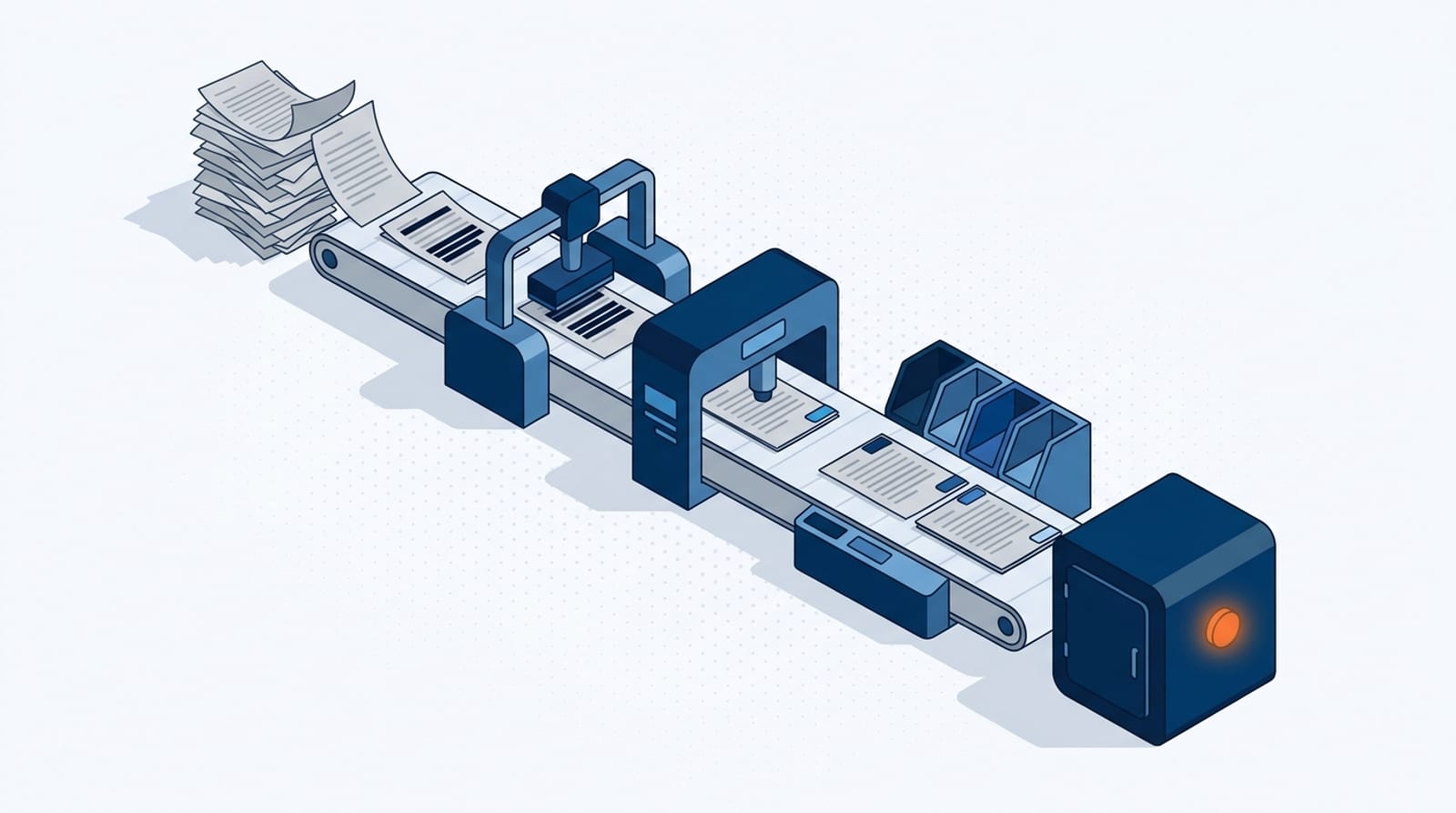
This step is usually underestimated because it looks bureaucratic. It is the step Thomson Reuters still has not finished after US$ 40 million: less than 10% of the content went into training. If it is like that there, it will be like that here too.
What this unlocks: curating the archive is the difference between a system that returns a usable draft and one that returns plausible text nobody can sign.
Permissions come before content
This is the rule that saves the most money the following year, and the most ignored one in the first month.
An AI assistant connected to your environment sees what the user sees. In Microsoft 365, for example, Copilot searches content through Microsoft Graph while respecting the permissions the user already has in SharePoint, OneDrive, Outlook and Teams. That is good news and a trap at the same time: if your shared folder is open to everyone today because "we are few and we know each other", the AI will inherit exactly that openness, only with an interface that finds everything in seconds.
There is a second reason, purely economic. Migrating permissions after the archive is already indexed means redoing the folder structure, regrouping people, reindexing and revalidating. It is the kind of rework that costs more than the original implementation. Defining it first is cheap; fixing it later is not.
The minimum design that works for a small team has four pieces:
| Piece | What it solves |
|---|---|
| Library per project | Access is granted per piece of work, not to whoever happens to be well liked. A sensitive project is isolated by design. |
| Groups, not individuals | People joining and leaving becomes a one-click operation, with no hunting for scattered permissions. |
| Sensitivity label | The document carries its own classification and takes the restriction with it when it is copied or sent. |
| Audit trail | Answers who accessed what and when. It becomes a requirement the day someone asks. |
The boundary between what leaves the company and what does not
Write the boundary into the system, not into people's heads. While the company is you and two others, personal discipline works. By the fifth hire it no longer does, and the Thomson Reuters Institute report shows why: 34% of professionals admit to using AI tools their organization has not sanctioned, in a way it cannot see.
This is not indiscipline, it is people trying to deliver. The person has a deadline, the official tool is bad for that task, and there is a better one a login away. The answer that works is not banning it: it is providing the official path for each type of data and making the wrong path technically difficult.
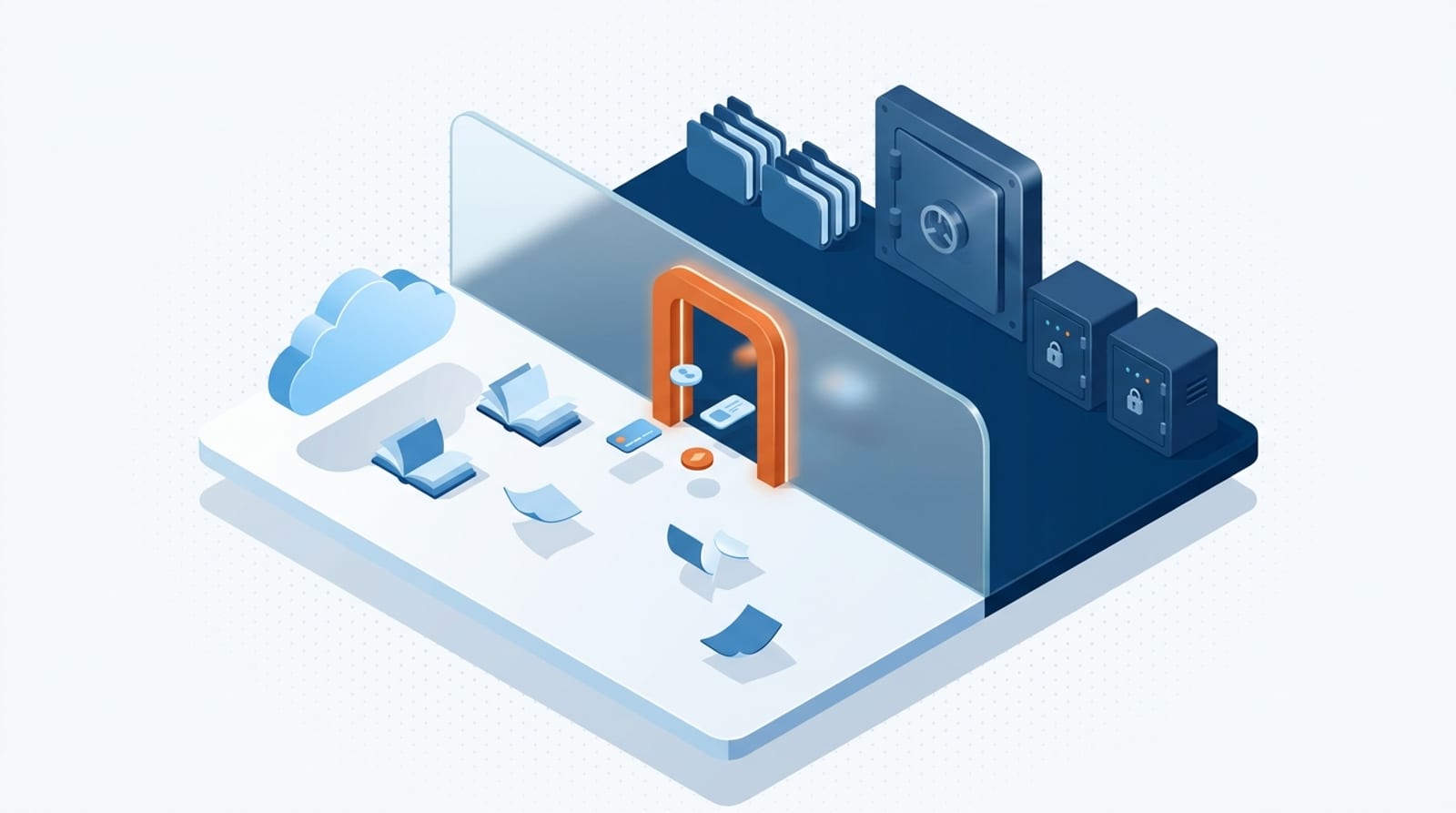
A split that usually works: public material and open research can circulate in general-purpose tools, because there is no confidentiality to protect. Documents with client data stay in the controlled corporate environment, where permissions are inherited and the trail exists.
The gain is twofold. You use the best tool for each type of task and you get a simple sentence to tell the client about where their material lives.
It is worth noting a fact about the corporate environment, because it changes the conversation with clients: Microsoft documents that prompts, responses and data accessed via Microsoft Graph are not used to train the foundation models. Having that in writing from the vendor is different from assuming it.
The archive is yours. The model is rented. Treat them that way
The question every owner asks, and rightly so, is: if I build this today, who will I be locked into?
The honest answer separates three layers. One is disposable by nature, one is replaceable with effort and one is yours.
Whoever keeps the archive in an open format, holds the business rules in their own code and versions prompts outside the platform greatly reduces the cost of switching clouds or models. Whoever writes the logic inside a proprietary tool, in its interface, redoes everything when they want to leave.
That said, plainly: architecture reduces the cost of leaving, it does not guarantee you can leave. Ownership of the code, the right to use what was built and the obligation to hand it over if the relationship ends are contract clauses. If that is not written on paper, no technical design solves it.
How much of this you can do on your own
A lot, and more than most people imagine. Current models write reasonable utility code, and it is common to see operations managers building a public data extractor or a file organization routine on their own, without ever having programmed. That path is legitimate and cheap.
It has a predictable stopping point.
Works well on your own
- Isolated routines on public data, with no confidentiality involved.
- Organizing and initially classifying your own archive, which requires the judgment of whoever knows the material.
- A prototype to find out whether the idea holds up before investing.
- Refining the instructions, done by whoever operates the system and knows what is wrong in the output.
Starts to require engineering
- A per-project permission model, which fails silently and expensively.
- Automatic verification of what the AI produces against a source of truth.
- Tests that prove today's change did not break what worked yesterday.
- Continuity: a system that survives its builder going on vacation.
The item that surprises people most is the third. At X-Apps, commercial proposal generation goes through more than a thousand automated tests, and it exists precisely because the previous version, without that safety net, started making mistakes as rules piled up. An agent with ten rules is docile; with a hundred, it forgets the first ones. Without tests, nobody notices until the client does.
The same logic applies to the team: a system only one person understands is a continuity risk, whether that person is an employee or the owner.
Where to start without stopping the operation
Start with the piece that does not touch confidential information and returns a visible result, usually the automated collection of public data that is done by hand today. That keeps the operation running while the slow work on the archive happens in parallel.
Two choices make a difference at the start. The first: size for the volume you actually have. An architecture designed for thousands of executions a day in an operation that runs dozens charges a lot to stay on unused. The second: whoever operates the system needs to be able to adjust it. Calibration done by whoever reviews the output every day is worth more than a quarterly improvement cycle.
Sources and method
Research from August 31, 2026, reviewed on November 11, 2026. The data on the Thomson model comes from the Thomson Reuters press release and LawSites coverage from August 24, 2026. The percentages on adoption, strategic direction and use of unsanctioned tools come from the Future of Professionals 2026 report, from the Thomson Reuters Institute, and the press release that accompanied it, published on June 22, 2026, with 1,816 professionals in 62 countries and fieldwork in March and April 2026. The information on grounding and data use in Microsoft 365 comes from Microsoft's technical documentation. Thomson Reuters and Microsoft are companies external to X-Apps and have no commercial relationship with this content.
Frequently asked questions
No. Loose documents in a shared folder are dead files. An archive is curated material, with confidential information removed, document type identified and permissions defined. Without that work the AI answers poorly and also answers people who should not see the content.
In most cases, no. Training a model is expensive and rarely necessary. The normal path is to index the archive and hand it to the model at question time, keeping each document's permissions.
A chatbot that reads PDFs answers questions. A curated archive feeds the production of work: drafts, opinions, proposals and reports that come out partly ready because the system knows how your firm does things.
With rules written into the system, not with personal discipline. Environments separated by data classification, sensitivity labels and technical blocking of outbound data are worth more than a policy nobody reads.
It depends on where the business rules and the archive live. An archive in an open format, rules in your own code and prompts versioned outside the platform greatly reduce switching costs. The exit guarantee, however, is contractual, not architectural.
Yes, and it usually manages faster, because it has fewer legacy systems and fewer people to align. The common mistake is sizing the architecture for a volume the company will never have.