Índice do artigofaltam 7 min de leitura
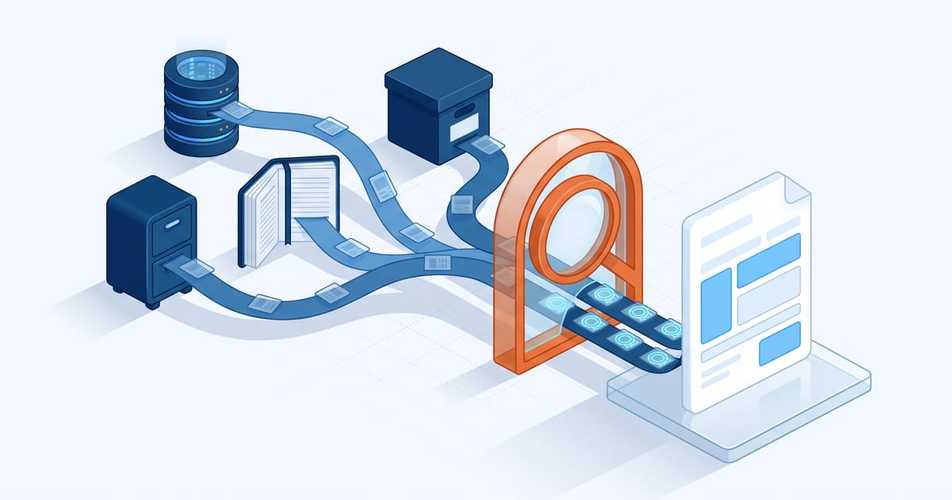
Nobody hires a specialist to copy a company registration number from a website into a form. But that is where a good part of the deadline goes.
Try the exercise with a typical document from your company: a technical proposal, a regulatory form, an expert report, a legal filing, a due diligence report. Split the time into two piles: time spent thinking and writing, and time spent looking for data, checking data and typing data into fields.
In most cases the second pile is large, sometimes larger than the first. And it is made up almost entirely of information that is already public, available on some portal, waiting for someone to open twenty tabs.
This article is about automating that half. It is the half with no confidentiality and no professional judgment at stake, which makes it technically simple to solve, and it is precisely the one that usually gets pushed back.
Article summary
- In business documents, the bottleneck is rarely the writing. It is collecting, checking and typing data that is already public.
- Asking a language model to look up this data does not work: it fills in plausible identifiers with the same confidence as when it is right.
- The split that works has three roles: a deterministic bot collects, AI writes, a system checks the text against the collected data.
- Since it does not touch confidential data, this is usually the first possible delivery of an AI project, running while the internal archive is still being processed.
Half of a document's deadline is digging
The anatomy repeats with few variations, whatever the sector. The work that requires professional training is squeezed between two layers of manual labor.
What makes this expensive is not difficulty, it is attention. Transferring thirty fields between windows is the task where qualified people make the most mistakes, because it is boring enough for attention to drop and important enough for the error to cost.
What this unlocks: automating the collection and transfer steps does not replace anyone. It gives back to the professional the time they spent as a typist, and reduces the most common class of error in the process.
Why asking AI to look up the data does not work
Because a language model does not search: it completes. When information is missing, it produces the most likely pattern, and a made-up CNPJ has exactly the format of a real one. Case number, revenue figure, registration date and partner name have the same problem: they are identifiers, and a plausible identifier is indistinguishable from a correct one for someone reading quickly.
This is not a defect to be fixed with a better model, it is the nature of the tool. A language model is excellent at interpreting, summarizing, classifying and writing. It is the wrong tool to guarantee that a field matches the official record.
The split that works: a bot collects, AI writes, a system checks
The mature architecture separates inference from verification. AI is free to decide and write only in the middle of the path: before it, deterministic code collects; after it, more deterministic code validates each verifiable claim against the source it came from.
The rule that holds the design together is simple: the model never makes up data because it never needs to look for it. It receives information already collected and checked, and its job is to write and adapt. If the final text mentions a number that is not in the database, the checker flags it before the document reaches anyone.
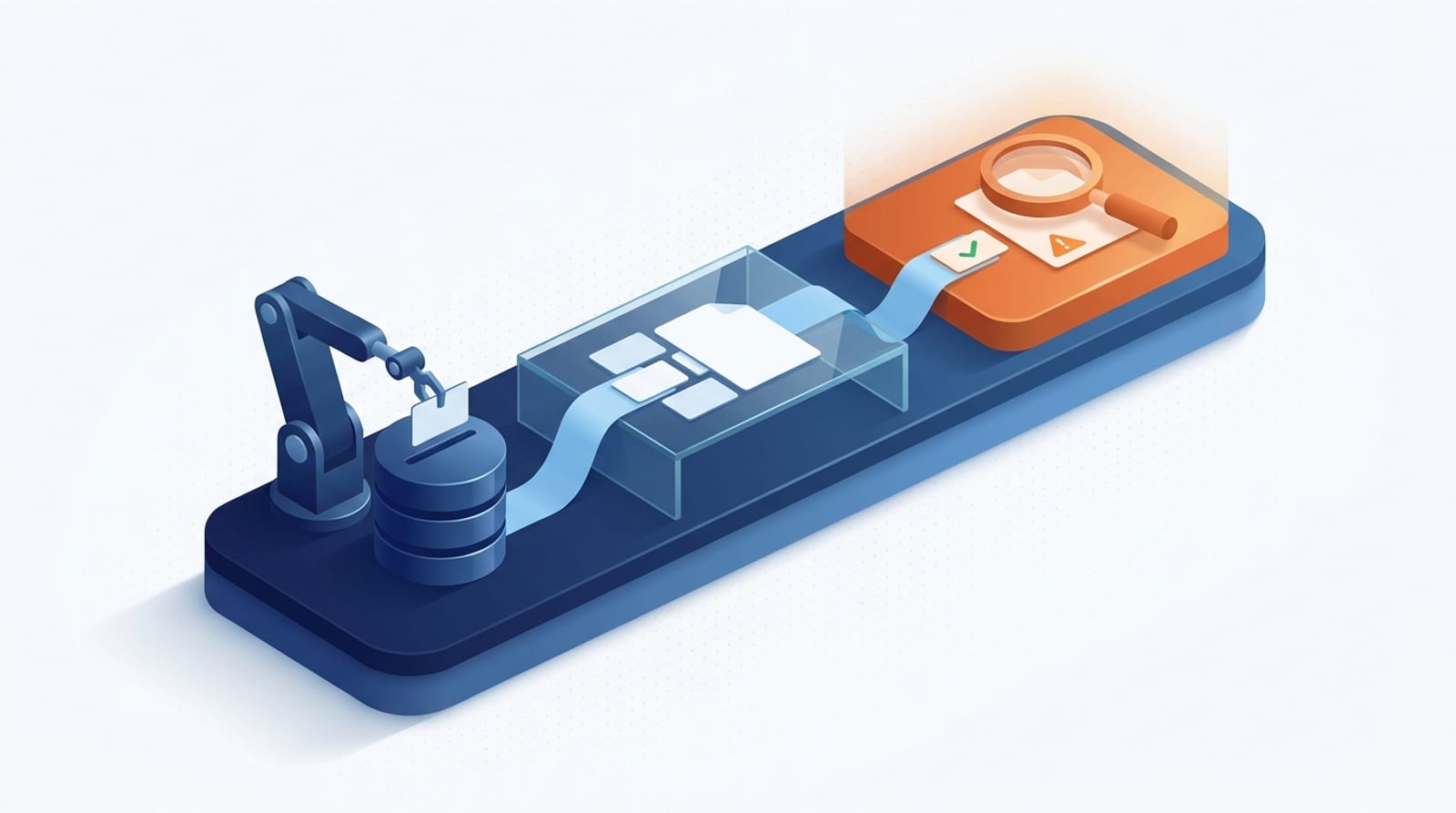
Notice that the checker is the piece almost every prototype skips, and it is the one that decides whether the system can be used in production. Without it, you have a convincing draft generator. With it, you have an auditable process.
It is also the cheapest piece to build, because comparing two values does not require intelligence: it requires code.
What is already public and almost nobody automates
Brazil publishes more structured data than companies' routines take advantage of. Receita Federal (Brazil's federal tax authority), for example, makes CNPJ open data available in the Open Data section of the gov.br portal, with separate files for companies, establishments, partners and enrollment in Simples Nacional (Brazil's simplified tax regime for small businesses), and the field layout documented in public metadata. It is the same information someone looks up manually, one query at a time.
- Company registryLegal name, status, address, business activity and shareholders.
- Public company filingsFinancial statements and notices published under regulatory obligation.
- Official publicationsActs, public notices and decisions published in official gazettes.
- Public court recordsDocket entries and filings in cases that are not under seal.
- Public procurementTenders, contracts and amounts of government purchases.
- Corporate registry and actsAmendments to articles and ownership recorded at the state commercial registries (juntas comerciais).
Not every source is the same, and that difference defines the effort. A source with structured open data, as a file or a documented API, is stable and cheap to consume. A source that exists only as a web page requires scraping, breaks when the site changes layout and needs maintenance. It is worth mapping both categories before estimating anything.
What this unlocks: a collector on a structured source eliminates the digging step once and for all, for all future cases, not just for today's document.
How much it costs to keep a collector running
Little, as long as it does not require a machine running and waiting for work. The model that pays off in a low-volume operation is pay-per-execution billing.
There is a catch in this model worth knowing before designing the flow: Microsoft documents that billing counts every execution, including retry attempts and loop iterations. An action with five retries is billed as six, and a loop over ten items generates eleven executions. A badly designed collector, which scans entire lists when it could search directly, gets expensive even without infrastructure.
A checked field is worth more than a filled field
This is the difference between a system that saves time and one that also reduces risk: storing, alongside each piece of data, where it came from and when it was read.
It looks like an engineering detail and it is a business decision. With the source recorded, three things become possible. The first is answering a question about a document without redoing the research, because the answer is stored. The second is detecting when a piece of data has gone stale, by comparing the read date with how often that information usually changes. The third is review by exception: instead of checking thirty fields, the reviewer looks at the three the system flagged as divergent or outdated.
| What to record | What it is for later |
|---|---|
| Data source | Prove where it came from, without redoing the search. |
| Read date | Know when the information went stale and needs to be fetched again. |
| Raw value and processed value | Audit the transformation when the result looks odd. |
| Check status | Direct human review to the fields that need attention. |
Why this is the best first delivery of an AI project
Because it is the only part that does not depend on the slow work. Organizing the internal archive, removing confidential information from old documents and defining permissions take months and produces nothing visible along the way. Public data collection produces results in the first week of use.
Why it fits first
- It works on public data, so it does not depend on anonymization
- Small, verifiable scope, with a result that is right or wrong
- Noticeable gain from the very first document produced
- Does not require changing the approval process or the client contract
What it does not solve
- The writing itself, which depends on a processed archive of drafts
- Professional judgment, which remains human
- Sources that exist only as web pages and break when the site changes
- Data that is not public and has to come from the client
What breaks, and how not to break with it
A collector is not software you install and forget. It depends on third-party systems that change without notice, and the way it fails is what separates a good one from a dangerous one.
The most important rule: fail loudly. A collector that does not find the data needs to stop and alert, never return an empty field or last time's value. An empty field becomes an incomplete document that someone rushes to complete; an old value becomes a silent error nobody notices. Both are worse than the interruption.
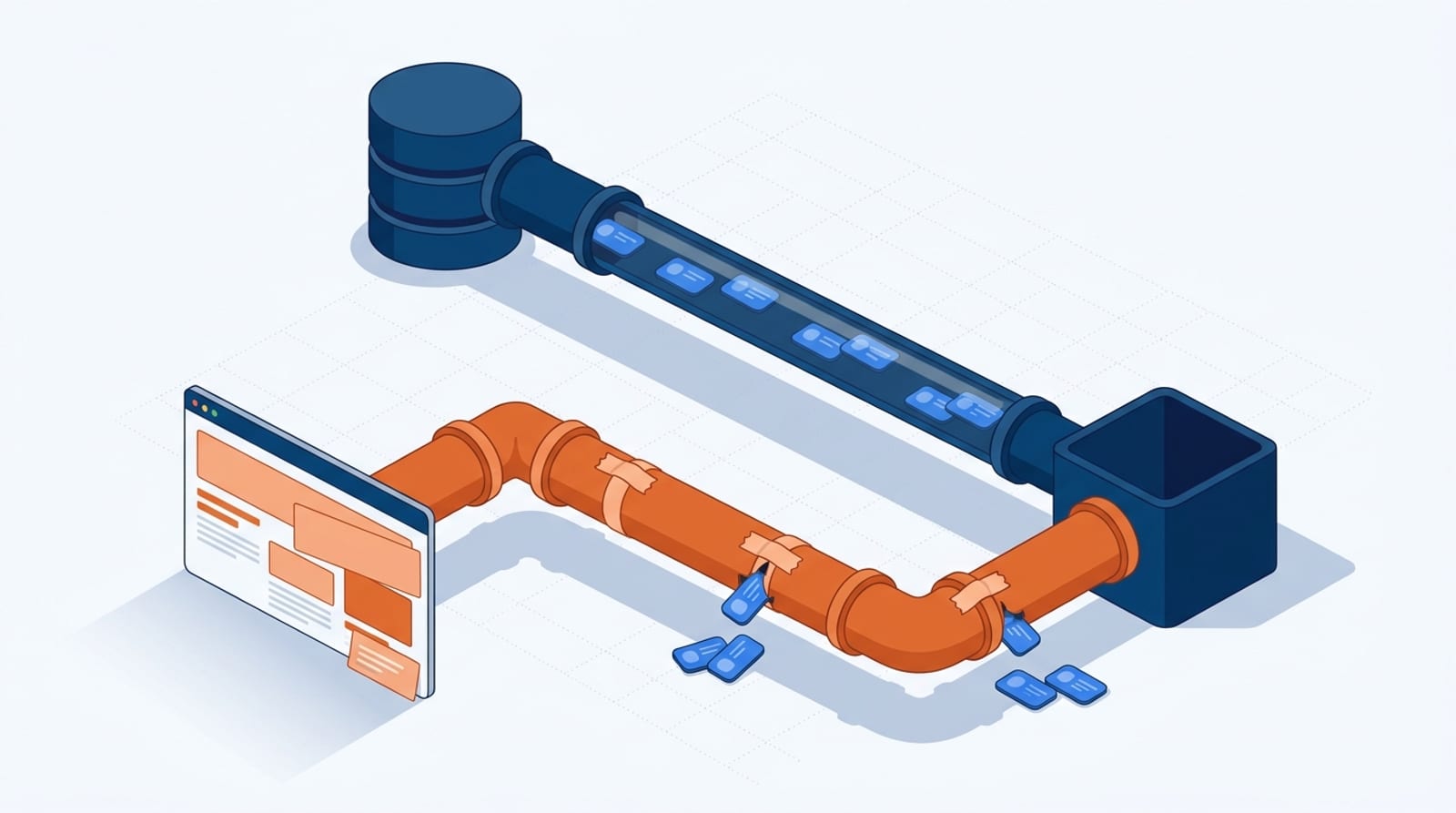
The other three: prefer a structured source over scraping whenever one exists, respect the source's usage limits so you do not get blocked, and monitor the success rate over time, because a gradual drop usually signals a site change before it breaks completely.
The difference between the two pipes shows up in maintenance, not in the first week. Both work on delivery day.
How to start
Start with a single document, and with its public fields. The roadmap below takes you from a chosen document to a collector in use, without going through any big architecture decision.
- Choose a document your company produces often, and list all the fields it consumes.
- Mark which fields are public, which come from the client and which depend on judgment. Only the first column goes into the initial scope.
- Separate structured sources from web pages, because the effort and stability of the two are different.
- Build the collector with source and date recording from the first version, not later.
- Measure the time before and after on the same type of document, with the same professional. That number is what supports the next stage of the project.
The last step is the one that is usually missing. Without measuring the starting point, the gain becomes an impression, and an impression does not get budget approved for the next phase.
Sources and method
Research from August 31, 2026, revised on November 11, 2026. In the revision, the Azure Logic Apps billing model was checked again on the official pricing page (which still lists the first 4,000 actions as free on the Consumption plan) and in Microsoft's documentation, still dated July 10, 2026. Neither source says this tier renews every month: the documentation talks about an initial number of free built-in operations per Azure subscription, and the text stopped calling it monthly. The architecture diagram now shows the checker outside the AI step, as the text always described. Information on CNPJ open data comes from the Receita Federal portal, Open Data section, and from the public layout metadata document. The pay-per-execution billing model, the initial tier of included built-in actions and the rules for counting retries and loops come from those same two sources. Microsoft is a company external to X-Apps and has no commercial relationship with this content. The categories of public sources cited in the corresponding section are examples of source types, and the availability and format of each vary by agency.
Frequently asked questions
You can ask, but the result is not reliable for identifiers. A language model fills in a CNPJ (Brazil's company registration number), case number or amount with the most likely pattern when it does not have the information, and does so in the same tone it uses when it is right. Collection needs to be deterministic.
The bot searches in the right place and returns exactly what it found, with the source. The agent interprets, decides and writes. The architecture that works uses both: the bot brings the data, the AI writes on top of it, and the system checks the result against the original data.
No, and that is precisely why it is usually the first delivery. Collection works on public sources, which makes it possible to put something into production while the processing of the internal archive, which is slow, happens in parallel.
The collector breaks, and it should break visibly. A well-built collector fails loudly and raises an alert, instead of silently returning an empty or outdated field. A source with structured open data is more stable than screen scraping.
At low volume, very little, as long as it does not require a machine running all the time. Pay-per-execution automation services charge per operation executed, and some include a free tier of executions that covers small operations.
No. It replaces typing and field-by-field checking. Review becomes about content and judgment, which is where the professional adds value, instead of whether the number was copied correctly.