
Índice do artigofaltam 8 min de leitura
"Signing online" is not pasting a scribble onto a PDF. It is building evidence: authorship, integrity, date and context, in a way anyone can verify.
The question comes up all the time in companies, fintechs, marketplaces, SaaS businesses and even law offices:
"Is an electronic signature valid?", "do I need an ICP-Brasil certificate?", "what is the difference between an electronic signature and a digital signature?".
The short answer: yes, it is valid, but "valid" does not mean "risk-free". The difference between a contract that holds up and one that falls apart in a dispute usually comes down to one thing: the evidentiary strength (and traceability) of the signing process.
Important notice: this content is technical and informational. It is not legal advice. For specific cases, check with the responsible lawyer and with your organization's compliance team.

What you will learn
- The practical difference between an electronic signature, a digital signature and a digitized signature (a scanned image).
- What Brazilian law says (Provisional Measure, or MP, 2.200-2/2001, Law 14.063/2020, Law 14.620/2023, the Civil Code and the Code of Civil Procedure), without legalese.
- How to choose between simple, advanced and qualified (ICP-Brasil) signatures using a risk matrix.
- Which pieces of evidence make up a strong audit trail (and why that matters in a dispute).
- How to implement it in a product: architecture, document versioning, evidence packages and retention.
- Common traps (and how to keep signatures from becoming a weak spot for your legal team).
1. First: what people confuse (and why it causes problems)
Three terms get used as if they were the same thing:
Digitized signature (image)
This is literally an image (for example, a scan of a signature) inserted into the document.
It may help "visually", but it does not guarantee integrity (the PDF can be changed afterwards) and does not prove authorship on its own.
In a dispute, it usually turns into an argument about:
- "Who inserted this image?"
- "Was the document changed afterwards?"
- "Where did this file come from?"
Electronic signature (broad concept)
Any electronic way of expressing consent and identifying someone, with different levels of trust.
It can range from an "accept while logged in" click to robust mechanisms with biometrics, certificates, logs and hashes.
Digital signature (in the cryptographic sense)
A cryptographic signature, generated with a private key and verified with a public key, usually tied to a digital certificate (ICP-Brasil or otherwise).
There is a strong technical property here: if the document is changed, the signature "breaks".
The key point: the law and the judge do not "buy technology"; they buy evidence.
Technology is what supports the evidence when someone challenges it.
2. Legal basis in Brazil (the minimum you need to know)
Without promising a one-size-fits-all formula, the legal basis can be organized into five blocks:
2.1 MP 2.200-2/2001: ICP-Brasil and the legal presumption
Provisional Measure No. 2.200-2/2001 created ICP-Brasil (Brazil's public key infrastructure, the government-run chain of trust for digital certificates) and contains the point most often cited in discussions about digital signatures:
- Electronic documents signed using the ICP-Brasil certification process carry a presumption of truthfulness with respect to the signatories (art. 10, § 1).
- The measure also says this does not rule out other ways of proving authorship and integrity, including certificates outside ICP-Brasil, as long as they are accepted by the parties or by the person against whom the document is presented (art. 10, § 2).
In plain English: ICP-Brasil "gives you an evidentiary shortcut".
Outside it, you can still sign, but you need to be more disciplined about evidence.
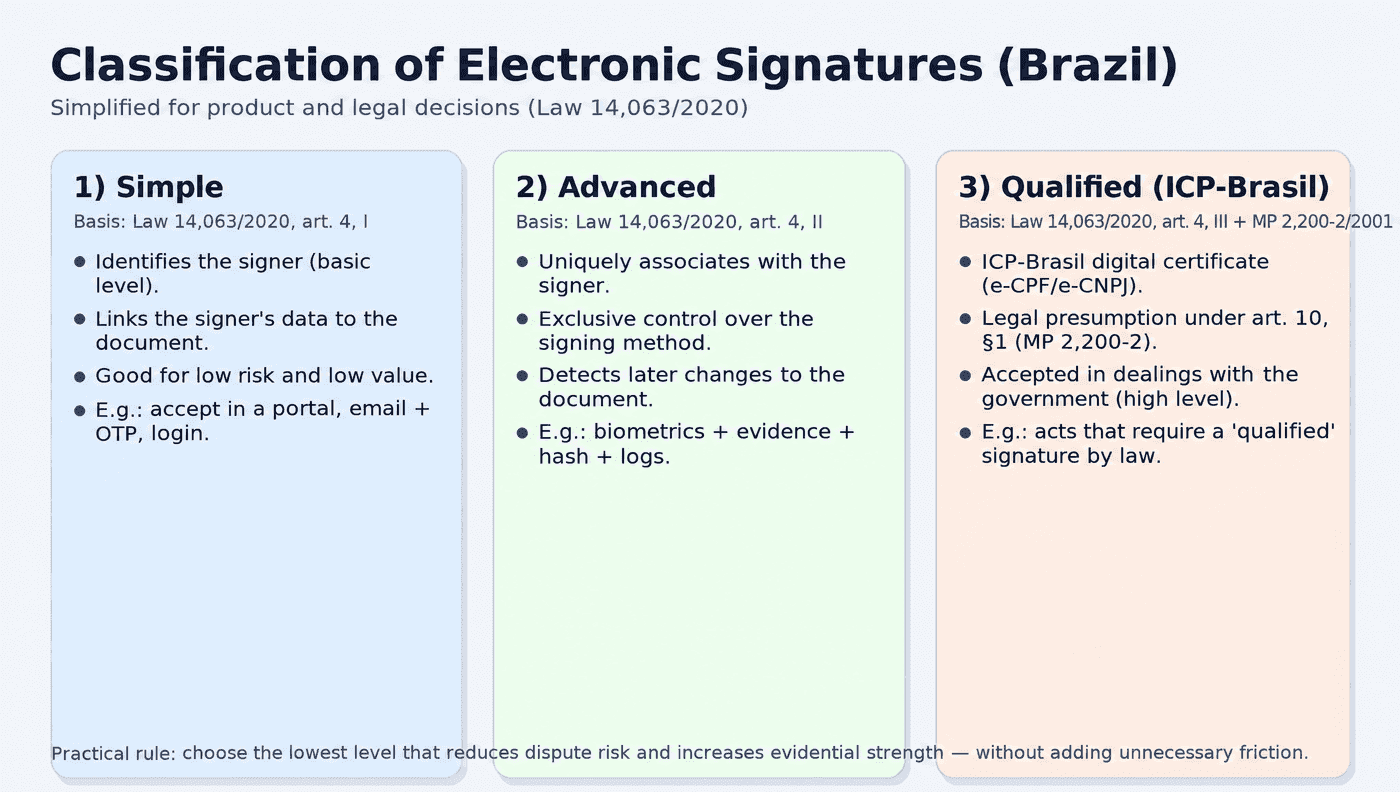
2.2 Law 14.063/2020: simple, advanced and qualified
Law No. 14.063/2020 classifies electronic signatures as:
- Simple
- Advanced
- Qualified (the one that uses an ICP-Brasil digital certificate)
It focuses mainly on interactions with the government and some specific acts, but it has become the market's "common language" for discussing signature levels.
2.3 Civil Code (general rule): free form, with exceptions
As a rule, the validity of a declaration of intent does not depend on any special form, except when the law requires one. This is used as the basis for electronic contracts and acceptances in general.
The detail is in the exceptions: for some acts (for example, certain real estate transactions, specific legal requirements, industry rules), the form may be stricter.
2.4 Code of Civil Procedure: authenticity and documentary evidence
In litigation, what matters is: can you demonstrate authenticity/authorship and integrity?
The Code of Civil Procedure deals with document authenticity and accepts certification methods, including electronic ones, plus rules on electronic documents produced and stored according to specific legislation.
2.5 Law 14.620/2023: enforceable instruments without witnesses and real estate credit
Law No. 14.620 of July 13, 2023 (the law behind Minha Casa, Minha Vida, Brazil's federal housing program) brought two changes that directly affect digital contracts. It came into force on the date of publication.
- Electronic enforceable instrument (Code of Civil Procedure, art. 784, § 4, added by art. 34 of the law): for enforceable instruments created or attested electronically, any type of electronic signature provided for by law is valid, and witness signatures are waived when integrity is ensured by a signature provider. In practice, the rule does not turn every contract into an enforceable instrument: it applies to documents that already qualify as enforceable instruments under the Code of Civil Procedure. In that case, the electronically signed contract no longer depends on witness signatures, as long as the provider guarantees the document's integrity.
- Real estate credit (Law 14.063, art. 17-A, added by art. 36 of the law): financial institutions that work with real estate credit and are authorized to execute private instruments with the force of a public deed, and the parties to those contracts, may use advanced or qualified electronic signatures. The article's sole paragraph was vetoed.
For product teams, this reinforces the argument in section 4: what waives the witness is integrity ensured by the provider, so the audit trail and the hash of the final document stop being a technical detail and start to underpin the contract's enforceability.
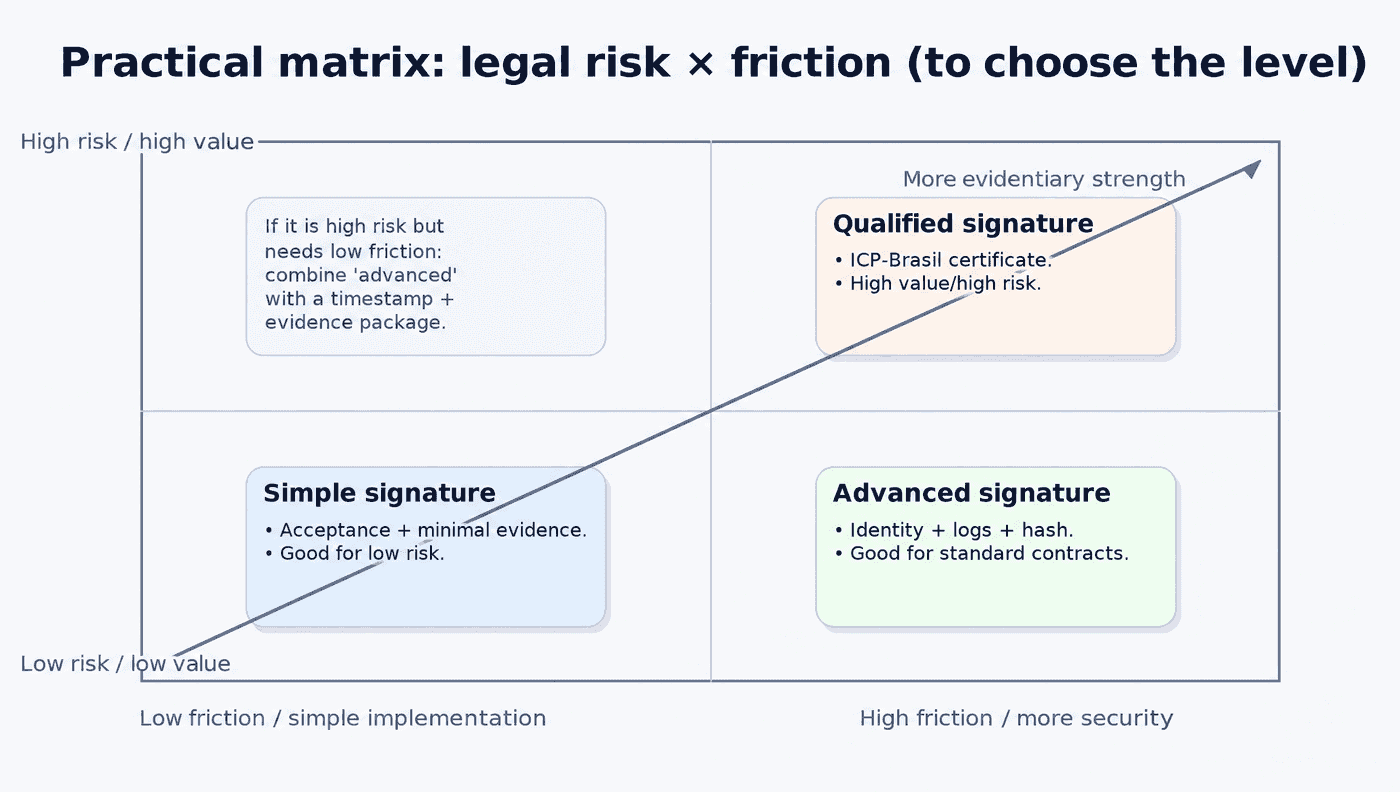
3. How to choose the signature type: stop debating "taste" and debate risk
The right question is not "which one is best?" but:
- What is the risk of a dispute (fraud/repudiation)?
- What is the value of the deal (financial and reputational)?
- What is the impact if the contract falls apart?
- How much friction is acceptable during onboarding?
Below is a practical map.
3.1 Summary classification (to align legal, product and engineering)
3.2 Decision table by scenario (typical examples)
| Scenario | Dispute risk | Common recommendation | Minimum expected evidence |
|---|---|---|---|
| Terms of use / policy acceptance | Low to medium | Simple or advanced | Record of acceptance, text version, IP/device, timestamp, authenticated account |
| Recurring B2B contract (SaaS) | Medium | Advanced (or qualified in sensitive cases) | Robust identification, logs, document hash, auditable trail, evidence package; if the contract must work as an enforceable instrument without witnesses, integrity ensured by the provider (Code of Civil Procedure, art. 784, § 4) |
| High-value / highly litigious contract | High | Qualified (ICP-Brasil) | ICP-Brasil certificate, timestamp, validation and retention (long-term validation, LTV, when applicable) |
| Interaction with government (when required) | Variable | As required by the agency/law | Follow the agency's requirement; qualified when mandatory |
| Real estate credit via private instrument with the force of a public deed | High | Advanced or qualified (Law 14.063, art. 17-A) | Authorized institution, full trail and intact final document |
| Other real estate transactions / specific legal cases | High | As required by law (qualified when required) | Meet the legal form (and record evidence of the act and the final document) |
The table above is a "product compass". The final design depends on your industry, fraud profile and risk appetite.
4. Audit trail: what separates a "signed" contract from a "probably signed" one
When someone challenges a contract, it is usually not a "fight about cryptography".
It is a fight about four things:
- Identity: who signed?
- Consent: did the person really agree?
- Integrity: is the document exactly what was signed?
- Date and context: when, where and how did it happen?
A good audit trail turns all of this into objective evidence.
4.1 What I consider a complete "evidence package"
If you need to be ready for a dispute, plan to produce and store a package with:
- The final document (PDF) with a unique identifier (e.g.
doc_id). - The document hash (SHA-256, for example) of the final file.
- Version metadata (which template and which version of the text/clauses).
- Signature events (timeline):
- invitation sent,
- document viewed,
- signer authenticated,
- acceptance,
- signature completed,
- any rejection or expiration.
- Technical evidence (in line with LGPD, Brazil's data protection law, and data minimization):
- IP, user-agent, device fingerprint used sparingly,
- geolocation if there is a legal basis and a need,
- evidence of the authentication factor (OTP sent/validated, bank verification, etc.),
- biometrics (in general, use providers that handle this securely and with documentation; avoid "saving selfies" without governance).
- When applicable: timestamp and validation data (certificate chain, OCSP/CRL, etc.).
If you cannot explain "how" you prove each of the four pillars (identity/consent/integrity/date), you have a risk.
4.2 How to generate and validate a hash (simple example)
You do not need to "invent" security: a hash is a basic building block.
# Generates the SHA-256 hash of the final PDF (to prove integrity)
shasum -a 256 contrato-final.pdf
Good practice: store this hash together with the doc_id and the document version, and record it in an immutable (WORM) log whenever possible.
4.3 Timestamps and proof of date
A timestamp links a hash to a date and time issued by a trusted third party (a Time Stamping Authority).
It does not "prove when the document was created", but it proves that that hash existed at that date and time.
This is useful to:
- strengthen proof of a "certain date" (a date the law treats as reliable against third parties) in disputes,
- support long-term validation when certificates expire.
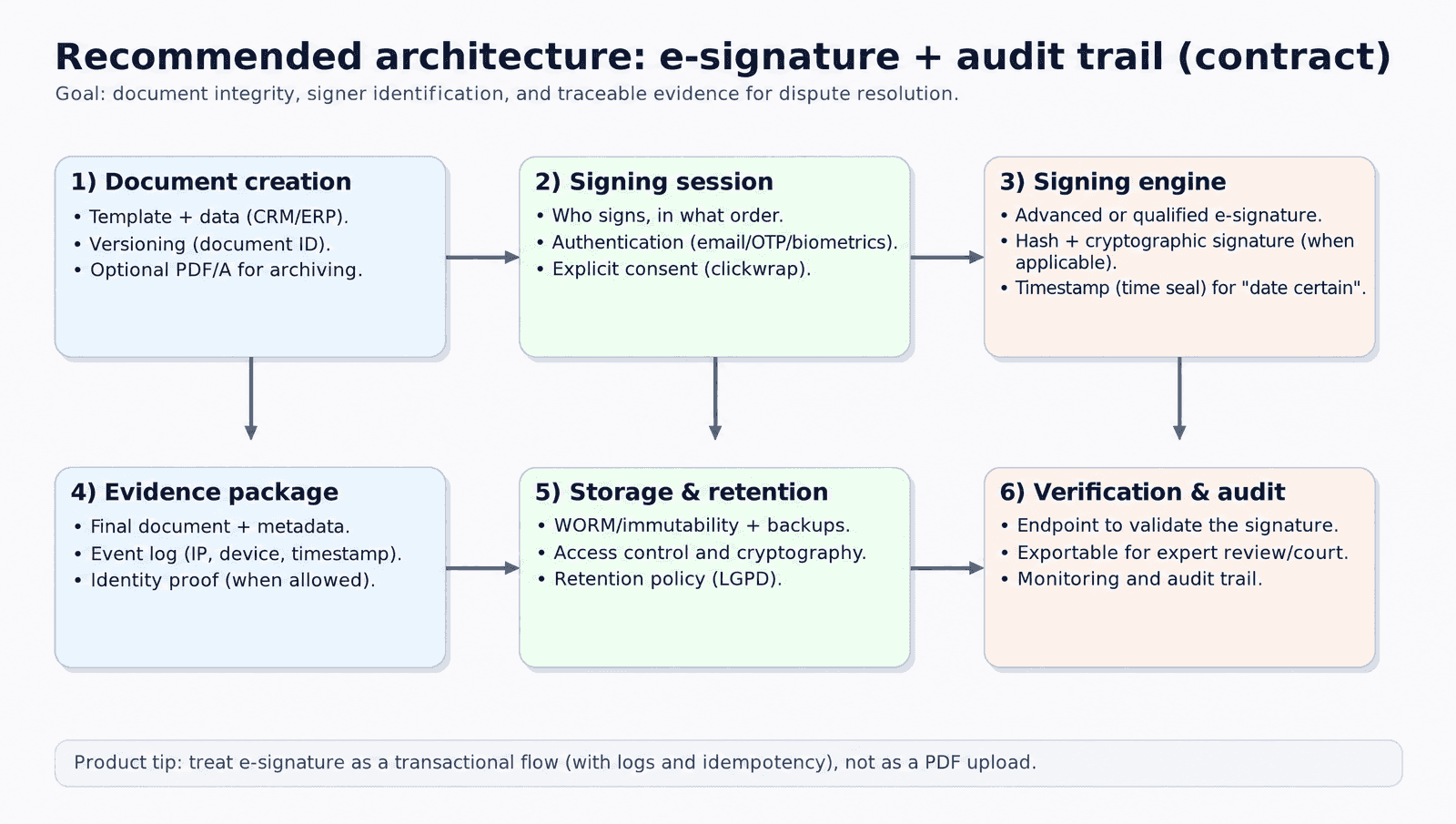
5. Product implementation: architecture and engineering decisions that matter
The worst architecture treats signing as a stateless "PDF upload/download" with no logs and no versioning.
The best architecture treats signing as a transactional flow:
- with idempotency,
- with state,
- with complete logs,
- with exportable evidence.
5.1 Build vs integrate a provider: an honest criterion
In 90% of cases, integrating a provider makes more sense than building everything from scratch, because:
- identity and anti-fraud are hard,
- signature standards (PDF, certificates, LTV) are full of details,
- operations and auditing take a lot of work.
Consider "building" when:
- you have very specific requirements (industry rules, data sovereignty, offline use, deep integrations),
- or when signing is a central part of your product's core.
The practical criterion is: if a failure here becomes a material legal risk, do not treat it as a side feature.
5.2 Technical robustness checklist (to avoid disputes)
- Does the document have a unique ID and a clear version?
- Is the signature applied to the final file (no "swapping the PDF" afterwards)?
- Is there a hash of the final document stored with the logs?
- Does the trail record events and timestamps with the correct time zone?
- Can you export an evidence package (PDF + JSON/CSV of the log)?
- Is there automatic integrity verification (with an alert on mismatch)?
- Is retention defined (period, legal basis, minimization)?
- Is there an access policy (RBAC), encryption and auditing?
6. LGPD and governance: a "signature" is personal data (and sometimes sensitive data)
Contracts and audit trails often carry:
- name, CPF (Brazil's individual taxpayer number), email, phone,
- address,
- authentication data,
- sometimes biometrics (sensitive).
The absolute basics:
- Minimize the data in the evidence package (keep what you need to prove).
- Define the legal basis and retention.
- Control access and keep an audit log (who viewed, who downloaded, who exported).
- If you use a vendor, treat it as a controller/processor relationship and adjust contracts, DPA and security.
7. Common mistakes that become legal pain (and are avoidable)
- Document without versioning
"Which version did they sign?" is a deadly question in a dispute.
- Swapping the PDF after signing
Even with good intentions (fixing formatting), this destroys integrity.
- "Simple" signature for a high-risk case
The wrong choice is not "illegal", but it can be indefensible when challenged.
- Proving identity with a single isolated selfie
Biometrics are powerful, but they need context, governance and a complete trail.
- Logs without a reliable timestamp and without a time zone
Disputes love details, and this becomes a loophole.
8. Wrapping up: a good signature is one that survives the worst week of litigation
If you want to reduce friction, close deals faster and still sleep well at night, the final question is:
"If someone denies the contract tomorrow, what can I prove, and how fast?"
If the answer is "it will take some work", you need to improve the flow.
If you want help designing this end to end (product + engineering + governance + legal), see our services page:
References (official and useful sources)
- MP 2.200-2/2001 (ICP-Brasil), art. 10, §1 and §2: https://www.planalto.gov.br/ccivil_03/MPV/Antigas_2001/2200-2.htm
- Law 14.063/2020 (classification: simple/advanced/qualified; art. 17-A on real estate credit): https://www.planalto.gov.br/ccivil_03/_ato2019-2022/2020/Lei/L14063.htm
- Law 14.620/2023 (art. 34, which adds § 4 to art. 784 of the Code of Civil Procedure, and art. 36, which adds art. 17-A to Law 14.063): https://www.planalto.gov.br/ccivil_03/_ato2023-2026/2023/lei/L14620.htm
- ITI, Brazil's National Institute of Information Technology (FAQ: digital certification and legal validity): https://www.gov.br/iti/pt-br/acesso-a-informacao/perguntas-frequentes/certificacao-digital
- ITI (timestamp FAQ): https://www.gov.br/iti/pt-br/acesso-a-informacao/perguntas-frequentes/carimbo-do-tempo
- Governo Digital (overview of electronic signatures and GOV.BR): https://www.gov.br/governodigital/pt-br/identidade/assinatura-eletronica/saiba-mais-sobre-a-assinatura-eletronica
- Law 11.419/2006 (electronic court proceedings and the concept of electronic signature): https://www.planalto.gov.br/ccivil_03/_ato2004-2006/2006/lei/l11419.htm
- Code of Civil Procedure (Law 13.105/2015), documentary evidence and electronic certification: https://www.planalto.gov.br/ccivil_03/_ato2015-2018/2015/Lei/L13105.htm
- Civil Code (Law 10.406/2002), art. 107 (free form, unless the law requires otherwise): https://www2.camara.leg.br/legin/fed/lei/2002/lei-10406-10-janeiro-2002-432893-normaatualizada-pl.html