
Índice do artigofaltam 20 min de leitura
Brazil's Lei Felca has left the legal department and entered the backlog.
When the market talks about the "Lei Felca", it usually means the popular nickname of Law No. 15,211/2025, Brazil's Digital Statute of Children and Adolescents (known as the ECA Digital), in force since March 17, 2026. For companies that build, maintain or operate digital products, the most useful reading of the law is not just "what it says", but what it changes in requirements, architecture, UX, data, moderation, advertising and governance.
In practice, this law does not only reach "children's" apps. It also covers information technology products and services that are likely to be accessed by children and adolescents. Depending on the specific case, this includes content apps, social networks, games, marketplaces, streaming, edtechs, platforms with UGC, apps with social features, device ecosystems, app stores, operating systems and, now explicitly in the regulating decree, conversational AI interfaces.
At X-Apps, the central point is this: complying with the Lei Felca is not a legal patch or a consent modal. It is a product + engineering + data + security + operations project.
This post was written for companies that develop systems and apps and need to turn the law into a technical and executive action plan.
What you will find in this guide
- who really needs to adapt;
- what already applies today and what still depends on further detail from the ANPD (Brazil's National Data Protection Authority);
- how to separate age rating, age assurance, guardian consent and parental supervision;
- the main compliance blocks for product, engineering, data, security, growth, trust & safety and legal;
- a practical roadmap to move from reading the law to executing on it.
1. The first point: your company is probably more exposed than you think
Law No. 15,211/2025 applies to every information technology product or service aimed at children and adolescents in Brazil or likely to be accessed by them. The law itself defines "likely access" based on factors such as probability of use, ease of access and degree of risk to privacy, safety or biopsychosocial development, with emphasis on social interaction and large-scale sharing services (art. 1).
This completely changes the question many companies had been asking.
The wrong question is:
- "Was our app built for children?"
The right question is:
- "Can our product be used by children or adolescents easily, attractively and with relevant risk?"
If the answer is "yes", even partially, compliance is on your radar.
A practical way to operationalize this scope
A good way to translate the law into the backlog is to classify the portfolio into three levels of regulatory exposure:
Level 1: high exposure
Products aimed at children and adolescents, or heavily used by this audience, especially when there is:
- algorithmic recommendation;
- UGC;
- chat, DM, voice or video between users;
- purchases;
- geolocation;
- monetization through advertising;
- conversational AI;
- creator economy.
Level 2: medium exposure
General-purpose products, but with likely access by minors and risky features, such as:
- communities;
- social login;
- streaming with a broad catalog;
- marketplaces with sensitive categories;
- intense gamification;
- extensive collection of events and profiles.
Level 3: residual exposure
Clearly corporate or adult products, but with some public surface or features that could, in theory, be accessed by minors.
Here, compliance tends to be more targeted, but it does not disappear.
2. The second point: companies are mixing up four different problems
One of the most expensive mistakes in adapting is treating everything as "age verification". It is not.
There are at least four different controls, and they need to be designed separately.
| Control | What it is for | Where it usually lives in the product |
|---|---|---|

Age rating
| Defines the appropriate age range for the content, feature or service | Catalog, onboarding, product pages, terms, store |

Age assurance or age verification
| Defines whether the user can access a given content, feature or journey | Sign-up, login, content unlocking, purchase, age signal API |

Guardian consent or authorization
| Authorizes specific acts of progressively lower impact or those required by law | Download, account creation, feature activation, purchases |

Parental supervision
| Gives the guardian ongoing means to follow, limit and configure use | Guardian dashboard, device controls, linked account, in-app controls |
Mixing these controls into a single "date of birth" field is an architecture mistake.
In the backlog, age rating, age assurance, guardian consent and parental supervision need to be designed from the start as separate controls, each with its own rules and surfaces.
What the law requires on each front
The law requires:
- age rating and age-appropriateness of content (art. 8);
- reliable age verification mechanisms, with self-declaration prohibited, for content, products and services that are improper, inappropriate or prohibited (art. 9);
- age signal, parental supervision and guardian consent in app stores and operating systems (art. 12);
- effective parental supervision tools, with concrete controls and a more protective default (arts. 17 and 18).
The decree deepened this separation. It defines age assurance, age verification, age signal and self-declaration, and reinforces that implementation must be proportional to risk, with data minimization, auditability and privacy protection (arts. 2, 24 and 25 of Decree No. 12,880/2026).
3. What already applies today and what the ANPD will still detail
There is a lot of confusion here too.
The practical rule is:
- the law is already in force;
- the decree has already regulated central points;
- the ANPD will still detail additional technical requirements, especially on age assurance, but that does not justify standing still.
What already applies today
Already in force, among other points:
- priority protection and the best interests of children and adolescents;
- security, privacy and data protection by design and by default;
- risk management;
- prevention of illegal, pornographic and manifestly inappropriate content;
- the duty to avoid compulsive use;
- advertising without profiling;
- prohibition of behavioral profiles for commercial advertising;
- parental supervision with a more protective default;
- moderation, reporting, takedown and appeal obligations;
- prohibition of loot boxes in games aimed at or likely to be accessed by minors;
- the obligation to keep a legal representative in Brazil.
What will still be detailed
The ANPD was designated as the autonomous administrative authority for the subject and has already announced it will follow a phased approach for age assurance solutions.
By March 20, 2026, the agency had:
- published preliminary guidance on reliable age assurance mechanisms;
- launched an official ECA Digital page;
- announced an implementation schedule with immediate monitoring of app stores and operating systems;
- planned final guidance from August 2026;
- indicated an adaptation and monitoring period between August and November 2026;
- and pointed to enforcement actions from January 2027, especially on age assurance.
Where the ANPD agenda stands in November 2026
The March schedule has partly moved forward. What the ANPD itself has published since then:
- Age assurance guide still preliminary. The agency put a proposed update of the guidance out for public input, with contributions accepted until July 9, 2026, and says they are being consolidated. The March guidance remains the reference "until final guidance is published". As of November 11, 2026, we had not found the final version published, although the schedule expected it from August.
- Scope guide published. On October 28, 2026, the ANPD published the guidance document Suppliers of information technology products or services: scope and general obligations of the ECA Digital, refined with contributions from the public input round held between April and June 2026. It is the document that details who is subject to the law, the concept of likely access and the general obligations. For anyone still unsure whether their product is in scope, it is the first thing to read.
- Sanctions in public consultation. The Regulation on Dosimetry and Application of Administrative Sanctions (the rules for calculating penalties) is in public consultation, with contributions until November 30, 2026.
- Enforcement has already started in a concrete case. On August 7, 2026, the ANPD opened an enforcement proceeding against Discord based on the ECA Digital, citing, among other points, the lack of effective age assurance mechanisms and failures in content removal. The January 2027 window is for enforcement planned around priority topics. In the face of a complaint or high risk, the agency can act earlier.
This matters because it allows a mature reading of the situation:
- it is not true that everything depends on future regulation;
- but it is also not right to pretend that there is already a final ANPD technical manual for every product scenario.
The right path is to comply with what is already clear in the law and the decree, and prepare the architecture to absorb the ANPD's complementary acts.

The practical implication is simple: the company can already fix UX, data, moderation and governance now, leaving the architecture ready to absorb the technical details the ANPD will still publish.
4. How to turn the Lei Felca into a product and engineering backlog
Below are the main compliance blocks for companies that develop systems and apps.
4.1 Scope, inventory and risk matrix
Before writing a line of code, the company needs to know where the law applies.
What the law asks for
The law requires suppliers to:
- carry out risk management of features, functionalities and systems and their impacts on the safety and health of children and adolescents (art. 8);
- map risks and, in certain data processing scenarios, prepare an impact, monitoring and evaluation report (art. 16, sole paragraph);
- carry out a safety and health impact assessment for children, with analysis of risks, probability, severity, mitigation and continuous follow-up, according to the decree (art. 47).
How this becomes real work
The company should build an inventory by product and by feature, looking at:
- declared target audience;
- evidence of likely access;
- age rating;
- presence of UGC;
- chat, voice, video and interaction with adults;
- recommendation systems;
- purchases, microtransactions and subscriptions;
- monetization through advertising;
- use of geolocation;
- collection of sensitive or extensive data;
- use of generative AI or conversational agents.
The result should become a risk matrix with an owner, priority, mandatory measures and deadline.
Minimum deliverables that make a difference
- inventory of affected products and features;
- internal classification by risk;
- record of architecture decisions;
- map of critical suppliers;
- compliance plan with owners per area;
- recurring committee across product, engineering, legal, security and data.
Without this block, the rest tends to become uncoordinated action.
4.2 Privacy, security and protection by default
This is one of the centers of gravity of the law.
What the law asks for
Law No. 15,211 requires products aimed at children and adolescents or likely to be accessed by them to operate by default with the highest level of protection of privacy and personal data, with the possibility of informed choices about less protective settings (art. 7).
It also requires:
- systems designed to prevent encounters with illegal, pornographic and inappropriate content (art. 8);
- settings from the design stage that avoid compulsive use (art. 8, IV).
The decree also orders companies to curb manipulative, deceptive or coercive practices, and lists clear examples of dark patterns: obstructing tasks, exploiting cognitive vulnerabilities and making it artificially hard to exercise rights, change preferences or stop using the product (art. 10).
How this becomes backlog
For product and design teams, this means reviewing defaults such as:
- public profile;
- open messaging;
- discovery by strangers;
- location sharing;
- broad permissions;
- autoplay;
- continuous rewards;
- excessive notifications;
- confusing paths to leave, cancel or reduce engagement;
- hidden privacy and parental supervision controls.
A practical rule for software companies
If your retention strategy depends on:
- hiding natural stopping points;
- starting new content without being asked;
- rewarding screen time;
- triggering artificial urgency;
- making it hard to cancel or change preferences;
you are very close to a zone of incompatibility with the decree.
What we recommend implementing
- safe defaults by age range;
- feature flags for child and adolescent protection;
- a UX standard without dark patterns;
- notification limits and windows;
- mandatory checklists in discovery and design review;
- automated tests for sensitive defaults;
- periodic review of permissions and SDKs.
4.3 Age assurance and verification: architecture, not improvisation
Age verification is perhaps the most visible topic of the law, but also the most misunderstood.
What the law asks for
The law requires reliable age verification mechanisms, with self-declaration prohibited, for content, products and services that are improper, inappropriate or prohibited for people under 18 (art. 9).
It also determines that:
- app stores and operating systems adopt proportional, auditable and technically secure measures to assess age or age range (art. 12);
- they provide an age signal via a secure API with privacy by default (art. 12, III);
- data collected for age verification is used only for that purpose (art. 13);
- the other players in the digital chain keep their own mechanisms and are jointly liable for full protection (arts. 14 and 15).
The decree reinforces the logic of proportionality, minimization, non-traceability, security, interoperability, transparency and auditability (art. 24). And it goes further: if a document is collected, processing must be limited to the age attribute, with immediate and irreversible deletion of the image or copy of the document after capturing the necessary information (art. 24, § 3).
What this means for engineering
The age architecture should not be a loose field in sign-up. At a minimum, it needs:
- a classification policy by risk;
- definition of age assurance levels;
- a decision engine to allow, restrict, hide or require an additional step;
- integration with age signals from operating systems and stores, when available;
- an audit trail on which attribute was validated, without retaining data beyond what is necessary;
- a flow to contest and correct the age classification;
- strict segregation between age data and ads, growth and profiling systems.
What not to do
Do not turn the requirement into a lazy solution of asking every user for a document, in every journey, without criteria.
The regulation itself points to a responsive approach proportional to risk. In some contexts, the requirement will be stronger. In others, the design may combine:
- age rating;
- parental controls;
- blocking by default;
- children's accounts;
- age signals from the device ecosystem;
- and the company's own mechanisms proportional to risk.
An important technical principle
Age assurance cannot become a data source for marketing.
If the product uses the captured age attribute for:
- lookalike audiences;
- commercial segmentation;
- advertising recommendation;
- building behavioral profiles;
- CRM enrichment;
the regulatory risk rises sharply.
4.4 Parental supervision: existing is not enough, it has to work
This is another point where the law leaves the abstract and enters real software.
What the law asks for
Suppliers must provide accessible and easy-to-use tools to support parental supervision (art. 17), with:
- information in an easy-to-find place;
- a clear notice when supervision is active;
- limits on and monitoring of usage time.
The default settings of these tools must adopt the highest level of protection available and include, at a minimum:
- restriction of communication with unauthorized users;
- limits on features that artificially extend use;
- monitoring of appropriate and healthy use;
- immediate viewing and limiting of time;
- control over recommendation systems, including the option to turn them off;
- restriction on sharing geolocation;
- regular review of AI tools;
- and, when technically feasible, emotional support and well-being features (art. 17, § 4).
The tools must also allow the guardian to:
- manage the account and privacy;
- restrict purchases and transactions;
- identify adult profiles the child or adolescent communicates with;
- access consolidated usage metrics;
- turn safeguards on or off;
- and operate everything in Portuguese (art. 18).
How this becomes product
There is no point burying controls at the fifth level of the menu.
The company needs to decide:
- will there be a guardian dashboard?
- will the link be through a linked account, invitation, operating system API or a combination?
- which controls stay on the device and which stay in the app?
- how does the minor see that they are under supervision?
- which controls are reversible and which cannot be loosened without the guardian?
Cases where this becomes even more critical
- apps with DM, chat, voice or video;
- games with purchases and social interaction;
- apps with a recommendation system;
- services with geolocation;
- marketplaces with one-click purchases;
- apps with conversational AI.
What we recommend implementing
- a guardian dashboard with a consolidated view;
- time limits and usage windows;
- purchase blocking pending approval;
- approved contacts;
- geolocation off by default;
- a personalized feed that can be turned off;
- controls in clear Portuguese;
- a visible notice of active supervision;
- logs of settings changes.
4.5 Social networks, social features and moderation
If your product has a feed, comments, communities, chat, uploads, live streams or DMs, compliance enters another layer of complexity.
What the law asks for
On social networks, the law requires accounts of children and adolescents up to 16 years old to be linked to the account of a legal guardian (art. 24).
If the service is improper or inappropriate for this audience, the provider must:
- clearly state that the service is not appropriate;
- monitor and restrict content clearly aimed at attracting children and adolescents;
- continuously improve age verification mechanisms (art. 24, § 1).
The law also prohibits building behavioral profiles of children and adolescents to target commercial advertising (art. 26).
What the law asks for in moderation
In addition, suppliers must:
- provide mechanisms to report violations (art. 28);
- remove content that violates the rights of children and adolescents regardless of a court order when notified by specific authorized parties (art. 29);
- ensure the right to contest, appeal, the grounds for removal and information on whether the review was human or automated (art. 30);
- keep mechanisms against abusive use of reporting tools and transparent procedures for sanctions for abuse (arts. 32 and 33).
The decree details that these reporting mechanisms must be accessible, free, effective and widely publicized (art. 41), and reinforces the priority and immediate removal of content reported by a victim, their representatives, the Public Prosecutor's Office (Ministério Público), police authorities or accredited entities (arts. 43 and 44).
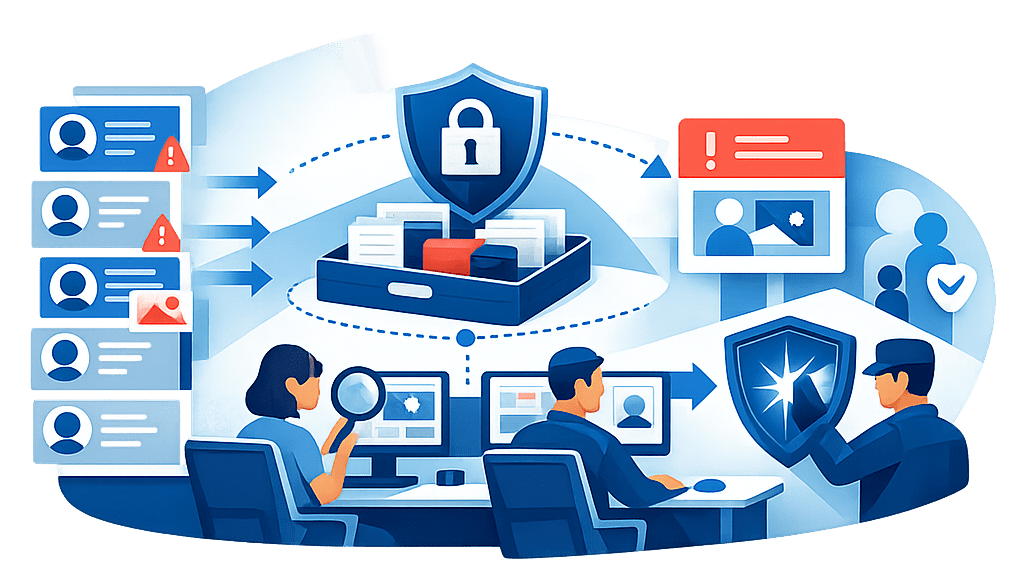
For products with UGC, chat or social features, "immediate action" stops being a slogan and becomes a requirement for queues, SLAs, routing and evidence preservation.
How this becomes backlog
Trust & safety and engineering teams need to treat this as a system, not as a manual queue in email.
You need to define:
- a taxonomy of violations;
- a reporting channel with a technical identifier for the content;
- a priority child safety queue;
- routing for human review;
- retention of evidence and metadata;
- an appeal flow;
- an indication in the takedown notice of whether the review was human or automated;
- detection of abuse of the reporting channel;
- operational metrics and reports.
For products with UGC, this is essential
If the platform allows uploads, comments, sharing or contact between users, the company should assume that compliance depends on:
- response time;
- quality of triage;
- proof of diligence;
- and the ability to preserve evidence.
4.6 Advertising, analytics and adtech: one of the biggest hidden risks is here
Many companies underestimate this block because they only think of banner ads. The problem is much bigger.
What the law asks for
The law prohibits the use of profiling techniques to target commercial advertising at children and adolescents. It also prohibits the use of emotional analysis, augmented reality, extended reality and virtual reality for this purpose (art. 22).
On social networks, the prohibition covers building behavioral profiles based on personal data, including data obtained in age verification, as well as group and collective data, to target commercial advertising (art. 26).
The decree repeats this prohibition and reinforces that advertising that takes advantage of a child's limited judgment and experience is considered abusive (arts. 31 to 33 of Decree No. 12,880/2026).
What this changes in practice
If the company operates a product with minors, it urgently needs to review:
- events sent to analytics;
- integrations with a CDP;
- segmentations in the CRM;
- custom audiences;
- remarketing;
- lookalikes;
- interest inference;
- cross-use of the age signal for growth;
- ad optimization based on minors' behavior.
A useful operational guideline
Data teams need to clearly separate:
- data needed for safety and legal compliance;
- data for functional personalization;
- data for commercial advertising.
These three layers can no longer be treated as if they were the same thing.
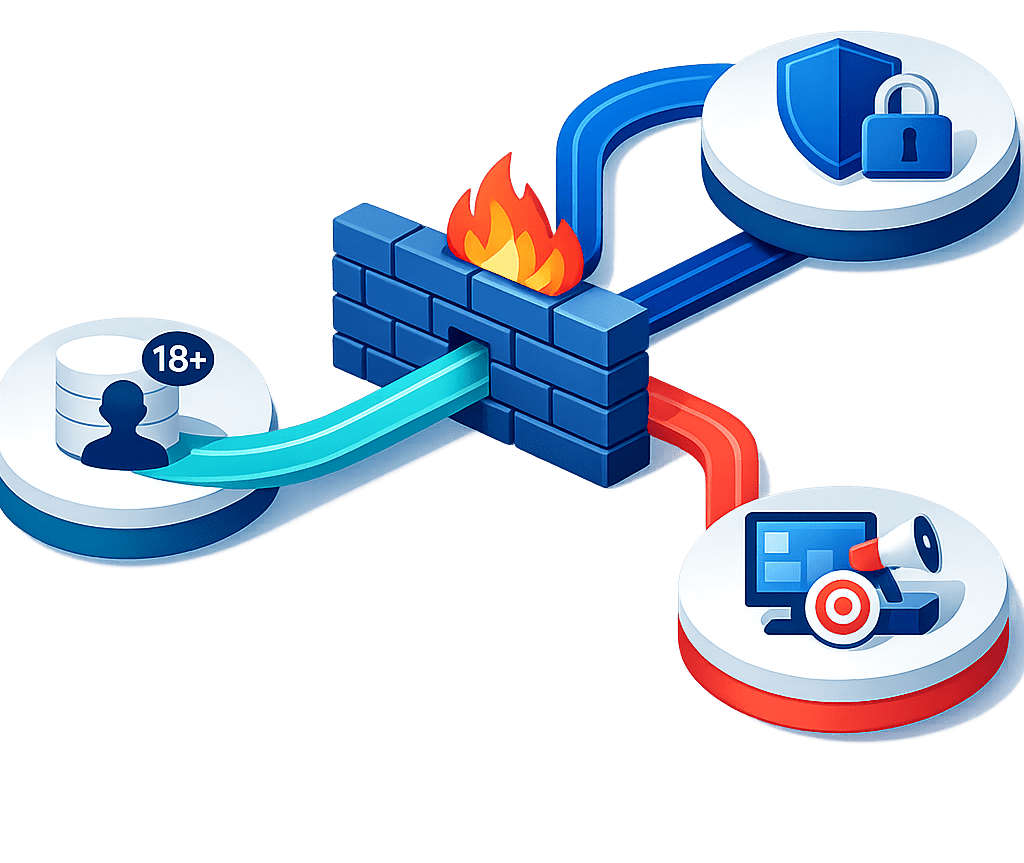
This is one of the most underestimated points in compliance: age data and safety signals cannot leak into CRM, adtech, lookalikes or commercial segmentation.
What we recommend implementing
- data lineage specific to age attributes;
- technical blocks on secondary use;
- review of tags, SDKs and pixels;
- contract review with ad networks and partners;
- retention and access policy;
- internal dashboards that prove age verification data does not feed advertising.
4.7 Games, microtransactions and the creator economy
This chapter became much more concrete than many companies imagined.
What the law asks for games
The law prohibits loot boxes in electronic games aimed at children and adolescents or likely to be accessed by them (art. 20).
It also requires games with interaction between users to observe the safeguards of Law No. 14,852/2024 (Brazil's legal framework for electronic games), especially on moderation, protection against harmful contact and parental involvement, and to limit these interactions by default to ensure guardian consent (art. 21).
The decree adds that games with loot boxes must perform age verification to prevent children and adolescents from accessing this feature, unless they offer versions without loot boxes or with the feature fully restricted by default (art. 23).

For products with reward mechanics, the impact can reach the business model: it is not just about changing the text of terms or policies, but about reviewing the monetization dynamics themselves.
What this means for the product
If your game or gamified app has:
- paid random rewards;
- microtransactions;
- open chat;
- guilds, squads, parties, clans;
- friend requests;
- rankings that encourage staying longer;
compliance requires reassessing the business model and not just publishing new terms.
What the law asks for content monetization involving minors
The decree brought an additional warning for creator economy, video and boosted content platforms:
when there is monetized or boosted content that habitually exploits the image or routine of a child or adolescent, the supplier must require court authorization; if it does not exist, the content must be removed immediately (art. 34 of Decree No. 12,880/2026). The obligation applies to content whose monetization or boosting starts within 90 days of the decree's publication.
What this changes for companies
Platforms that pay creators, boost content or do sponsored distribution need to create:
- a documentation flow for court authorization, when applicable;
- eligibility rules for monetization;
- detection heuristics for content that habitually exploits the image or routine of minors;
- human review of sensitive cases;
- preventive blocks on automatic boosting.
4.8 Generative AI, conversational agents and natural language interfaces
This is a new and important point for companies that have been embedding copilots, assistants and chatbots in their products.
What the decree asks for
Decree No. 12,880/2026 determines that suppliers of products or services capable of generating content and interacting with users based on natural language instructions, including language models, conversational agents and similar interfaces, must:
- be transparent about the synthetic and automated nature of the interaction;
- prevent behavioral manipulation of children and adolescents;
- assess algorithmic risk to safety and health;
- implement safeguards for physical, mental and psychosocial development (art. 11).
In addition, the law itself mentions regular review of AI tools in the context of parental supervision tools and the possibility of disabling features that are not essential to basic operation (art. 17, § 4, VIII).
What this means for software companies
If your company integrates AI into apps accessible to minors, it needs to review:
- the agent's persona and tone;
- behavioral incentives;
- conversation persistence;
- memory and personalization;
- automatic suggestions;
- safety filters;
- the ability to turn the feature off;
- audit trail and monitoring;
- escalation to a human in risky situations.
A useful question for product managers
Was your agent designed to help the user or to increase retention at any cost?
If the practical answer is the second one, the product needs review.
4.9 Transparency, proof of compliance and governance
Compliance without evidence is weak compliance.
What the law asks for
The law requires half-yearly reports, in Portuguese, from internet application providers with more than 1 million registered child and adolescent users in Brazil, with information on reports, moderation, identification of children's accounts, privacy, parental consent and impact assessments (art. 31).
It also requires a legal representative in Brazil for suppliers covered by the law (art. 40).
The decree details that:
- reports must include proportional data on the follow-up given to notifications (art. 45);
- there must be a safety and health impact assessment for children, with a public summary version in clear and accessible language (art. 47);
- and the ANPD will accredit research and journalism institutions for access to data, under specific conditions (art. 48).
How this becomes real governance
The company needs to be able to prove:
- its risk classification by product;
- which defaults are active;
- how the age logic works;
- which parental controls exist;
- how content is moderated;
- how long it takes to respond;
- which decisions are human and which are automated;
- how age data is segregated;
- how third-party suppliers are governed.
Important executive deliverables
- a policy for protecting children and adolescents in the digital environment;
- an executive committee with minutes and owners;
- evidence of UX, ads and AI reviews;
- an impact report;
- a plan to respond to official requests from the ANPD;
- an audit trail per critical feature;
- a register of third parties, SDKs and integrations.

When the company can prove impact, decision and trail, the conversation with legal, audit, the ANPD and leadership stops being abstract and becomes workable governance.
5. An essential point: the law does not treat all services the same way
Not everything is a uniform obligation.
Law No. 15,211 itself provides that several obligations will be applied according to the characteristics and features of the product or service, modulated by the supplier's degree of interference over content, the number of users and the size of the supplier (art. 39).
In addition, the law provides a partial exemption for certain services with editorial control and previously licensed content, as long as they meet conditions such as:
- age rating;
- transparency;
- parental mediation;
- and adequate reporting channels.
Along the same lines, the decree exempts some providers from adopting age assurance if they offer age-appropriate children's accounts and effective parental supervision mechanisms (art. 22 of Decree No. 12,880/2026).
What this means for companies
The best strategy is not to apply a single compliance package to everything.
The best strategy is to design proportional compliance:
- more intense where the risk is higher;
- leaner where the service is editorial, controlled and low risk;
- but always documented, justifiable and auditable.
6. A practical compliance roadmap
Below is a roadmap model that makes sense for software development companies, platforms and companies that operate digital products.
| Horizon | Priority deliverables |
|---|---|
| 0 to 30 days | inventory of affected products and features; risk classification; freeze on sensitive launches without review; review of defaults; map of SDKs and adtech; executive committee |
| 31 to 90 days | privacy and safety by default adjustments; reporting channel and child safety queue; logs and audit trail; review of ads and segmentation; parental controls MVP; internal policies and playbooks |
| 91 to 180 days | age assurance architecture by risk level; integration with ecosystem age signals when available; dashboards and reports; AI review; documented proof and processes to contest decisions |
| Now (November 2026) | check the scope against the ANPD guide of October 28, 2026; contribute to the sanctions consultation, if it makes sense; monitor the final version of the age assurance guide, which as of November 11, 2026 was still preliminary |
| When the final age assurance guide comes out | absorb the final guidance; fine-tune flows, APIs, minimization, interoperability and audit |
| By January 2027 | close the age assurance gaps and prepare for enforcement by priority topics, without losing sight of the fact that the other obligations have applied since March 2026 and that the ANPD has already opened a proceeding before that date |

This kind of visual helps turn the law into a real schedule: one part goes into the first correction cycle, another depends on structural design and another on progressive regulatory absorption.
7. Common mistakes to avoid
- treating the law as an exclusively legal topic;
- waiting for a final regulation to start from scratch;
- using only self-declaration or a free-text date of birth to block prohibited content;
- reusing age data for growth or advertising;
- hiding parental controls in confusing UX;
- keeping autoplay, aggressive notifications and rewards for staying as the default;
- thinking a "general-purpose" product is outside the law;
- ignoring suppliers, SDKs, app stores and operating systems;
- not producing documented evidence of compliance.
8. Executive checklist for companies that develop systems and apps
- Has the company already classified which products are aimed at or likely to be accessed by children and adolescents?
- Is there a risk matrix per feature?
- Have the privacy, contact, location and recommendation defaults been reviewed?
- Is there a clear design for age rating, age assurance, guardian consent and parental supervision?
- Does the product block secondary use of age data for advertising and profiling?
- Is there an accessible, free, effective reporting channel with priority for child safety?
- Does the moderation flow state the grounds for removal and whether the review was human or automated?
- Is there protection against abuse of the reporting tools?
- Have games, microtransactions and social features been reassessed?
- Have AI features gone through a specific review for the ECA Digital?
- Is there an impact report and executive governance with a decision trail?
- Is the company prepared to respond to the ANPD with technical, organizational and legal documentation?
9. How X-Apps can support companies in this adaptation
For many companies, the biggest risk is not "not knowing the law", but not being able to translate it into backlog, architecture and operations.
That is exactly where a software development company with a product mindset makes a difference.
In practice, X-Apps can support work such as:
- technical and regulatory assessment by product and feature;
- architecture review for age rating, age assurance and data segregation;
- implementation of parental controls, moderation, audit trails and operational governance;
- review of UX, critical journeys and patterns to remove dark patterns;
- adaptation of analytics, adtech, SDKs and third-party integrations;
- design of a compliance roadmap with deliveries prioritized by risk.
This is especially relevant when the company needs to adapt a product already in production, with active users, legacy dependencies and multiple teams working at the same time.
In these scenarios, the best approach usually combines:
- a quick assessment to map exposure;
- an execution plan in waves;
- incremental technical deliveries that reduce risk without paralyzing the business.
Frequently asked questions about the Lei Felca
What is the Lei Felca (ECA Digital)?
It is the popular name of Brazil's Law No. 15,211/2025, which sets specific rules to protect children and adolescents in digital environments. For software companies, the impact is direct on product, data, moderation and governance.
Who needs to comply?
Any digital product or service likely to be accessed by children and adolescents, especially when there is social interaction, algorithmic recommendation, advertising, purchases or conversational AI.
Does the law only require age verification?
No. Compliance involves four distinct controls: age rating, age assurance, guardian consent and parental supervision. Treating everything as "age verification" creates compliance failures.
What changes for apps and platforms?
What changes are the privacy defaults, recommendation criteria, moderation, UX and the way the company proves compliance (audit trails, internal policies and impact reports).
What is the first practical step for companies?
Map products and features by risk level and turn the law into a prioritized backlog. This avoids late fixes and reduces regulatory friction.
See also
To complement governance and account security, see MFA and 2FA for clients. To understand account deletion obligations and LGPD (Brazil's data protection law), see Account deletion and LGPD.
Conclusion
For companies that develop systems and apps, the Lei Felca is not just a rule about childhood on the internet. In practice, it is a new layer of regulatory engineering.
It changes how the company:
- classifies its own product;
- designs sign-up and access flows;
- structures privacy by default;
- defines parental controls;
- operates moderation;
- organizes advertising and analytics;
- integrates AI;
- documents risks and proves compliance.
A company that tries to solve this only with internal policy or cosmetic interface tweaks will remain exposed.
A company that understands the law as an architecture + product + governance project tends to adapt with less rework, less regulatory friction and much more predictability.
In practice, the most efficient path is this:
- map scope and risk;
- separate the regulatory controls that are mixed up today;
- fix defaults and dark patterns;
- rewrite adtech and moderation where needed;
- prepare the architecture for the ANPD's regulatory agenda.
That is how the Lei Felca stops being a headline and becomes a well-implemented technical requirement.
Official and regulatory sources
- Law No. 15,211/2025 at the Chamber of Deputies
- Text of Law No. 15,211/2025 (original publication)
- Law No. 15,352/2026 (in force from March 17, 2026)
- Decree No. 12,622/2025 (designation of the ANPD)
- Decree No. 12,880/2026 (regulation of the law)
- Official ECA Digital page at the ANPD
- ANPD: preliminary guidance and schedule for age assurance
- ANPD: guide on the scope and general obligations of the ECA Digital (October 28, 2026)
- ANPD: webinar on the ECA Digital, with the deadline for the public consultation on calculating and applying sanctions (October 15, 2026)
- ANPD: enforcement proceeding against Discord (August 7, 2026)
- ANPD: initial monitoring of companies subject to the ECA Digital