Índice do artigofaltam 11 min de leitura
Most of the time, "the ERP has no API" describes a question that has not been asked yet, not a system.
The sentence arrives ready-made from the vendor, usually by email, usually two lines long. It ends meetings, postpones projects and makes companies switch ERPs for no reason. This article does two things: it separates the four possible meanings of that sentence, and, for the case where the absence is real, it compares the five remaining options and shows where each one charges.
Article summary
- The sentence "it has no API" usually means a module not purchased, a service turned off in the environment, a field not published or integration sold separately. Two of these cases (module not purchased and integration sold separately) are commercial decisions, and none of the four is a real absence of an API.
- When the API really does not exist, five options remain: files in a folder, a mirror database, RPA, an intermediate layer and an integration platform.
- Two of them have a public unit price: RPA, per bot, and the integration platform, per credit. Microsoft charges US$ 150 per bot per month for Power Automate Process, and US$ 215 when it hosts the machine.
- The choice is about operations and contracts, not technology: what decides it is the tolerated delay, the volume and who answers when the integration stops.
"It has no API" almost never means there is no API
The sentence has four readings, and they call for completely different actions. None of them requires switching ERPs.
- Module not purchasedThe API exists in the product and is not in the company's contract. It becomes a commercial negotiation, not a technical project.
- Service turned off in the environmentThe framework publishes the interface and nobody enabled it on that server. It is configuration, and it usually gets done in days.
- Field not publishedThe API responds and the data you need is not in it. It requires a change on the vendor's side, and goes into their schedule.
- Integration sold separatelyThe vendor has the component and prefers to sell the integration project. It is the commercial answer disguised as a technical limitation.
The fifth possibility, real absence, exists and is rarer than it seems. It shows up in old systems, in custom software built by someone who left, and in niche products that were never designed to talk to anything. That is the case the rest of the article covers.
In TOTVS Protheus (one of Brazil's most widely used ERPs), for example, "having an API" is already three separate questions, and the answer changes depending on the environment. The same reasoning applies to practically any ERP on the market.
The four questions that separate "does not exist" from "is not turned on"
Send all four in writing, in the same message, before accepting the answer. Requiring a written answer is what turns opinion into commitment, and it is what you will take to the contract meeting later.
- Does the product publish any integration interface? Ask for its name and the documentation link, not a yes or no. Public documentation is what lets you estimate without depending on a meeting.
- Is that interface enabled in our environment? A service available in the product and a service enabled on the company's server are different things, and the second one is configuration.
- Are the fields we need exposed in the published resource? List the fields by the name that appears on the ERP screen. A field filled in on screen does not mean a field returned in the response.
- Is what is missing a contract or development work? If it is a contract, ask for the proposal. If it is development by the vendor, ask for the timeline and the queue. Both answers are acceptable; not getting either is not.
If all four answers confirm there is no published path, then the project changes shape. The choice between five options begins, and each one charges in a different place.
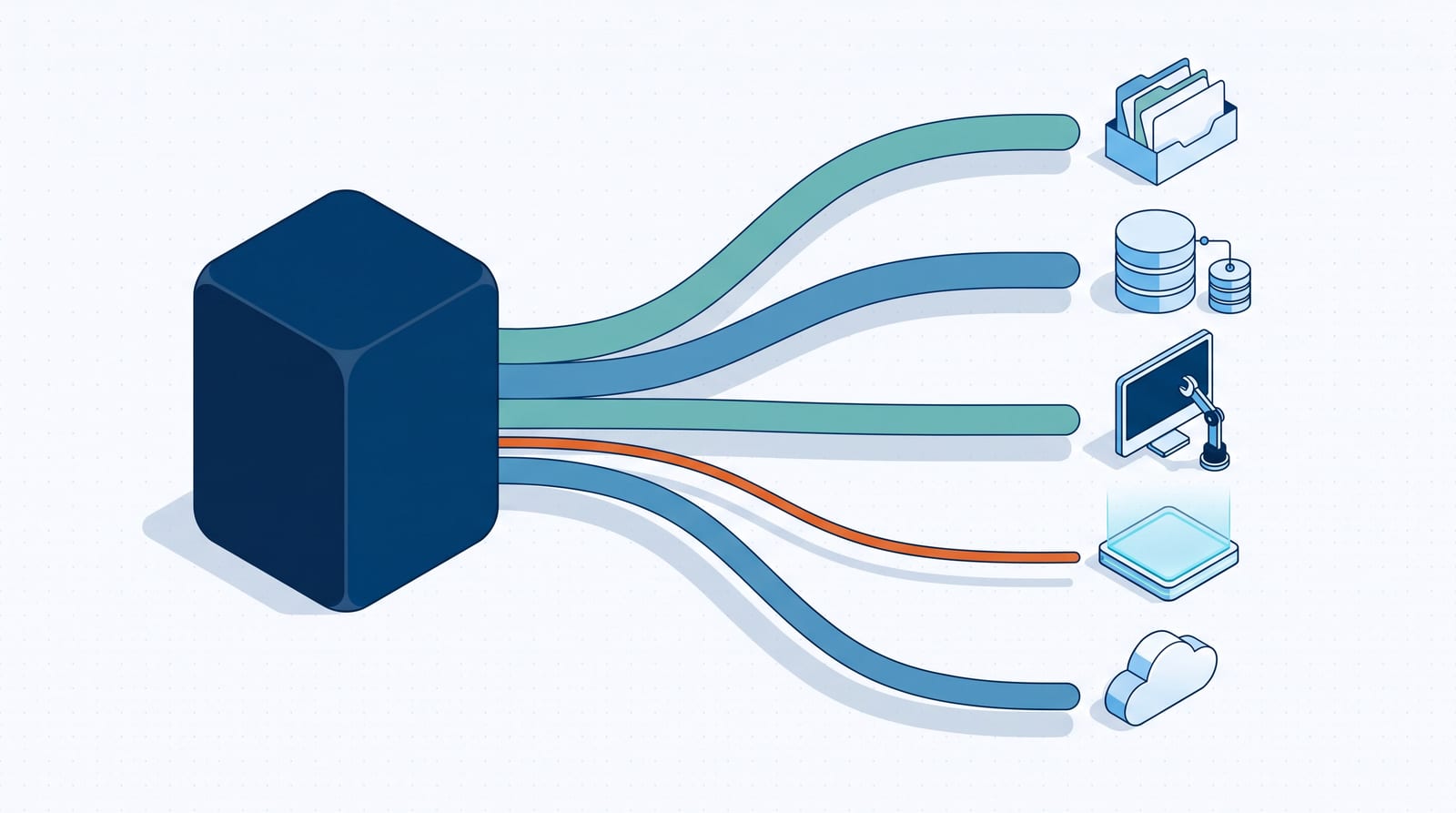
The five options are not equivalent alternatives. Two of them move data in batches and accept delay. One repeats a person's clicks. One builds what the ERP did not publish. And one outsources the whole connection, charging per event.
In practice, real projects combine two: batch for the historical volume and a second option for what needs to be recent.
Files in a folder: the cheapest option, and the delay it charges
Files are the option that goes into production fastest and depends least on the vendor. Almost every ERP exports CSV, fixed-width TXT or XML, even if only through a scheduled report, and almost every ERP imports the same format back. The company agrees on a folder, a schedule and a layout, and the integration exists without a single line of code inside the ERP.
The price comes in the form of delay. The data is always from the last export, and the operation starts living with a window: the order that came in at 10 a.m. shows up in the other system in the 2 p.m. cycle. That is acceptable for catalogs, payroll, accounting close and historical loads. It is not acceptable for stock levels in an online store with concurrent sales, because the customer buys what does not exist.
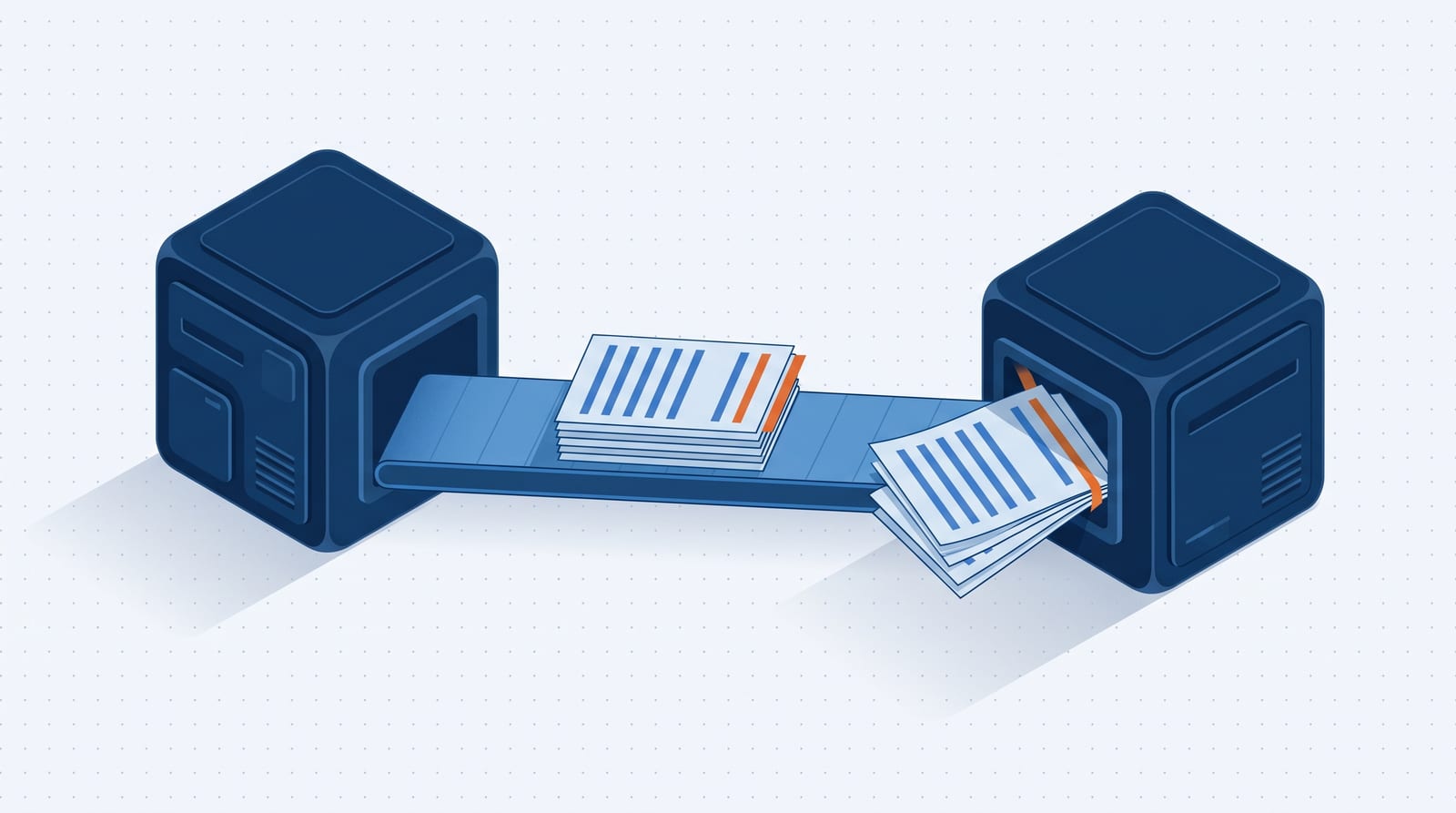
File exchange works as long as the layout is the agreed one. The day someone adds a column to the ERP report, the importer on the other side receives a file it does not recognize.
When the break raises no alarm, it shows up weeks later, at month-end close, as a number discrepancy with no apparent cause.
The second cost is silent and shows up months later: a file layout has no contract. Someone adds a column to the ERP report, the importer breaks, and nobody finds out until month-end close. If this is the chosen option, the minimum is to version the layout, validate the number of columns on input and raise an alarm when the day's file does not arrive.
Mirror database: you can read it, and that is where support ends
Reading directly from the database solves queries and reports, and does not solve writing. This distinction is the most important thing in this section. Reading a copy of the ERP database is a defensible path for a legacy system with nobody maintaining it; writing to the ERP database bypasses the application's validation and is usually forbidden by the vendor's support contract. In SAP Business One, for example, the database being SQL Server does not authorize writing to it, and supported writes go through the DI API or the Service Layer.
The word "mirror" also matters. Pointing reports at the production database turns a badly written query into slowness for whoever is invoicing. The design that works is a read replica, updated at an agreed interval, with read-only access and with queries running away from the database the operation uses.
Pros
- Reaches all the data that exists, including what no API would publish
- Does not depend on the ERP vendor's schedule or budget
- Low implementation cost when the replica already exists for backup
Cons
- Solves reading and not writing, which still depends on the application
- Breaks silently with every version update that changes the table structure
- May conflict with the support clause in the contract, and you check that before, not after
What this table decides: a mirror database is excellent for pulling reports, feeding dashboards and supplying an internal search assistant, and it is the wrong option for posting documents.
RPA: the robot costs US$ 150 per bot per month and breaks when the screen changes
RPA is the only option that needs no cooperation from the ERP, and it is also the one with the most visible unit price. The robot does what a person would do: opens the screen, fills in the field, clicks confirm. To the ERP, it is a user. This solves exactly the case where nothing else works, because the graphical interface always exists.
Power Automate Premium
Attended robot, with a person at the machine US$ 15per user, per month, paid annually- Attended desktop flows
Power Automate Process
Cost reference Unattended robot, running on its own US$ 150per bot, per month, paid annually- Unattended desktop flows
Power Automate Hosted Process
Unattended robot on a Microsoft machine US$ 215per bot, per month, paid annually- Hosted virtual machine included
Source: Power Automate pricing page, Microsoft, read on September 21, 2026 and checked again on November 11, 2026, with the same values. The page itself states that the prices shown are for reference and vary by currency, country, region and organization; the actual price appears at checkout.
Three readings come out of these numbers. First: unattended automation, which is the kind that serves integration, costs ten times the attended robot, because the license stops being for a person and becomes for a process running on its own. Second: the hosted tier charges US$ 65 more per bot so you do not maintain the machine, which is usually cheap compared to the cost of administering a fleet of workstations. Third, and decisive: the robot's price is the smallest of the costs.
The biggest cost of RPA is maintenance. The robot relies on the screen, so it breaks when the vendor changes the layout, when the ERP version changes the order of the fields, when a new warning appears in the middle of the flow. Each of these breaks is an operational incident, not a software bug, and it comes without warning. RPA is a legitimate option when volume is low, the flow is stable and the deadline is short. It is an expensive option when it becomes the company's permanent architecture.
Intermediate layer: building the API the ERP did not publish
The intermediate layer is worth it when more than one system will need the same data. Instead of each consumer inventing its own way to reach the ERP, a single component talks to the legacy system, and everything else talks to that component through a modern, documented interface.
The commercial gain is concrete and has a name: the day the company switches ERPs, the layer changes, not the three consumers. This lowers the cost of the switch and shortens its timeline. It is worth saying what the layer does not do, because the opposite claim is common: architecture design reduces dependence on a vendor, measures it and makes it cheaper. It does not guarantee independence, which is a matter of contract.
The cost is a new component to maintain, with its own queue, retries and monitoring. If the company has a single consumer and no plans for a second, the layer is overhead and the right move is to go direct.
Integration platform: cheap in the pilot, expensive at volume
An integration platform charges per event, and that is why it is misleading in the pilot. The entry bill is tiny and the curve is straight: on Make's Core plan, in the price table read on September 21, 2026, 10,000 credits were listed at US$ 9 per month, which comes to about US$ 0.0009 per credit. The research did not record which billing cycle the US$ 9 corresponded to, and Make itself states that annual billing is cheaper than monthly, so check on its page the price for the cycle the company will sign up for. Multiplying this by the operation's real volume is a two-minute exercise that changes the decision.
There is a second limit almost nobody budgets for, and it is not about price: it is the quota on the other side. When the target is a Brazilian cloud ERP, its API has its own ceiling. Bling (a Brazilian cloud ERP) publishes 3 requests per second and 120,000 per day. Omie (another Brazilian cloud ERP) publishes 960 requests per minute per IP address, 240 per minute for the same combination of IP, key and method, 100 records per page, and blocks the method for 30 minutes, with HTTP 425, on the tenth failed request for the same combination of IP, key and method. A naive sync hits these limits before it hits the budget, and the business symptom is the order that did not go through.
The option almost nobody proposes: buying the vendor's own module
Before building any of the five previous options, ask the ERP vendor for an integration proposal and compare. The answer "it has no API" is sometimes the short form of "it does, and it is a commercial item you did not purchase".
This comparison is usually uncomfortable and almost always worth it, for a reason that is not price: when the integration is the vendor's, responsibility for breakage in the next update is theirs. In the other five options, responsibility belongs to the company or the partner that built it. There is no public price list for these modules in the Brazilian market, so the only way to know is to ask for the proposal in writing, with the scope of fields and the maintenance clause.
When the vendor's proposal comes in too expensive, it is still useful: it becomes the reference ceiling for estimating the other options.
How to choose, and what it changes in the contract
The choice is not technical. It comes from three operational questions: what delay the operation tolerates, what the monthly volume is and who answers the phone when it stops at 11 p.m. on a Friday.
| Option | Typical delay | Where the cost grows | What to put in the contract |
|---|---|---|---|
| Files in a folder | Hours | Fixing broken layouts, always at month-end close | Versioned layout and an alarm when the day's file does not arrive |
| Mirror database | Minutes | Every ERP version update | Read-only access and confirmation that support allows it |
| RPA | Minutes | License per bot plus maintenance with every screen change | Who rebuilds the robot when the ERP changes, and how fast |
| Intermediate layer | Seconds to minutes | Initial build and maintenance of the component | Code ownership, repository access and exit plan |
| Integration platform | Seconds | Price per event and the API quota on the other side | Monthly usage cap and what happens when it is exceeded |
The intermediate layer is the one that supports the most consumers over time, and it is not the right answer for everyone: with a single consumer and a short deadline, files in a folder deliver sooner and cost less. The practical rule that settles the matter is that the chosen option needs to appear in the contract with a name, an owner and a fix deadline. An integration without an owner is the one that disappears from the budget and reappears as an operational outage.
Frequently asked questions
Almost never. Before accepting the answer, confirm in writing whether the product publishes any integration interface, whether it is enabled in that environment, whether the fields you need are exposed and whether what is missing is a contract or development work. These four questions usually change the answer.
Technically you almost always can, and that is where the risk lies. Reading a copy is a defensible path; writing to the ERP database bypasses the system's validation and is usually forbidden by the vendor's support contract. Check the contract first.
It solves the flow, not the data. The robot repeats what a person would do on screen, so it breaks when the screen, the version or the layout changes. Microsoft charges US$ 150 per bot per month for Power Automate Process, with unattended desktop flows, as a reference price on Microsoft's page, checked in November 2026.
When more than one consumer will need the same data and the operation cannot wait for the vendor's schedule. The layer concentrates the rules in one place and leaves the legacy system intact, at the cost of a new component to maintain.
In the pilot, almost always. At volume, the price is per operation. On Make's Core plan, in the price table read in September 2026, 10,000 credits were listed at US$ 9 per month, with no record of which billing cycle, and annual billing is cheaper than monthly; that is less than one US cent per credit, and the bill grows in a straight line with the number of events.
Files in a folder, if a delay of a few hours is acceptable for the operation. It is the option that goes into production fastest and depends least on the ERP vendor.
Sources and method
Research on September 21, 2026. Third-party prices and limits were read on the vendors' official pages on the same date: Microsoft's Power Automate pricing page; Make's plans page; Bling's API v3 limits documentation; and Omie's API usage limits article. Review on November 11, 2026: Power Automate prices, Bling limits and Omie limits were checked again on the same pages and had not changed. The price of Make's Core plan could not be checked again, because the plans page does not show the values without running in a browser, so it appears dated September 21, 2026. Published prices change, and Microsoft itself states that its prices vary by currency, country, region and organization.
The architecture facts about SAP Business One and TOTVS Protheus come from the research we have already published on each, with the vendors' sources cited there. The article does not claim what proportion of ERPs on the Brazilian market publish an API, nor the price of a Brazilian ERP integration module, because no public survey supports either number.