
Índice do artigofaltam 5 min de leitura
Split payments are not just "dividing money". They are about setting clear rules so that commissions, fees and payouts do not turn into an endless argument along the lines of "a payout is missing".
If your company runs (or will run) a marketplace (multiple sellers) or a platform (multiple service providers), finance becomes part of the product.
Because once you charge the customer and pay out to third parties, practical questions come up, such as:
- Who gets paid first: the platform or the seller?
- Does the payout happen right away or days later?
- What is the commission charged on (shipping? discounts? taxes?)
- How do you reconcile what was sold with what landed in the bank?
- Why does money sometimes "disappear" (spoiler: it is almost always fees, refunds, chargebacks or a poorly defined rule).
In this post, I will explain split payments without legalese and without too many technical terms, in a way that helps day-to-day operations.

What you will find here
- What split payments are (and what they are not).
- Who "gets paid first" and why it depends on the model.
- How to define commission and payout rules without ambiguity.
- Reports and reconciliation: how to match order × transaction × payout.
- Common mistakes that turn into disputes (and how to avoid them).
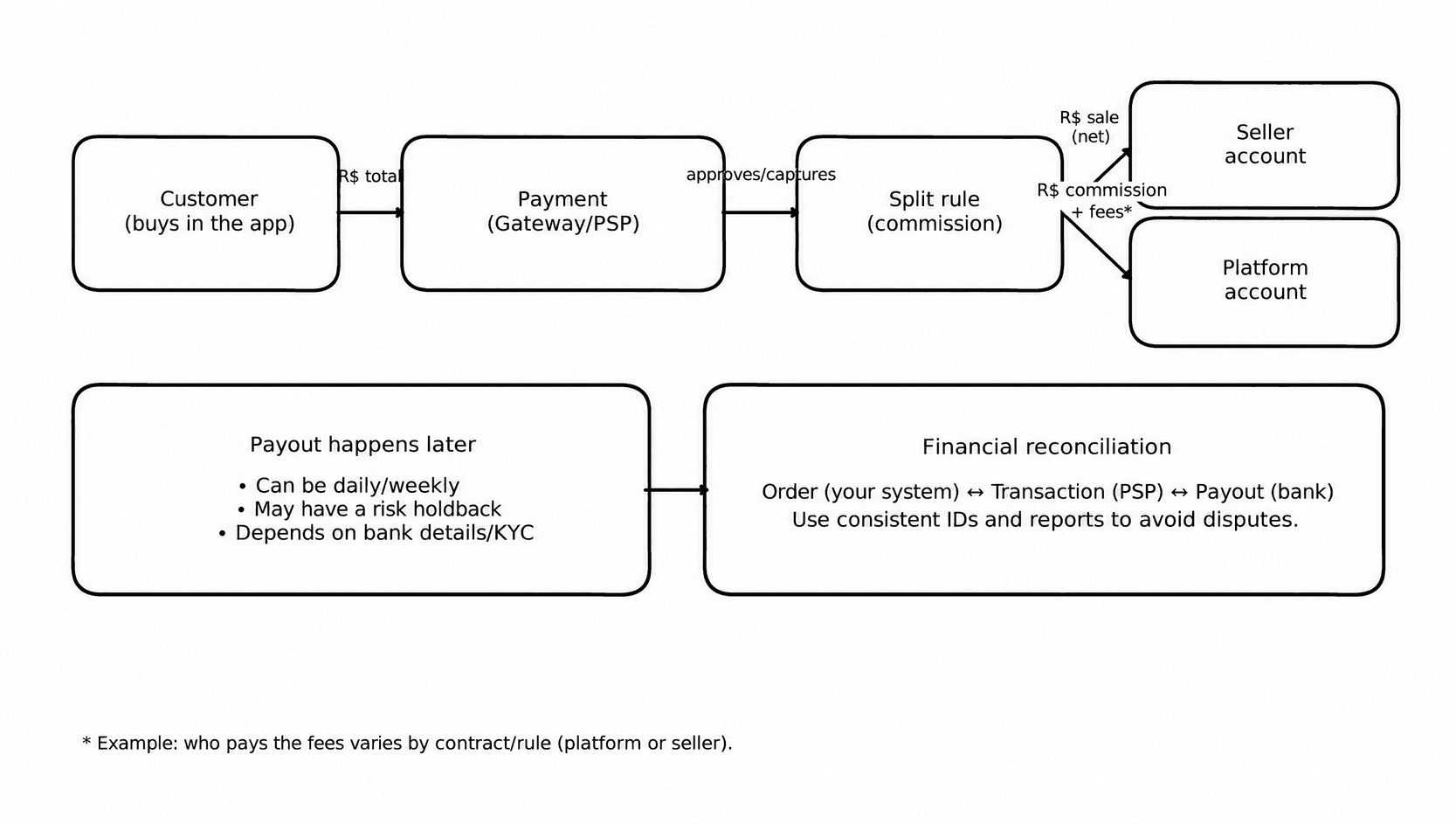
1) What split payments are (in practice)
Split payments are the ability to automatically divide the amount of a purchase between two or more recipients (for example: the seller and the platform), based on predefined rules.
Instead of the platform receiving everything and "running a payout spreadsheet", split payments let you:
- separate what is the seller's sale;
- separate what is the platform's commission;
- separate (when applicable) other shares: courier, affiliate, fees, partner, etc.
The main idea is simple: each transaction is "accounted for" from the start for each party involved.
Important: split payments do not eliminate payouts.
They organize the money into "buckets" (balances), and the payout to the bank happens on a schedule (for example D+7, meaning seven days after the sale, or weekly, or every two weeks).
2) Who gets paid first? (the question everyone asks)
This question comes up in almost every project because the models vary. In practice, there are two different "moments":
- Moment of sale (transaction): when the customer pays and the split rule is applied
- Moment of payout: when the money actually lands in each recipient's bank account
That is why you may see scenarios such as:
- "The sale was today, but the payout is on D+7".
- "The money stays in a held balance until delivery is confirmed / risk is reduced".
- "The seller only gets paid after completing bank details / verification".
In other words: the split defines who the money belongs to; the payout defines when it reaches the bank.
3) Three common marketplace models (and how they change the payout)
There are variations, but most projects fall into one of these models.
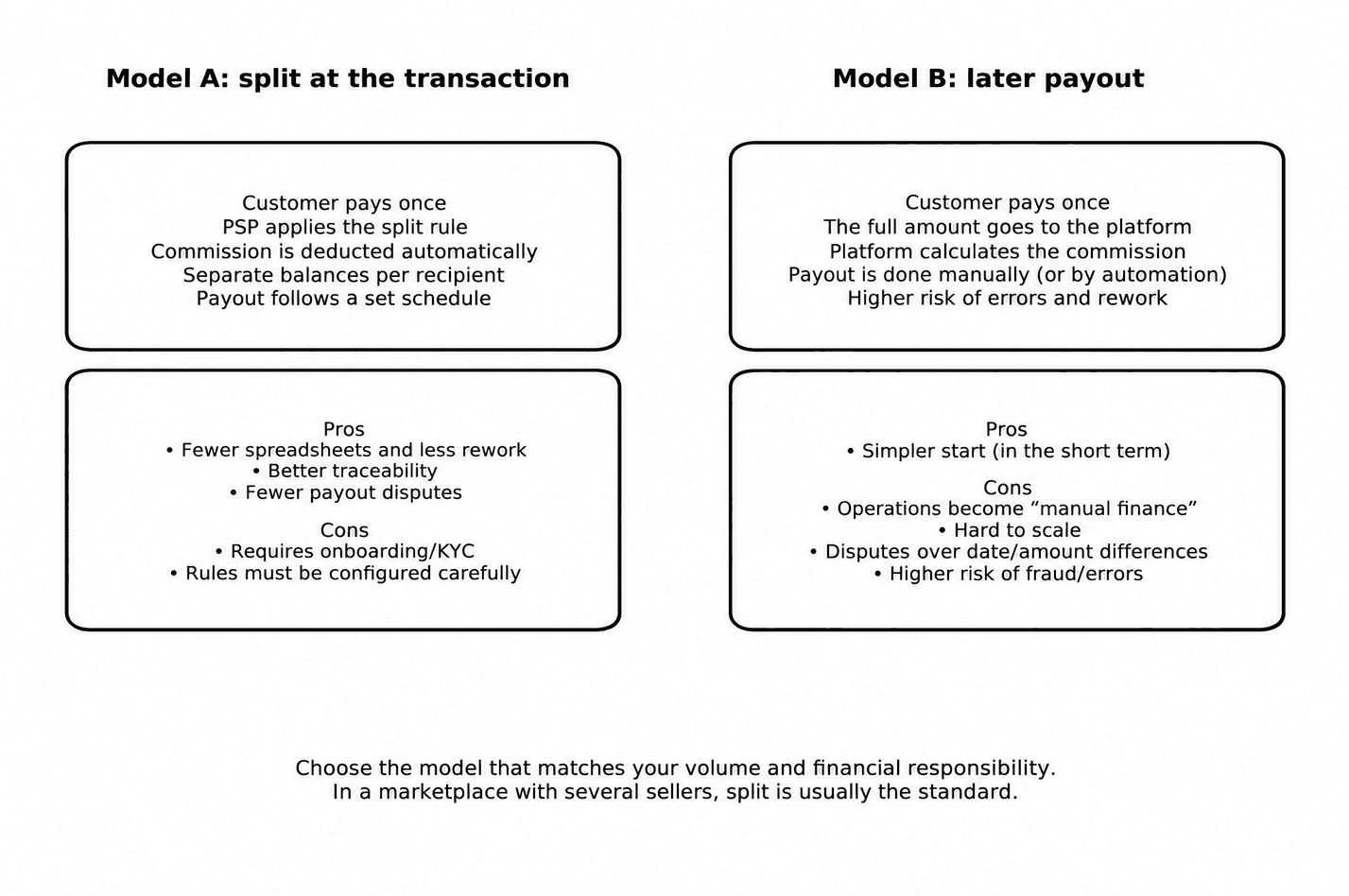
Model A: split at the transaction (the most common in marketplaces)
The customer pays once, the rule is applied, and each recipient gets their own balance.
The payout follows a schedule (for example, weekly).
This model reduces spreadsheets and tends to scale better.
Model B: later payout (the "manual finance" model)
The customer pays and the full amount goes into the platform's account.
Afterwards, the platform calculates the commission and makes the payouts separately (manually or with its own automation).
At first it looks "simpler", but at volume it usually becomes:
- an expensive operation;
- a high risk of error;
- a recurring argument with partners (mainly about dates and fees).
Model C: split with an event-based hold (escrow)
This is common when there is a "release event", for example:
- delivery confirmed;
- service completed;
- the cancellation window has closed.
The money can be held in the balance and only then released for payout.
4) Commission and payout rules: what to define before going live
Most disputes are not "bugs". They are ambiguous rules.
Below is a checklist of definitions that solves 80% of the problem.
4.1 Define the commission base
Explain it with sentences like "it is charged on…".
Examples (pick one and document it):
- Commission is charged on the item subtotal (excluding shipping).
- Commission is charged on subtotal + service fee.
- Commission is charged on the net amount (after payment method fees).
(Careful: this changes how the seller reads the numbers.)
Rules that need to be explicit:
- does a discount/coupon reduce the commission base?
- is shipping included in the commission?
- are service fees included in the commission?
- are taxes included in the commission (when applicable)?
- rounding: how are cents handled?
4.2 Define "who pays the fees" (and how it shows in the report)
There are two possible readings:
- fees are a platform cost (the seller gets a more predictable amount);
- fees are a seller cost (more in line with "you pay for the payment method").
The problem is when nobody defines this and the partner compares the "gross order amount" with the "net amount deposited".
4.3 Define when the payout happens (timing and trigger)
Points that need to be clear:
- schedule: daily, weekly, every two weeks?
- rule by status: paid, delivered, accepted, completed?
- is there an initial hold for new sellers? For how long?
- is there a minimum payout amount (e.g. only pay out above X)?
Tip: always explain the difference between the sale date and the payout date.
4.4 Define how to handle refunds and chargebacks (this prevents 90% of fights)
Typical events that affect payouts:
- full refund;
- partial refund;
- cancellation before capture (when applicable);
- chargeback/dispute (card).
What you need to document:
- what happens to the commission in case of a refund? Is it returned? Kept?
- if the payout has already happened and a refund comes later, how is the adjustment made?
(it usually becomes a "negative balance" deducted from the next payout) - who is liable in case of a chargeback? The seller, the platform or both?
(this needs to be in the contract, but the app needs to reflect it in the report)
Illustrative example (just to visualize)
Suppose a sale of R$ 200.00 (Brazilian reais) on a marketplace:
- commission: 10% (R$ 20.00)
- payment method fees: R$ 6.50 (fictional example)
- seller's net: R$ 173.50
The question you need to answer is: who do the fees come out of?
And how does it show up for the seller: "fees" listed separately or a "final net amount".
5) Reports and financial reconciliation: how to "match" without headaches
Financial reconciliation for a marketplace basically means answering, with traceability:
- What the user bought (the order in your system)
- What was paid and approved (the transaction at the payment provider)
- What was paid out and when (the payout to the bank)
For that, you need consistent identifiers:
- Order ID (your system)
- Transaction ID (gateway/PSP)
- Payout ID (payout/batch)
- Recipient ID (seller/service provider)
The best reconciliation is one that anyone in finance can follow without "calling IT".
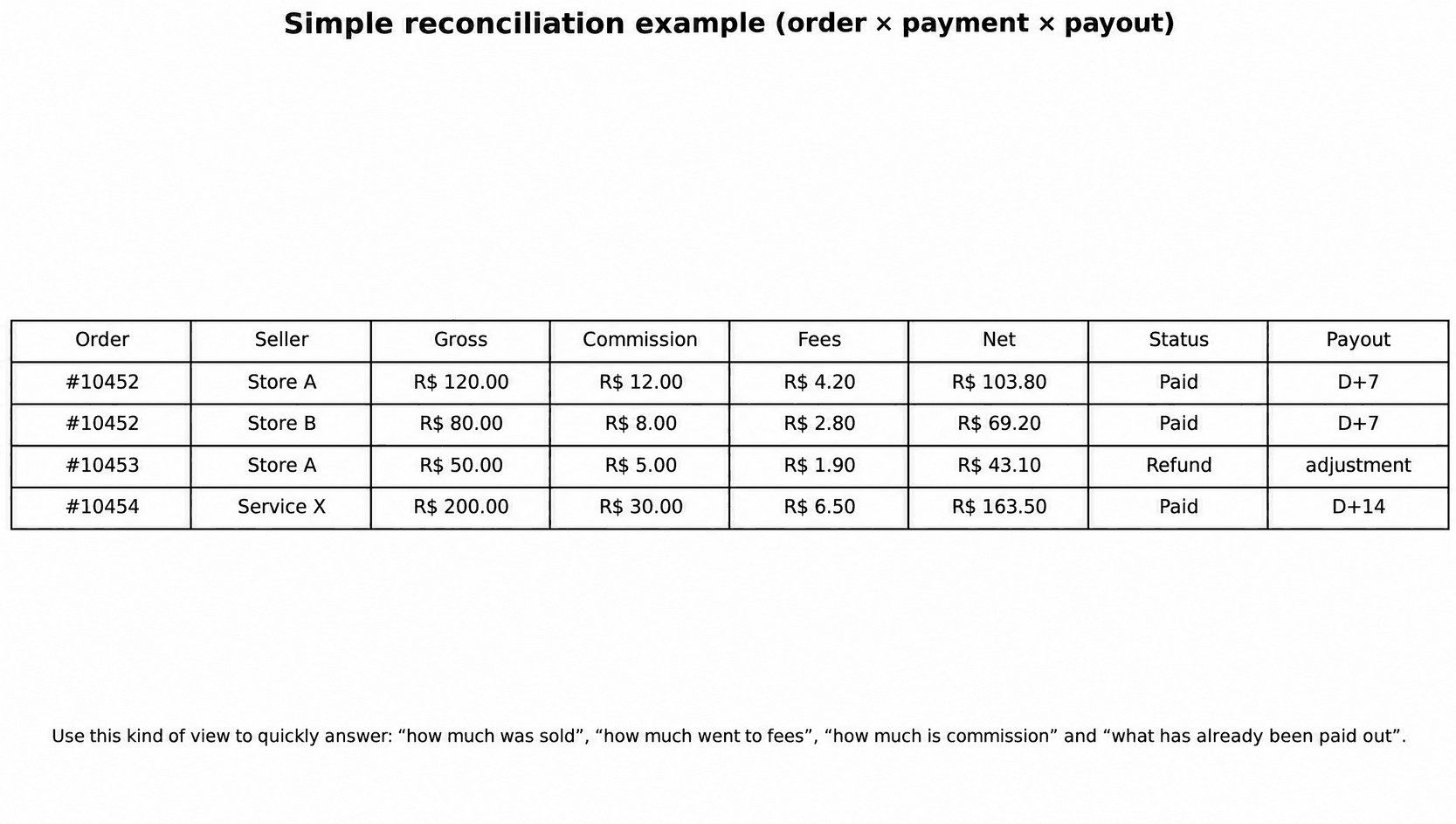
5.1 What a good payout report needs to include
At a minimum, for each seller:
- report period (from/to)
- list of sales (order/items)
- gross
- commission
- fees (if applicable)
- adjustments (refund, chargeback, bonus, discounts)
- net
- status (paid, pending, held, refunded)
- payout date/ID (when it lands in the bank)
5.2 How to avoid the classic "a payout is missing"
"A payout is missing" is almost always one of these cases:
- the seller is looking at the gross, but received the net
- the payout is on D+7 and the seller expects "D+0"
- there was a refund/chargeback and it became an adjustment
- bank details/KYC were incomplete and the payout was held
- the cart had more than one seller and shipping/discount was prorated
If the report shows this clearly, the dispute usually dies in 5 minutes.
6) Common mistakes that turn into disputes (and how to prevent them)
The fastest way to reduce friction is to anticipate the questions.
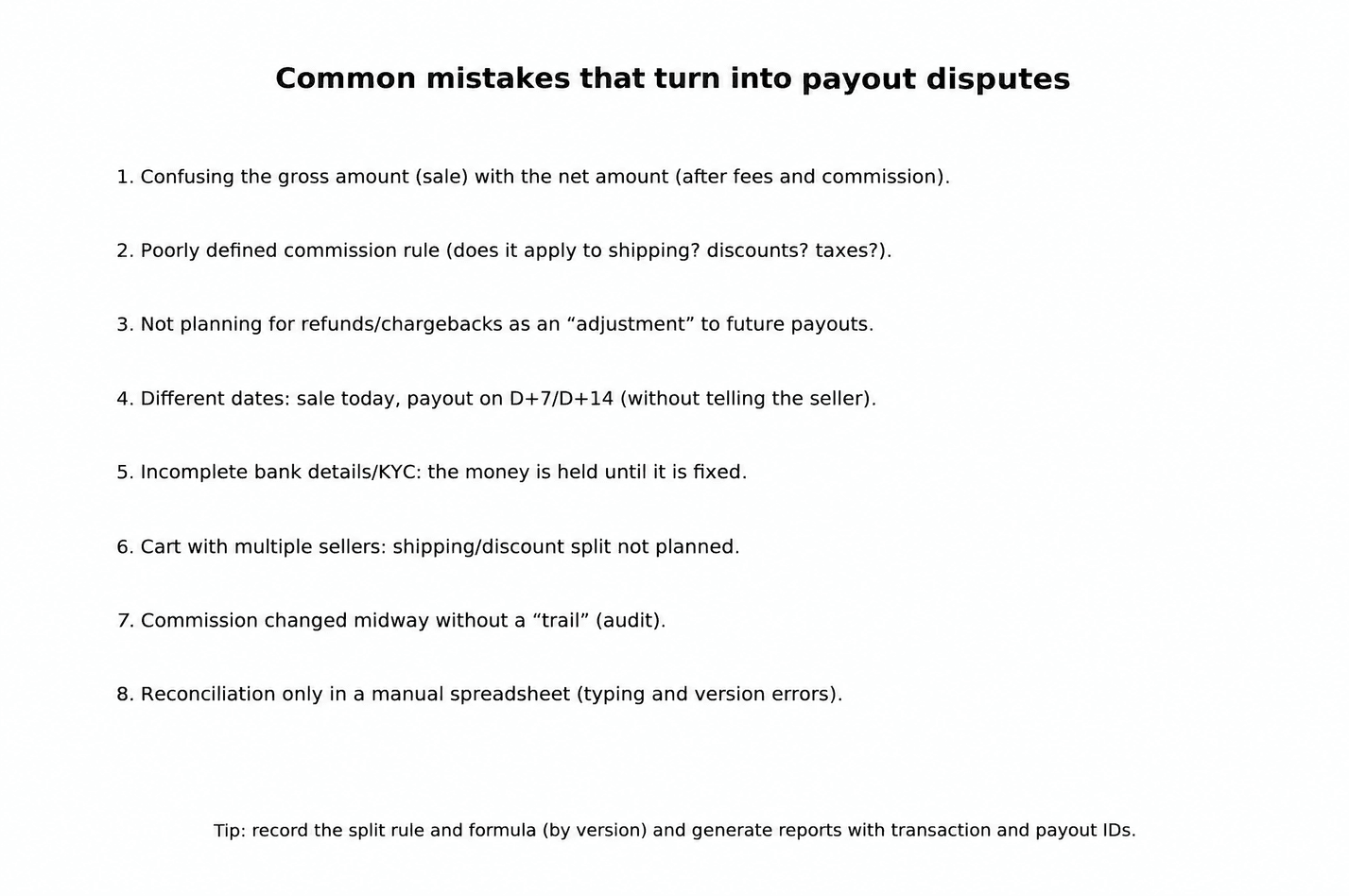
To prevent them, use these simple practices:
- Document the split rule with numerical examples
- Show "gross vs net" in the seller dashboard
- Explain the payout timing (with dates)
- Have an "adjustments" screen (refund/chargeback)
- Use transaction and payout IDs in the report (for auditing)
- Rule versioning: if the commission changes, record "as of when"
Final checklist (copy and use before launch)
- The commission is defined (base, percentage/fixed, rounding).
- It is clear who pays the fees and how this shows on the statement.
- The payout timing is defined and communicated (D+X).
- Refunds and chargebacks have an adjustment rule (including after payout).
- There is a report per seller (sales, fees, commission, adjustments, payout).
- Order/transaction/payout IDs are connected.
- An end-to-end test was run with real scenarios (sale, refund, cart with 2 sellers).
If you solve these points, the marketplace's financial operation stops being a "ticking time bomb" and becomes a predictable, auditable process.