Índice do artigofaltam 17 min de leitura
Direct answer: there is no
gpt-5.6-spark. What exists, and what almost nobody noticed, is OpenAI making the opposite move to the rumor: instead of creating a small, ultrafast model for the 5.6 generation, it put the largest one on Cerebras. If you want speed in Codex, the way forward is not waiting for a new Spark, it is understanding the speed levers that exist. In August there were three; in November 2026 Spark left and Ultrafast came in.
The idea circulating among developers is that OpenAI would launch a GPT-5.6 Spark, that is, a small, almost instant 5.6-generation model running on Cerebras infrastructure, the same way GPT-5.3-Codex-Spark ran from February until it was retired in September. In some groups the name shows up as Luna Spark, gluing the suffix onto the cheapest tier of the family. The hypothesis is tempting because it looks like the obvious next move: the 5.3 generation had its Spark, Luna became 80% cheaper in July and the partnership with Cerebras exists and is active.
We went looking. We combed through API catalogs, changelogs, Codex documentation, the Codex CLI source code, Cerebras's blog and financial results, plus forums and rumor aggregators. The result is more interesting than a simple denial.
Verdict in one table
| Claim | Status on August 5, 2026 |
|---|---|
There is a gpt-5.6-spark model | No. Zero occurrences in official sources, code or community |
| There is some Spark in the 5.6 family | No. The only Spark is GPT-5.3-Codex-Spark |
| Some GPT-5.6 model runs on Cerebras | Announced, not yet launched. GPT-5.6 Sol, at up to 750 tokens/s, promised by OpenAI and confirmed by Cerebras (launched on August 13 as Ultrafast Mode) |
| GPT-5.6 Luna runs on Cerebras | No. No source, from either OpenAI or Cerebras, links Luna to wafer-scale |
| Codex-Spark has been discontinued | Not in August. Update: OpenAI retired it on September 14, 2026 |
| OpenAI plans more ultrafast models | Yes, and said so in February. But pointing to larger models |
How we verified it, and why it matters
A model rumor is easy to spread and hard to kill. That is why it is worth recording the method, which you can repeat in fifteen minutes the next time a new name shows up in your WhatsApp group.
1. Official API catalog. OpenAI's models page lists three models in the 5.6 family: gpt-5.6-sol, gpt-5.6-terra and gpt-5.6-luna. No identifier with "spark" appears in the family. The URL developers.openai.com/api/docs/models/gpt-5.3-codex-spark returns 404, which confirms that the existing Spark is not even a public API model.
2. Codex catalog. On August 5, the Codex models documentation described four relevant options: Sol, Terra, Luna and "GPT-5.3 Codex Spark: text-only research preview model optimized for near-instant, real-time coding iteration". No 5.6 Spark. Update: in November 2026 that address redirects to learn.chatgpt.com/docs/models, which lists Astra, GPT-6.1 Sol, GPT-6.1 Terra and GPT-6 Luna and records Spark as retired on September 14, 2026.
3. Codex's own code. The file codex-rs/models-manager/models.json, in the openai/codex repository, is the catalog the CLI ships with. On August 5, 2026, it was 192 KB of configuration with eight model identifiers, and the strings "spark" and "cerebras" appeared zero times in the entire file. A model in preparation usually leaves traces in code before the announcement. On that date, there was no trace. With the catalog change in November, the size and the count of identifiers have probably changed, but we did not recheck the file after that.
4. GitHub code search. The literal string gpt-5.6-luna-spark returns zero results across the whole platform, and searches for gpt-5.6-spark and gpt-5.6-codex-spark bring up no source, official or community. A loose search for luna-spark returns 44 files, all unrelated to OpenAI: game avatars, an adapter for iFlytek's Spark model, expired domains.
5. Community. On Hacker News, searching for the exact phrase "Luna Spark" returns zero results. In the thread about the GPT-5.6 Sol preview, several users discuss Spark and Cerebras in the same paragraph, but none proposes a 5.6-generation Spark. On August 5, 2026, 200 issues in the Codex tracker mentioned "spark", and the most recent, from August 4, was still about 5.3-Spark.
6. The full documentation dump. On August 5, 2026, the file OpenAI published with all of the Codex documentation in plain text was about 1.43 MB. The phrases "5.6 spark" and "luna spark" appeared zero times, and the word "cerebras" did not appear even once in the entire Codex documentation. Update: in November the documentation moved to learn.chatgpt.com, and we did not re-measure the file after that.
The honest conclusion is stronger than "there is no confirmation": there is not even a traceable rumor. What exists is a reasonable expectation of a pattern, since the 5.3 generation got its Spark, combined with two real and distinct names, gpt-5.3-codex-spark and gpt-5.6-luna, appearing side by side on automated comparison pages. The hypothesis is born from that expectation and that proximity of names, not from a leak.
One caveat on method, because it is fair: Reddit, X and the official OpenAI forum blocked our automated access. If the phrase circulates in some closed channel, we did not reach it. What we can state with confidence is that it does not exist in any official source, any catalog or any public code.
The four things everyone confuses
Most of the confusion about speed in Codex comes from treating four different mechanisms as if they were a single button. In August there were three; Ultrafast came later.
| Mechanism | What it is | How it is paid for | Where it lives |
|---|---|---|---|
| Codex-Spark | A separate model, smaller and less capable | Its own allowance, outside the standard pool | Codex selector, Pro only. Retired on September 14, 2026 |
| Fast mode | A service mode that speeds up the model you already chose | 2.5x the allowance in Codex (2x on purchased credits), 2x the price in the API | /fast command or service_tier |
| Ultrafast | A service mode faster than Fast | 8x the allowance, 6x on purchased credits | In Codex, only GPT-6 Astra and GPT-6.1 Sol, on the US$ 500 Pro plan and eligible Enterprise or Edu plans |
| Cerebras | Hardware on which certain models are served | Built into the price of the model or tier | Infrastructure, invisible in the selector |
In August, the official documentation made this distinction in plain words. The Codex speed page said Codex-Spark "is a separate fast, less-capable Codex model" and that, "unlike fast mode, which speeds up a supported model at a higher credit rate, Codex-Spark is its own model choice and has its own usage limits".
The numbers for each lever, checked at the source (reviewed in November 2026):
- Fast mode in Codex: applies to GPT-6.1 Sol, GPT-6.1 Terra, GPT-6 Astra, GPT-6 Sol and GPT-6 Luna and consumes the plan allowance at 2.5 times the standard rate, or 2 times when usage comes from purchased credits or Enterprise pay-as-you-go. The rule no longer depends on the model. On GPT-5.6, the speed gain is 1.5x. In August, the 2x applied to GPT-5.4, which left Codex on August 31.
- Ultrafast in Codex: only GPT-6 Astra and GPT-6.1 Sol. GPT-6 Astra in Ultrafast generates tokens up to 8 times faster than in standard mode, consuming the allowance at 8 times the standard rate (6 times on purchased credits).
- Fast mode in the API: delivers up to 2.5 times the standard speed for double the price, with no change in intelligence (rechecked in the API documentation on November 11, 2026). It used to be called Priority processing and was renamed on July 30, 2026.
- Codex-Spark: announced at more than 1,000 tokens per second on the Cerebras Wafer-Scale Engine. Retired on September 14, 2026.
The two Fast mode speed figures have diverged from each other since August. In November 2026, the Codex documentation still gives 1.5x for GPT-5.6, and the API documentation talks about up to 2.5x for GPT-5.6 Sol. They are different surfaces, ChatGPT credits versus API tokens, but OpenAI keeps publishing both numbers without reconciling them. It is worth knowing this before promising a speed gain to a client.
If you want to understand in depth how each configuration drains your allowance, we wrote a whole guide on Codex credits by model and reasoning effort.
What Codex-Spark really is
It is worth taking apart the Spark myth before wishing for a new version of it.
GPT-5.3-Codex-Spark was launched on February 12, 2026 as a research preview. It was a scaled-down version of GPT-5.3-Codex, designed to fit and perform on wafer-scale architecture. It was OpenAI's first production model to run on non-Nvidia silicon. Its stated characteristics, while it was available:
- text-only input;
- a context window of 128,000 tokens;
- made minimal, targeted edits and did not run tests automatically unless you asked;
- was available only to ChatGPT Pro subscribers, with separate usage limits that could queue under high demand;
- was not in the public API, only available to a restricted group of design partners.
In practice, the reception was mixed. On Hacker News, one user measured about 150 tokens per second instead of the announced 1,000 and concluded that "it's not a very good model". Another called the model a failure because of its small context window. On the other side, some people used it precisely because it was instant, as in AI-assisted technical interviews, and some considered it better than GPT-5.4-mini for well-specified tasks.
An independent evaluation puts Spark at around 56% on SWE-Bench Pro, against roughly 72% for the full GPT-5.3-Codex. The summary is harsh and correct: speed without intelligence just means failing faster.
Add to that the queue of integration bugs reported between July and August 2026, including HTTP 400 errors from an unsupported reasoning summary parameter and a weekly limit meter stuck at 100%, and it becomes clear why the community felt Spark had aged badly. Just over a month later, on September 14, 2026, OpenAI retired it: it left the ChatGPT desktop app, the Codex CLI and the IDE extension, and the documentation asks anyone who selected it in a configuration or script to switch to an available model. There was no successor with the Spark name.
What GPT-5.6 Luna really is
Luna, on the other hand, aged well in three weeks.
| Feature | GPT-5.6 Luna |
|---|---|
| Context window | 1,050,000 tokens (maximum of 922,000 input) |
| Maximum output | 128,000 tokens |
| Input | Text and image |
| Knowledge cutoff | February 16, 2026 |
| Input price | US$ 0.20 per million tokens |
| Cached input price | US$ 0.02 per million |
| Output price | US$ 1.20 per million |
| Measured speed | About 180 tokens per second |
On July 30, 2026, OpenAI cut Luna's price by exactly 80%, from US$ 1.00 and US$ 6.00 to the current figures, and Terra's by 20%. Sol's price stayed unchanged at US$ 5.00 and US$ 30.00. After that, OpenAI put Sol on a promotional price: on November 11, 2026 the API table shows US$ 4.00 input and US$ 20.00 output, a promotion that the API pricing table says runs until November 30, 2026 (other OpenAI pages guarantee it only until November 21). Luna remains at US$ 0.20, US$ 0.02 and US$ 1.20. Watch out for a catch in the table: prompts above 272,000 input tokens are charged at 2 times on input and 1.5 times on output, for the entire request.
The price cut explains much of the conversation that produced the rumor. After it, Luna became the natural choice for high-volume work, and comparisons started appearing. A practical analysis published on August 1, 2026 measured, on DeepSWE, 67% resolution at US$ 0.61 per task with Luna at Max effort, against 73% at US$ 8.39 with Sol at Max. Almost 14 times cheaper for 6 percentage points less.
But notice what Luna is not: it runs at about 180 tokens per second. That is roughly five times slower than Codex-Spark's announced figure and four times slower than Sol on Cerebras. Luna is cheap and capable. In August, it was not an instant-latency model, and no special hardware treatment was announced for it.
There is a technical detail that reinforces this. On July 29, 2026, OpenAI itself published an engineering piece explaining where the 5.6 family's efficiency comes from: a 20% reduction in the cost of serving the models through optimization of production GPU kernels and more than 15% gain in token generation with speculative decoding. The piece does not mention Cerebras or wafer-scale hardware even once. Luna's price drop came from software running on GPUs, not from exotic silicon.
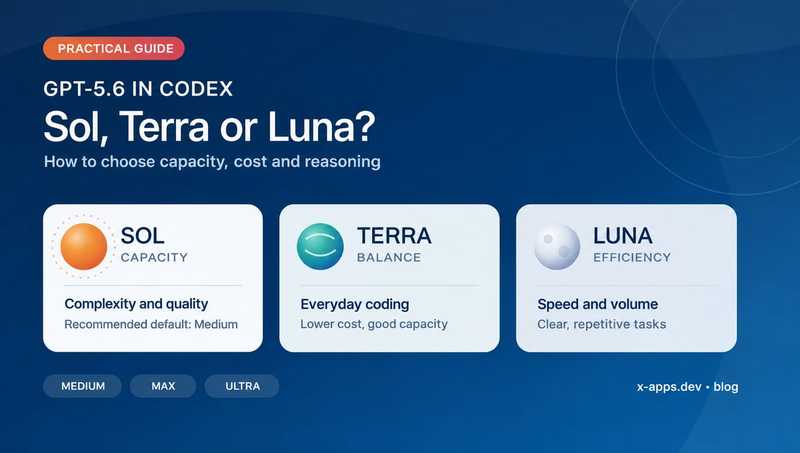
To choose between the three tiers day to day, it is worth reading our guide on Sol, Terra or Luna in Codex.
The real move went up, not down
Here is the data point that turns the rumor upside down.
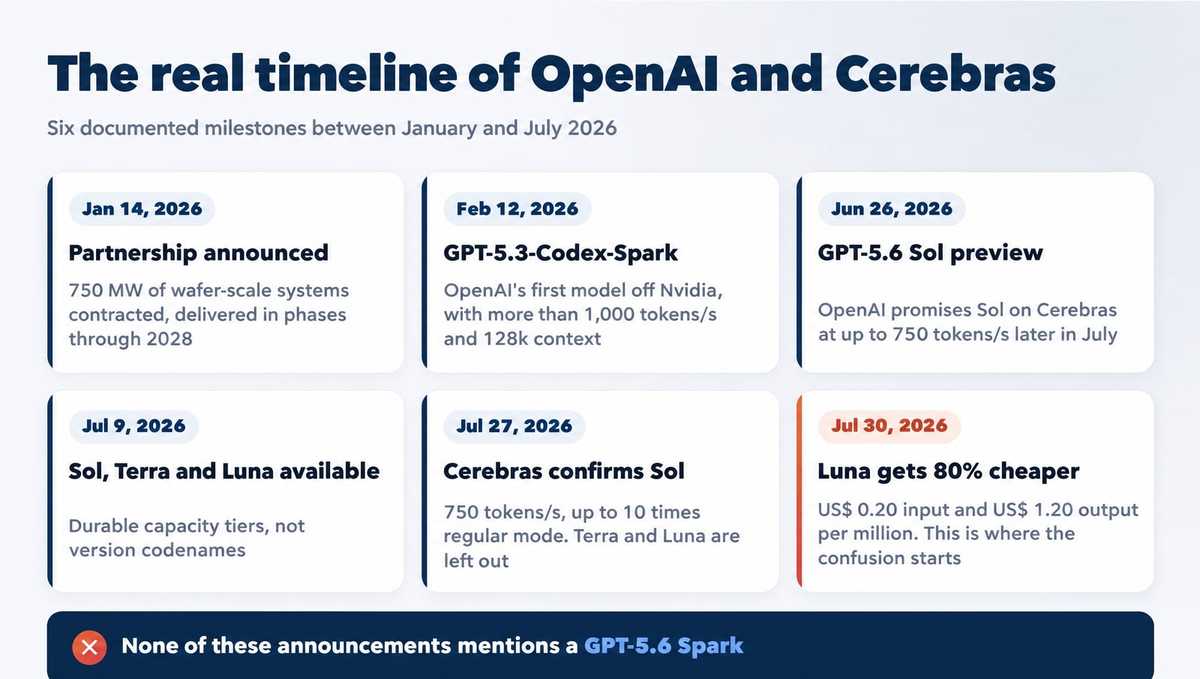
On June 26, 2026, when presenting the GPT-5.6 Sol preview, OpenAI wrote that it would also launch "GPT-5.6 Sol on Cerebras at up to 750 tokens per second in July". On July 27, Cerebras itself published its guide to the 5.6 family confirming: "you can run Sol on Cerebras at 750 tokens per second", described as up to 10 times faster than Sol's regular mode.
In the same text, Cerebras talks about Terra and Luna without linking either of them to wafer-scale. No throughput figure, no mention of deployment.
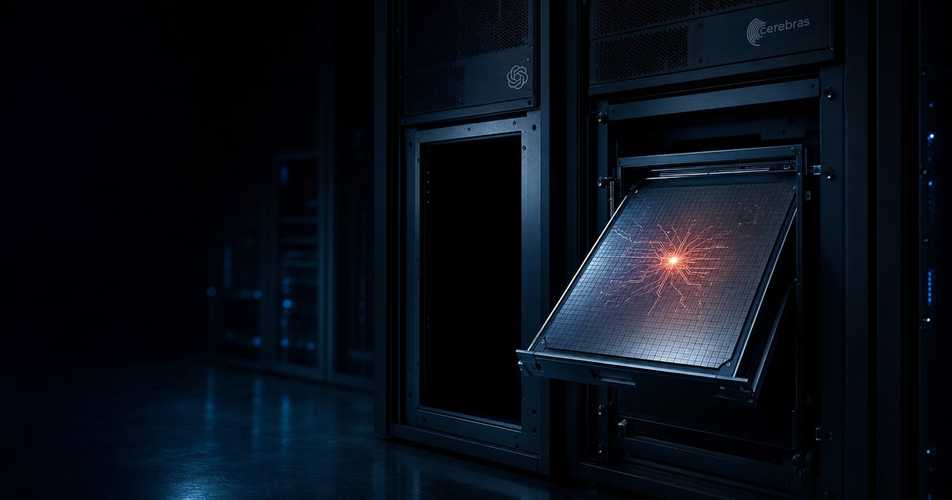
The launch came on August 13, 2026. Cerebras announced Ultrafast Mode, a service tier launched first on the OpenAI API, with GPT-5.6 Sol at up to 750 output tokens per second and initial access restricted to a selected group of customers. After that, Ultrafast reached Codex for GPT-6 Astra and GPT-6.1 Sol, and on November 11, 2026 the API pricing table already lists it only for those two, without GPT-5.6 Sol. OpenAI's documentation does not say which hardware those two run on.
In other words: when OpenAI expanded the ultrafast line, it took the most expensive and most capable model and put it on the fastest hardware, selling the result to a restricted set of customers. It did not take the US$ 0.20 model.
This is consistent with the roadmap stated from the start. In the Codex-Spark announcement, Cerebras wrote that it expected to "bring this ultra-fast inference capability to the largest frontier models in 2026". OpenAI, on the same day, called Spark "the first in a family of ultra-fast models" and promised "larger models, longer context lengths, and multimodal input". Both pointed up. The GPT-5.6 Spark hypothesis, which by definition would be a smaller model, points down.
Why Luna is unlikely to go onto the wafer
There are three reasons, and none of them is a lack of will.
The physical reason
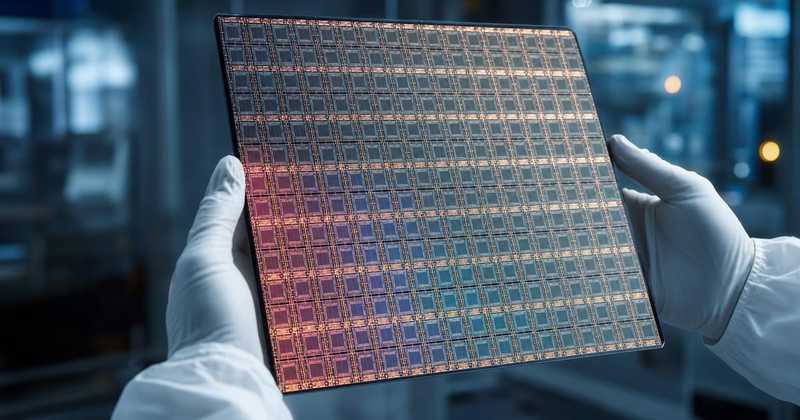
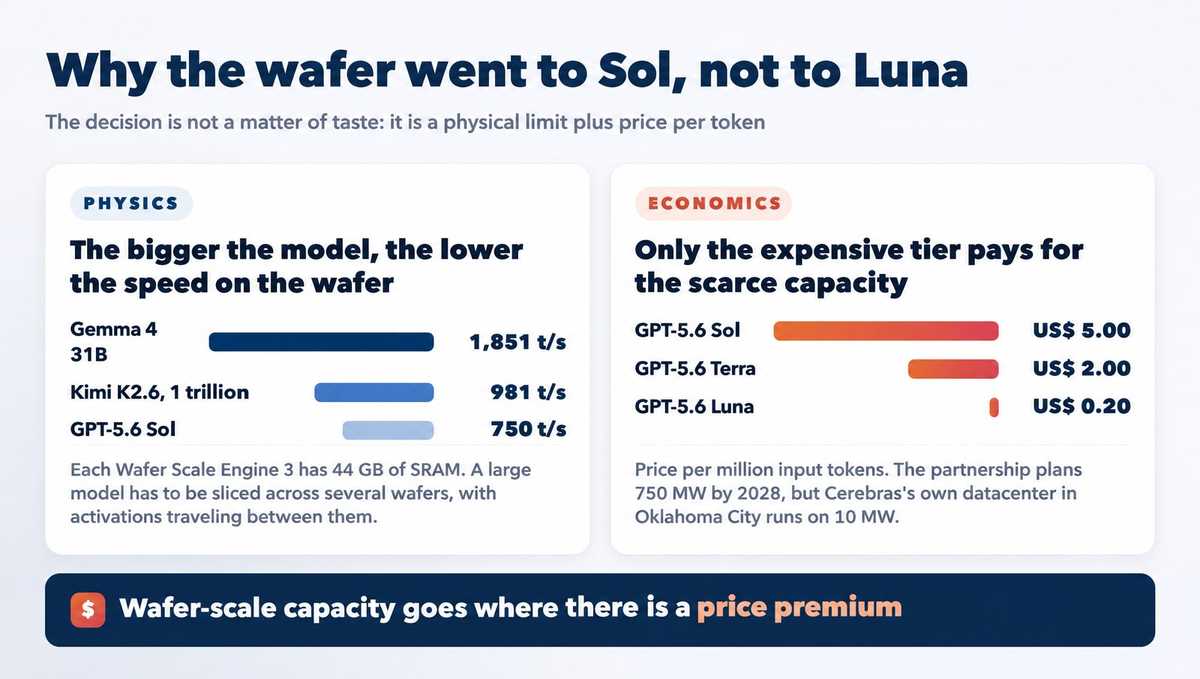
The Wafer Scale Engine 3 is a 46,225 mm² chip, with 900,000 cores, 4 trillion transistors and 125 petaflops of peak performance. The number that decides everything, however, is a different one: 44 GB of on-chip SRAM. It is this memory on the wafer itself, with 21 petabytes per second of bandwidth, that removes the external HBM bottleneck and makes token-by-token decoding fly.
The problem is that 44 GB does not hold a frontier model. To serve Kimi K2.6, with 1 trillion parameters, Cerebras describes weights spread over several wafers, with activations streamed between them and communication running over the internal fabric. Each new model requires compilation and mapping work that resembles VLSI floor planning, a notoriously expensive problem to solve.
Notice the pattern in the numbers Cerebras publishes: Gemma 4 31B at 1,851 tokens/s, the 1-trillion-parameter Kimi K2.6 at 981 tokens/s, GPT-5.6 Sol at 750 tokens/s. The larger the model, the lower the throughput. There is no wafer-scale free lunch.
The economic reason
Wafer-scale capacity is scarce and is being rationed. The partnership foresees 750 MW delivered in tranches through 2028, but Cerebras's data center in Oklahoma City, opened in September 2025, has 10 MW with more than 300 CS-3 systems. The distance between what is committed and what is installed is huge.
The first-quarter 2026 numbers tell the rest of the story. Cerebras had revenue of US$ 193.4 million, almost double the previous year, with OpenAI representing 63% of revenue. Remaining performance obligations add up to US$ 25 billion. And the gross margin projection for the following quarter fell to 36% to 38%, against 46.5% in the previous quarter, because the company had to rent data center capacity from third parties to meet OpenAI's volume while it builds its own infrastructure.
Now do the math from the seller's side. A wafer rented at high cost, serving a model that costs US$ 0.20 per million input tokens, is a terrible allocation of capital. The same wafer serving Sol, at US$ 5.00 input and US$ 30.00 output, with Fast mode charging double that, pays the bill. Wafer-scale goes where there is a price premium, and Luna exists precisely so there is no premium. (The Sol prices cited here are those from August 2026.)
The naming reason
When launching GPT-5.6, OpenAI was explicit: "The number identifies the generation, while Sol, Terra, and Luna are durable capability tiers that can advance on their own cadence". Sol, Terra and Luna are durable capability tiers, not version codenames.
"Spark", in turn, was never a rung on that ladder. It was always a Codex product: the full name of the only one that existed is gpt-5.3-codex-spark, retired in September 2026, with "codex" in the middle. That makes "GPT-5.6 Spark", on its own, an unlikely name: it leaves out precisely the part that defines what the model is. In August, if an ultrafast successor appeared, the name consistent with the taxonomy would be gpt-5.6-codex-spark. It did not appear. And "Luna Spark", the other form in circulation, is even less likely, because it would attach a fourth surname to a tier OpenAI had just declared durable.
One more detail reinforces this: the 5.6 family has no Codex variant at all. Codex uses Sol, Terra and Luna directly, and the last generation with its own Codex model was 5.3. In other words, for a GPT-5.6-Codex-Spark to exist, OpenAI would first have to go back to creating Codex-specific models, something it stopped doing. Generation 6 kept the pattern: the Codex selector uses Astra, Sol, Terra and Luna, with no Codex variant.
What was plausible in August, and what happened
Separating wishes from evidence, these were the scenarios in order of probability on August 5, 2026. The outcome of each one, checked in November, appears alongside.
- Wider access to GPT-5.6 Sol on Cerebras. On August 5, already announced and confirmed by the vendor, but not yet launched. It was just a matter of capacity coming online. Evidence: strong and dated. Outcome: on August 13 Cerebras launched Ultrafast Mode with GPT-5.6 Sol on the API, initially for selected customers. On November 11, the API pricing table lists Ultrafast only for GPT-6 Astra and GPT-6.1 Sol.
- Expansion of Fast mode as a product. OpenAI already monetizes speed through price, without creating a new SKU. The documentation says future models may support Fast mode, with no guarantee for all of them. Evidence: strong. Outcome: it happened. In Codex, Fast mode applies to GPT-6.1 Sol, GPT-6.1 Terra, GPT-6 Astra, GPT-6 Sol and GPT-6 Luna, where available, and Ultrafast became a second paid tier.
- A GPT-5.6-Codex-Spark replacing 5.3. Consistent with the promise of a "family of ultra-fast models" and with the age of the current Spark. Evidence: circumstantial, no sign in code or changelog. Outcome: it did not happen. Spark was retired on September 14 with no successor of that name.
- Terra or Luna on wafer-scale. Technically easier than Sol, economically hard to justify. Evidence: none. Outcome: we found no announcement up to November 11.
- A model literally called GPT-5.6 Spark, or Luna Spark. Evidence: zero. Outcome: it does not exist.
A final reminder of skepticism that applied to all five scenarios: in August, no independent benchmark had measured Codex-Spark or Sol running on Cerebras. The figures of 1,000 and 750 tokens per second are self-reported by OpenAI and Cerebras. In August, independent measurement providers listed only open-weight models on Cerebras.
What to do about this in your team today
None of this changes your roadmap if you keep treating speed as a single button. It changes a lot if you build your workflow in layers. This section was rewritten in November 2026 with the current Codex model lineup; the August version recommended GPT-5.6 Sol and GPT-5.6 Luna, which remain in the API but left the recommended list.
Use GPT-6.1 Sol to reduce uncertainty. Architecture, hard bugs, changes that span many files, review of critical code. OpenAI describes it as performance close to Astra at a lower cost. In the API, it costs US$ 2 per million input tokens and US$ 10 output. Save Astra (US$ 10 and US$ 50) for the most demanding work, when Sol is not enough.
Use GPT-6 Luna to execute what has already been decided. Extraction, classification, transformation, tests, structured summaries, mechanical migrations. In Codex, it uses 2.5 credits per million input tokens, against 50 for GPT-6.1 Sol: 20 times less. In August, with the 5.6 generation, a practical measurement already showed Luna at Max effort 14 times cheaper per task than Sol at Max.
Use Fast mode with judgment. It makes sense when someone is waiting in front of the screen: interface iteration, visual tweaks, short correction cycles. It makes no sense at all in overnight jobs, batch processing or CI pipelines, where 2.5 times the allowance consumption (2 times on purchased credits) only buys the satisfaction of watching the log scroll faster. Ultrafast follows the same logic with a higher bill: 8 times the allowance.
Do not build your architecture on privileged access. Codex-Spark was a research preview with its own limits that could queue, and it was retired on September 14, 2026: anyone who had gpt-5.3-codex-spark hard-coded in a configuration or script was left without the model. In Codex, Ultrafast is restricted to the US$ 500 Pro plan and eligible Enterprise and Edu plans. Neither should become a dependency of your delivery process. If your workflow breaks without them, it is already broken.
The rule we use in our projects is simple: latency is a product requirement, not a developer preference. When the end customer is waiting for the answer, every second is money and paying for speed is worth it. When the one waiting is a pipeline, the only number that matters is cost per task completed correctly.
If the topic is choosing the right tool for each stage, it pairs well with which AI to use to build software prototypes and the comparison of ultrafast inference with open models.
A checklist for the next rumor
Another model name will show up this week. Before replanning anything:
- Look for the exact identifier on the API models page and in the Codex catalog. If it is not there, it does not exist for you.
- Check the official changelog with a date. A real announcement has a date and a changelog entry.
- Look in the code. The
models.jsonfile in the openai/codex repository shows what the tool knows before the documentation catches up. - Check the hardware vendor mentioned. If someone says it runs on Cerebras, Cerebras usually publishes its post before or at the same time.
- Be wary of round numbers without third-party measurement. An announced thousand tokens per second turned into about 150 measured by a real user.
If the name survives all five steps, then it is worth talking about architecture.
The summary that matters
GPT-5.6 Spark does not exist, and its absence is not a bureaucratic catalog detail. It reveals how OpenAI is actually allocating the scarcest resource of the moment, which is very low-latency inference capacity: upward, where there is a price premium, and not downward, where there is cheap volume.
The cheap model got much better in July. The instant model was a limited preview from February and was retired in September. And the bridge between the two, for now, is not a new product: it is an architecture decision you make inside your own workflow.
And in your team, who controls the selector?
Here is the question that usually divides the teams we work with: have you defined in writing which model goes into which stage of your process, or does each person choose based on what they read on Twitter that morning? Standardizing this usually saves more than any model switch.
If you want to discuss this design applied to your product, with your team's real volume and cost, talk to us about AI-assisted development.
Sources consulted
- OpenAI API model catalog
- GPT-5.6 Luna technical sheet
- Models available in Codex
- Speed and Fast mode in Codex
- OpenAI API changelog
- Introducing GPT-5.3-Codex-Spark
- Previewing GPT-5.6 Sol
- GPT-5.6: Sol, Terra and Luna naming
- Price cut and Fast mode in the API
- Cerebras: guide to GPT-5.6 Sol, Terra and Luna
- Cerebras: Codex-Spark announcement
- Wafer Scale Engine 3 specifications
- Cerebras first-quarter 2026 results
- openai/codex repository on GitHub
- Codex models and retirements, November 2026
- Fast mode and Ultrafast in Codex, November 2026
- Codex pricing and credits, November 2026
- Cerebras: Ultrafast Mode with GPT-5.6 Sol
Read also:
- GPT-5.6 Sol, Terra or Luna: which model to choose
- Codex credits: how much each model and effort level costs
- Speed is the new intelligence: what Cerebras changes in the cost of your AI
- How to get more out of ChatGPT and Codex without spending more credits
- The US$ 500 ChatGPT for developers: cost and risk for client code
Catalogs, prices and speeds verified on August 5, 2026. Retirements, speed modes, the recommended Codex lineup and API prices reviewed on November 11, 2026. AI models change name, price and availability within weeks, so confirm in the official documentation before making any architecture decision.
Frequently asked questions
No. On August 5, 2026, OpenAI's official catalog lists only gpt-5.6-sol, gpt-5.6-terra and gpt-5.6-luna in the 5.6 family. The only model with Spark in its name is GPT-5.3-Codex-Spark, launched in February 2026. There is no announcement, changelog, leak or code string supporting the existence of a 5.6-generation Spark, whether named GPT-5.6 Spark, Luna Spark or GPT-5.6-Codex-Spark. On November 11, 2026 it still does not exist: the API pricing table has no Spark model, and GPT-5.3-Codex-Spark itself was retired on September 14, 2026.
Two documented cases so far. GPT-5.3-Codex-Spark, from February 12 to September 14, 2026, when it was retired, and GPT-5.6 Sol, which OpenAI promised on June 26, 2026 and Cerebras confirmed on July 27, 2026, running at up to 750 tokens per second. On August 13, 2026, Cerebras announced this service as Ultrafast Mode, launched first on the OpenAI API and initially open to a restricted group of customers. On November 11, 2026, the API pricing table lists the Ultrafast tier only for GPT-6 Astra and GPT-6.1 Sol, without GPT-5.6 Sol. GPT-5.6 Luna does not run on Cerebras hardware.
Fast mode speeds up a model you already use and charges more for it. In the API, it costs double the standard price. In Codex, in November 2026, it applies to generation 6 (GPT-6.1 Sol, GPT-6.1 Terra, GPT-6 Astra, GPT-6 Sol and GPT-6 Luna) and consumes the plan allowance at 2.5 times the standard rate, or 2 times when usage comes from purchased credits. On GPT-5.6, the speed gain is 1.5x. Codex-Spark was a different model, smaller and less capable, with its own option in the selector and separate usage limits, and it was retired on September 14, 2026. Today the speed lever above Fast mode is Ultrafast, which in Codex applies only to GPT-6 Astra and GPT-6.1 Sol.
It replaces it on cost and capability, not on latency. Luna costs US$ 0.20 per million input tokens and runs at about 180 tokens per second in independent measurement. Codex-Spark was announced at more than 1,000 tokens per second. They were products solving different problems: one is cheap and capable, the other was instant and limited. Since September 14, 2026, Spark is no longer available, and the recommended volume model in Codex became GPT-6 Luna.
Wafer-scale capacity is scarce and expensive. Each Wafer Scale Engine 3 has 44 GB of SRAM, so large models must be spread over several wafers in a pipeline. That rationed capacity goes to the model that commands a premium price, which was Sol at US$ 5 per million input tokens in the August 2026 table (in November, US$ 4 at a promotional price), not the US$ 0.20 tier.
Yes, it already has been. OpenAI retired GPT-5.3-Codex-Spark on September 14, 2026, and it is no longer available in the ChatGPT desktop app, the Codex CLI or the IDE extension. Anyone who had the model in a configuration, agent or script needs to switch to an available model. In the same period, on separate dates, GPT-5.4 and GPT-5.4-mini had already left Codex with ChatGPT login on August 31, 2026 (replacements: gpt-6-sol and gpt-6-luna), and GPT-5.5 left later, on October 14, 2026.
Check four sources in order: the OpenAI API models page, the official changelog, the models.json file in the openai/codex repository on GitHub and the blog of the hardware vendor mentioned. If the model identifier does not appear in any of them, you are looking at a user's proposal, not a leak.