Índice do artigofaltam 30 min de leitura
Straight recommendation: choose the fastest and cheapest model that clears the quality floor your customer service requires. Speed is an operational advantage, not a substitute for naturalness, persuasion or staying true to the brand's voice. And only you can measure the quality floor, because no public ranking measures Brazilian business Portuguese.
Article summary
- Parameter count is no longer a spec: OpenAI and Anthropic stopped publishing model sizes, and Kimi K2.6 activates about 32 billion parameters per token, not 1 trillion.
- Tokens per second is not the time the customer feels: in the August 2026 measurement, time to the first answer token was 1.55 s for GPT-OSS-120B on Cerebras and 15.67 s for Gemini 3.6 Flash.
- Three thousand conversations a month cost US$ 10.20 on GPT-OSS-120B and US$ 54.00 on Gemini 3.6 Flash at the 2027 list price, a difference of US$ 43.80 per month. GPT-6 Luna and Claude Haiku 5.5 do the same math for US$ 3.60.
- Cerebras has no permanent free plan: the Free Trial gives US$ 5 in credits that expire in 30 days and requires a verified payment method.
- No public ranking measures Brazilian business Portuguese, so the deciding metric is cost per correctly resolved conversation, measured with your own cases.
For three years, the market bought artificial intelligence the way people buy cars by engine size: the bigger the number, the better.
In 2026 that number became a footnote. The two companies that lead the reasoning rankings, OpenAI and Anthropic, simply stopped publishing the size of their models. What they publish today is price per million tokens, context window, reasoning effort levels and benchmark results.
But the pendulum swung too far the other way. Swapping "how many billions of parameters" for "how many tokens per second" is the same mistake with a different metric. Customer service that answers instantly and writes badly loses the customer just the same.
This article compares the models available today on the three axes that really decide: speed, cost and writing quality. And it shows why the third is the hardest to measure, and the most expensive to get wrong.
Quick summary for those in a hurry
| If your problem is... | Initial choice | Why |
|---|---|---|
| Classifying intent, checking status, updating the CRM | GPT-OSS-120B on Cerebras | 1,851 tokens/s measured, US$ 0.35 per million input, open weights |
| Reading a screenshot, a photo of a payment slip or a receipt | Qwen 3.8 27B on Cerebras | Accepts PNG or JPEG images directly, without leaving the fast infrastructure; replaced Gemma 4 31B, which left shared inference on September 3, 2026 |
| Long document or complex PDF | Gemini 3.6 Flash | Natively multimodal and good at text, but 15.67 s to answer in the August measurement |
| Tough negotiation, serious complaint, proposal | Claude Opus 5.5 | The model Anthropic recommends as the starting point for most workloads, at a cost that is only justified as an exception |
| Very high-value text, executive communication | Claude Fable 5.2 | Anthropic's recommendation for demanding reasoning; Fable 5 led the writing ranking in August. It is the most expensive of the current generation |
| Validating the idea on a small budget | Cerebras Free Trial | US$ 5 in credits that expire in 30 days, requires a payment method |
| Huge volume on a minimal budget | GPT-6 Luna or Claude Haiku 5.5 | US$ 0.10 per million input and US$ 0.50 output, the cheapest in the comparison |
If you want to jump straight to the numbers, go to the WhatsApp math. If your problem is choosing by quality, go to the answer quality section.
The end of the parameter race
Parameter counts died for three concrete reasons.
First: the number became marketing. Kimi K2.6, from Moonshot AI, has 1 trillion parameters on paper. But it uses an architecture called Mixture-of-Experts: instead of activating the whole model for each word, a router picks only a few specialized subnetworks per token. In practice, Kimi K2.6 activates about 32 billion parameters per token, not 1 trillion. GPT-OSS-120B has 117 billion in total and activates 5.1 billion. Saying "trillion-parameter model" describes the size of the file on disk, not the capacity that runs for each word.
Second: the leaders no longer tell. No one outside Anthropic knows how many parameters Claude Opus 5.5 has. No one outside OpenAI knows the size of GPT-6.1 Sol. Estimates circulate in technical forums, but none is confirmed and none should go into an architecture decision.
Third: small models caught up with large ones in raw capability. Gemma 4 31B, from Google DeepMind, is a dense model with 30.7 billion parameters under an Apache 2.0 license, and it competes head to head with entry-level proprietary models.
The practical conclusion is uncomfortable: parameter count stopped being a spec and became a compression ratio. The right question became "how many tokens per second, at what cost, with what quality?"
And it is on the third part of that question that almost everyone slips.
Speed: what the numbers really say
There is an evaluation mistake that repeats in almost every customer service project. The team tests five models in the playground, picks the one with the best answer and only discovers the problem in production: the customer does not wait.
But measuring this by "tokens per second" is misleading, and badly so.
Tokens per second is not the time the customer feels
A model can generate text very fast once it starts and still take a long time to start. When the model reasons before answering, the customer stares at the screen during all of that reasoning.
The cleanest proof is to compare the same model with itself. Gemini 3.5 Flash, on the same provider, measured by Artificial Analysis in August 2026 (since then Google removed 3.5 Flash from AI Studio and began routing its API calls to 3.6 Flash, but the effect the measurement shows still holds):
| Gemini 3.5 Flash | Tokens per second | Time to first answer token |
|---|---|---|
| Minimal effort | 168.3 | 1.05 s |
| High effort | 181.1 | 16.76 s |
Notice: at high effort it generates faster, and even so the customer waits sixteen times longer. The variable is not generation speed, it is the reasoning time before the first visible word.
The same pattern appears in Gemini 3.5 Flash-Lite: 391.5 tokens/s, throughput far above the category median, but 8.63 seconds to the first answer token.
And the most important case for anyone choosing a model now is Gemini 3.6 Flash, launched on July 21, 2026 and recommended in several recent comparisons. At the high-effort setting, Artificial Analysis measured it in August 2026 at 212.7 tokens per second, well above the category median of 72.8 t/s. And it also measured 15.67 seconds to the first token, against a median of 2.80 seconds among reasoning models in the same price range.
In other words: it generates fast and takes a long time to start. For an asynchronous report, that is irrelevant. For someone waiting on WhatsApp, it is the difference between a conversation and a customer who gives up.
Where Cerebras really stands
Here I need to correct a number that circulates widely, including in an earlier version of this article.
Cerebras publishes about 3,000 tokens/s for GPT-OSS-120B, and not only in an old post: the number is in the speed column of the model catalog and on the model's own page, in the current documentation. But it is the company's own number, with no independent measurement cited. Artificial Analysis measured 1,851 tokens/s in August 2026 and stated on its providers page that no provider comes close to 3,000 tokens/s. Both are real, with different origins: one is a spec declared by the vendor, the other is a third-party measurement.
The third-party numbers, in August 2026:
| Model on Cerebras | Tokens per second | Time to first answer token |
|---|---|---|
| GPT-OSS-120B | 1,851 | 1.55 s |
| Gemma 4 31B (left shared inference on 9/3/2026) | 1,508 | 2.0 to 3.2 s |
The Cerebras catalog has changed since then. Gemma 4 31B left shared inference on September 3, 2026 and remains only on dedicated endpoints; Cerebras itself names Qwen 3.8 27B as its replacement, a dense, multimodal model with 27 billion parameters. For it, Cerebras declares about 1,850 tokens/s, a vendor figure, with no independent measurement cited here. In November 2026, the shared inference catalog has only these two models: gpt-oss-120b and qwen-3.8-27b.
That is still a huge difference against the 100 to 400 tokens/s typical of GPU endpoints. But the advantage is one order of magnitude, not twenty times, and the time to the first answer is not zero: it is about 1.5 seconds.
How long the customer is willing to wait
The honest answer: less than is commonly claimed, and more than marketing articles suggest.
There is no study supporting specific abandonment thresholds in seconds on WhatsApp. What exists, and is a classic citable source, are Miller's limits as consolidated by Nielsen: 1 second is the ceiling for not breaking the user's flow of thought, and 10 seconds is the ceiling for keeping their attention on the task.
With that yardstick, the picture becomes clear:
- 1.55 s for GPT-OSS-120B on Cerebras: close to the fluidity limit, a great experience;
- 8.63 s for Gemini 3.5 Flash-Lite with reasoning: within the range where attention starts to drift;
- 16.76 s for Gemini 3.5 Flash at high effort: above the attention limit.
And it is worth noting a counterpoint that goes against commercial intuition: academic research does not show that faster is always better. Gnewuch and colleagues, in a study published in BISE in 2022 with 202 participants, found that a moderately delayed response increases perceived social presence and intention to use among novice users. A 2025 study in IJHCI showed that the "typing" indicator neutralizes much of the latency penalty.
The infrastructure revolution: the Cerebras phenomenon
To understand why Cerebras gets these numbers, you need to understand why a GPU is slow at generating text. And the answer is surprising: it is not a lack of compute power, it is a lack of memory bandwidth.
To generate each word, the chip needs to read the model's weights from memory. On a GPU, those weights live in external memory and need to cross a bus to reach the cores. The cores spend most of their time idle, waiting for data. When the model does not fit on one card, it is split across several GPUs, and now data also travels over cables between cards.
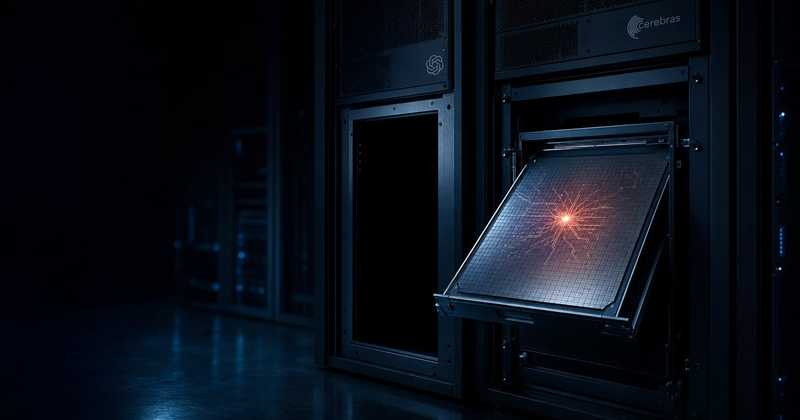
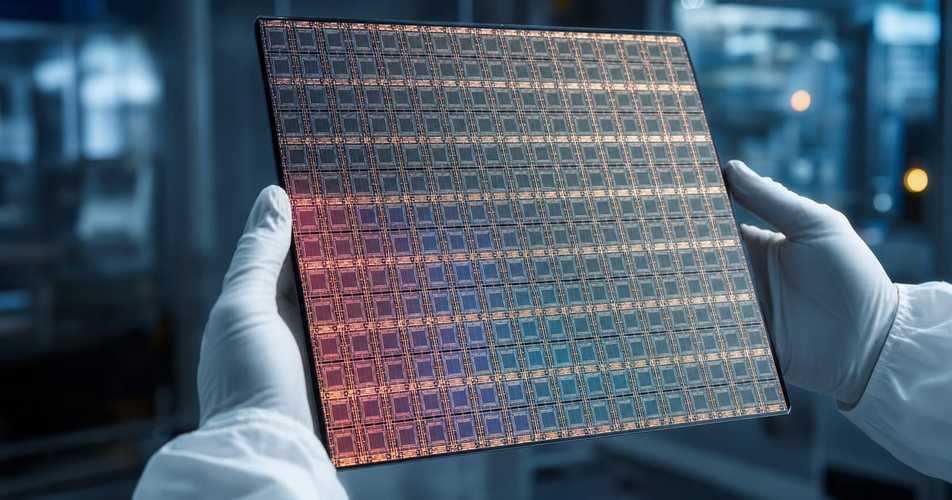
Cerebras attacked exactly this bottleneck with an engineering decision that sounds absurd. A regular chip is made on a 300 mm silicon wafer that is then cut into hundreds of dies. Cerebras does not cut. The Wafer-Scale Engine 3 uses the whole wafer as a single processor:
That last item is what changes the game: the weights stay in ultra-fast memory inside the silicon, a few millimeters from the cores.
| Criterion | GPU cluster | Wafer-Scale Engine 3 |
|---|---|---|
| Where the weights live | In memory outside the chip | In 44 GB of SRAM inside the silicon itself |
| Path to the cores | Crosses a bus, with the cores idle waiting for data | A few millimeters, with no external bus |
| Model that does not fit on one card | Split across several GPUs, with data traveling over cables between cards | No splitting and no cables between cards |
Comparison built from the architecture description in this section. The bottleneck is not a lack of compute power, it is a lack of memory bandwidth.
Answer quality: what speed and price do not show
We now reach the part that most comparisons, including the first version of this article, treat with adjectives instead of evidence.
An answer can be factually correct and still be bad for the customer: too long, robotic, too formal, unconvincing or out of step with the company's voice. For business customer service, quality breaks down into at least five dimensions:
- Naturalness in Brazilian Portuguese: forms of address, contractions, conversational rhythm, no literal translations.
- Adherence to the brand's voice: keeping a consultative, direct, technical or informal tone according to the company.
- Sales competence: asking the right question, identifying the need, handling objections and moving to the next step without pressure.
- Continuity: not repeating a question already answered, remembering agreed conditions, adapting to the history.
- Reliability: not inventing prices, deadlines or policies, and using the available tools correctly.
What public rankings show, and what they do not measure
The most widely used public signal is Arena, which collects human preference in blind battles between models. In the writing category, snapshot of August 1, 2026:
| Model | Writing position | Score |
|---|---|---|
| Claude Fable 5 | 1st | 1515 |
| Claude Opus 5 Max | 4th | 1494 |
| Claude Opus 5 High | 6th | 1483 |
| Gemini 3.6 Flash | 7th | 1483 |
| Gemini 3.5 Flash High | 10th | 1480 |
| Gemini 3.1 Pro Preview | 13th | 1479 |
| Claude Sonnet 5 High | 47th | 1446 |
| Gemini 3.5 Flash-Lite | 52nd | 1443 |
| GPT-5.6 Luna XHigh | 56th | 1439 |
| Gemini 3.1 Flash-Lite | 75th | 1421 |
| Claude Haiku 4.5 | 106th | 1399 |
| Qwen3-235B without thinking | 137th | 1379 |
| GPT-OSS-120B | 216th | 1310 |
Models launched after this snapshot, such as Claude Opus 5.5, Claude Fable 5.2, Claude Haiku 5.5, GPT-6 Luna and Qwen 3.8 27B, do not appear in the table. And the five caveats below still apply to any newer snapshot.
Before using this table to decide anything, here are five caveats that practically invalidate it for our use case:
1. The category excludes, by definition, business writing. This is the most serious. Arena's own documentation states that "write a thank-you email" does not qualify for the writing category; only the "humorously sarcastic" version does. The occupational category comes from the SOC classification of the US Bureau of Labor Statistics, and covers writers, editors and literature, not customer service. The ranking excludes exactly the kind of text we are trying to compare.
2. There is no Portuguese breakdown. Arena has a language filter for English, Chinese, French, German, Spanish, Russian, Japanese, Korean and Polish. Portuguese is not on the list: the Spanish page returns a full leaderboard, the Portuguese one returns an empty page. And a generic Portuguese filter would not separate Brazilian from European Portuguese either, a distinction that matters in a sale in Brazil.
3. The ranking rewards the behavior WhatsApp forbids. Arena voters favor long, elaborate, markdown-rich answers. The platform itself acknowledges this bias, so much so that it created a style control mechanism to try to neutralize it. WhatsApp does not render headings or tables, uses its own formatting dialect and visually truncates messages. A good customer service answer is two to four lines long. The metric is anti-correlated with the channel.
4. The differences at the top are not statistically significant. The site publishes bootstrap rank intervals. Opus 5 Max appears in 4th, but its interval runs from 1st to 18th. Gemini 3.6 Flash appears in 7th, with an interval from 2nd to 25th. It and Opus 5 High tie at 1483. Saying one is better than the other is reading noise as signal.
5. The number of votes per model is small. The category has more than 1.8 million votes in total, but that is the sum across all models. Opus 5 Max has about 1,445 votes there. Gemma 4 31B has 929 votes in creative writing.
What can be said honestly
After the five caveats, much less is left than the table suggests. This is what is left:
- GPT-OSS-120B's gap in free text is too large to be noise. It is 216th in the writing category and 240th in creative writing, against the top 10 for frontier models. A confidence interval does not explain a chasm that size. Treating the fastest model in the Cerebras catalog as a good writer is the least defensible conclusion of the comparison. It is excellent at what it does, and what it does is not writing beautifully.
- At the top, they cannot be ranked. Fable 5, Opus 5, Gemini 3.6 Flash and Gemini 3.5 Flash are within each other's margin of error. Choosing among them by ranking is a guess dressed up as method.
- Gemma 4 31B is better than the first version of this article said. It appears in 46th in instruction following, above GPT-5.6 Luna, which is 51st. The phrase "follows a script well and improvises poorly" that I published before had no test behind it and was removed.
And the conclusion that matters, said plainly: as of August 2026, there is no public evaluation comparing these models in Brazilian business Portuguese. Not Arena, and not the Artificial Analysis intelligence indexes, which are made up of benchmarks for scientific reasoning, code and agentic use, all in English. Anyone who claims a specific model "writes better in Portuguese" is giving an opinion, not citing a measurement. Including me, in the first version of this text.
These rankings are useful for building a shortlist of candidates. They are not useful for choosing.
The way to know is to measure. Further on I describe how to set up that test.
The full comparison: speed, cost and writing
Prices in dollars per million tokens, checked against the official price lists in November 2026. The writing column comes from the Arena snapshot of August 1, 2026; "not in snapshot" indicates a model launched after it.
| Model | Input | Output | Context | Image | Writing (Arena) |
|---|---|---|---|---|---|
| GPT-6 Luna | 0.10 | 0.50 | 1.05 M | Yes | Not in snapshot |
| Claude Haiku 5.5 (prompt up to 100,000 tokens) | 0.10 | 0.50 | 1 M | Yes | Not in snapshot |
| GPT-5.6 Luna (previous generation) | 0.20 | 1.20 | 1.05 M | Yes | 56th |
| Gemini 3.1 Flash-Lite | 0.25 | 1.50 | 1.05 M | Yes | 75th |
| Gemini 3.5 Flash-Lite | 0.30 | 2.50 | 1.05 M | Yes | 52nd |
| GPT-OSS-120B (Cerebras) | 0.35 | 0.75 | 131 K | No | 216th |
| Qwen 3.8 27B (Cerebras) | 0.99 | 1.49 | 65 K on the trial, 131 K paid | Yes | Not in snapshot |
| Claude Haiku 4.5 | 1.00 | 5.00 | 200 K | Yes | 106th |
| Gemini 3.6 Flash (promotional until 12/31/2026 / from 1/1/2027) | 0.75 / 1.50 | 3.75 / 7.50 | 1.05 M | Yes | 7th |
| Claude Sonnet 5 | 2.00 | 10.00 | 1 M | Yes | 47th |
| Claude Sonnet 5.5 | 2.00 | 10.00 | 1 M | Yes | Not in snapshot |
| Gemini 3.1 Pro Preview | 2.00 | 12.00 | 1.05 M | Yes | 13th |
| Claude Opus 5.5 | 4.00 | 20.00 | 1 M | Yes | Not in snapshot |
| Claude Opus 5 (previous generation) | 5.00 | 25.00 | 1 M | Yes | 4th to 6th |
| Claude Fable 5.2 | 8.00 | 40.00 | 1 M | Yes | Not in snapshot |
| Claude Fable 5 (previous generation) | 10.00 | 50.00 | 1 M | Yes | 1st |
Gemini 3.5 Flash, which was in this table in August (US$ 1.50 / US$ 9.00), has left the price list: Google removed it from AI Studio and began routing its API calls to Gemini 3.6 Flash.
Qwen3-235B, which appeared here in August (US$ 0.60 / US$ 1.20), has also left: the Cerebras deprecation page lists qwen-3-235b-a22b-instruct-2507 as discontinued on shared inference on May 27, 2026, with the recommendation to migrate to GPT-OSS-120B, and no official price list read in November shows a per-token price for it.
Four warnings that prevent budgeting mistakes:
Gemini 3.6 Flash is on a promotional price. The US$ 0.75 / US$ 3.75 is valid until December 31, 2026. From January 1, 2027, Google's price list moves to US$ 1.50 / US$ 7.50. If you are building an annual budget, use the 2027 price. The math in this article uses that value.
The Sonnet 5 price did not go up. The US$ 2 / US$ 10 was announced as a launch price until August 31, 2026, with an expected increase to US$ 3 / US$ 15. Anthropic dropped the increase: the official price list states that US$ 2 / US$ 10 became the standard price. Sonnet 5.5 costs the same.
Reasoning tokens are billed as output. This applies to Google and Anthropic. A visible 150-token answer can generate hundreds or thousands of internal thinking tokens, all billed at the output rate, which is the expensive one. Worse: on the Anthropic API, the default effort is high on Sonnet 5, Sonnet 5.5, Opus 5 and Fable 5.2; only Opus 5.5 and Haiku 5.5 start at medium. On GPT-6 Luna the default is medium. Leaving it implicit in a chatbot is signing a blank check for cost and latency.
Luna's price is not universal, and neither is Haiku 5.5's. GPT-6 Luna charges more above 272,000 input tokens (US$ 0.20 / US$ 0.75), and Haiku 5.5 charges US$ 0.50 / US$ 2.50 when the prompt exceeds 100,000 tokens. If your architecture puts an entire knowledge base into the prompt, confirm which tier you fall into before projecting cost.
Text, image and PDF: what each model really accepts
This confusion costs rework, and the Qwen family is the most misleading case.
Qwen3-235B-A22B-Instruct-2507 and Qwen3-VL-235B-A22B-Instruct are different models, not the same model with vision turned on. The first is strictly text-only: it does not read images or video. The second is the multimodal version, with OCR declared in 32 languages and video understanding.
An extra catch: both have the same native window. The text model documents 262,144 tokens and the VL documents 256K. It is the same number written two ways, because 256 K equals 262,144. The extension to about 1 million in the text model is not standard: it requires enabling specific techniques in your own deployment.
| Model | Text | Image | Video | PDF sent directly | Status on Cerebras |
|---|---|---|---|---|---|
| Gemini 3.6 Flash | Yes | Yes | Yes | Yes | Not available |
| Claude Opus 5.5, Sonnet 5.5, Haiku 5.5 and Fable 5.2 | Yes | Yes | No | Yes, native | Not available |
| GPT-6 Luna | Yes | Yes | No | Yes, via the Responses API | Not available |
| Qwen 3.8 27B | Yes | Yes, PNG or JPEG | No | Depends on the integration | Shared inference |
| Gemma 4 31B | Yes | Yes | No | Depends on the integration | Dedicated endpoint only since 9/3/2026 |
| GPT-OSS-120B | Yes | No | No | Requires external extraction | Shared inference |
| Qwen3-235B Instruct | Yes | No | No | Requires external extraction | Discontinued on shared inference on 5/27/2026 |
| Qwen3-VL-235B | Yes | Yes | Yes | Depends on the provider | Not in the shared inference catalog |
For Qwen 3.8 27B on Cerebras, the Free Trial accepts up to 2 images per request and paid plans up to 10. Watch out for a latency detail: its reasoning is on at a high level by default. For fast receipt reading, pass reasoning_effort="none" or a low level.
About PDFs, there are three cases that should not be confused:
- PDF with digital text: just extract the text with a library and send it to any text model. The model is not "reading the PDF", your application is.
- Scanned PDF, with a table or relevant layout: you need to render the pages as images and use a model with vision.
- API that accepts the file directly: that is a provider capability, not just a model capability. In OpenAI's Responses API, the uploaded PDF has its text extracted and its pages converted to images, and both go to a model with vision.
Practical consequence: the cheapest model per token can lead to the most expensive architecture, because it requires an OCR pipeline, more calls and more points of failure.
Practical case: how much it costs to serve customers on WhatsApp
The calculation basis
A qualification and scheduling conversation has, on average, eight exchanges. With each new message your automation resends the system prompt and the history, because the API does not keep state. With a 400-token system prompt, customer messages of 35 tokens and answers of 100, a conversation consumes:
- about 8,000 input tokens
- about 800 output tokens
A longer support conversation consumes two to three times that. And if you use a reasoning model, add the thinking tokens to the output count.
Scenario 1: 100 customers a day
One hundred daily conversations add up to 880,000 tokens a day, and that fits within the 1-million-token daily cap of the Cerebras Free Trial.
But here it is worth clearing up a common misunderstanding, which was even in an earlier version of this article: Cerebras has no permanent free tier. The documentation is explicit when answering whether there is a free plan: there is not. What exists is a Free Trial limited by time and credit, with US$ 5 in credits that expire 30 days after they are granted, and it requires a verified payment method to be unlocked.
In other words: the 1 million tokens a day is a throughput cap, not a renewable free quota. It lets you validate the idea for a few weeks, not operate for free.
| Cerebras Free Trial | What applies today |
|---|---|
| Free plan | There is no permanent free plan |
| Credits | US$ 5, expiring 30 days after they are granted |
| Unlocking | Requires a verified payment method |
| Daily cap | 1 million tokens, a throughput cap and not a renewable quota |
| Requests | 5 per minute |
| Context | About 65,000 tokens on gpt-oss-120b and qwen-3.8-27b, about 131,000 on paid plans |
Free Trial terms checked in the Cerebras documentation in November 2026. Confirm in the official documentation before projecting volume.
If you prefer to pay for predictability, the monthly cost for 3,000 conversations looks like this, at November 2026 list prices:
| Model | Monthly cost | Per conversation |
|---|---|---|
| GPT-6 Luna | US$ 3.60 | US$ 0.0012 |
| Claude Haiku 5.5 | US$ 3.60 | US$ 0.0012 |
| GPT-5.6 Luna (previous generation) | US$ 7.68 | US$ 0.0026 |
| Gemini 3.1 Flash-Lite | US$ 9.60 | US$ 0.0032 |
| GPT-OSS-120B (Cerebras) | US$ 10.20 | US$ 0.0034 |
| Gemini 3.5 Flash-Lite | US$ 13.20 | US$ 0.0044 |
| Qwen 3.8 27B (Cerebras) | US$ 27.34 | US$ 0.0091 |
| Claude Haiku 4.5 | US$ 36.00 | US$ 0.0120 |
| Gemini 3.6 Flash (2027 price) | US$ 54.00 | US$ 0.0180 |
| Claude Sonnet 5 or Sonnet 5.5 | US$ 72.00 | US$ 0.0240 |
| Claude Opus 5.5 | US$ 144.00 | US$ 0.0480 |
| Claude Fable 5.2 | US$ 288.00 | US$ 0.0960 |
Until December 31, 2026, at the promotional price, Gemini 3.6 Flash costs half: US$ 27.00 per month. Anthropic's previous-generation models remain on the official price list and would cost US$ 180.00 on Opus 5 and US$ 360.00 on Fable 5.
Scenario 2: 1,000 customers a day
Now it really is 8.8 million tokens a day, far beyond the Free Trial cap. Thirty thousand conversations a month:
| Model | Monthly cost |
|---|---|
| GPT-6 Luna | US$ 36.00 |
| Claude Haiku 5.5 | US$ 36.00 |
| GPT-OSS-120B (Cerebras) | US$ 102.00 |
| Gemini 3.5 Flash-Lite | US$ 132.00 |
| Qwen 3.8 27B (Cerebras) | US$ 273.36 |
| Claude Haiku 4.5 | US$ 360.00 |
| Gemini 3.6 Flash (2027 price) | US$ 540.00 |
| Claude Opus 5.5 | US$ 1,440.00 |
| Claude Fable 5.2 | US$ 2,880.00 |
Thirty thousand conversations a month, with 8,000 input tokens and 800 output tokens per conversation. The highlighted row is the one recommended for the hot path of customer service, not the cheapest on the list.
The metric that really matters
Now ask yourself: how much is one sale of your product worth?
If Gemini writes better, handles more objections, requires less human review, hands fewer cases over to an agent and reads the screenshot the customer sent without an extra pipeline, US$ 43.80 per month pays for itself with a single additional conversion in most Brazilian B2B businesses.
That is why the correct metric is not cost per million tokens, nor cost per conversation. It is:
Cost per correctly resolved conversation.
And the word "correctly" needs a definition, otherwise the metric rewards the wrong behavior. "Resolved without human intervention" counts the customer who gave up as a success, which is the opposite of what you want to measure. Define it like this:
- the conversation was closed with no reopening and no recontact through another channel within 7 days;
- abandonment counts as failure, not as resolution;
- there is a quality check alongside it, such as a satisfaction score or a human-reviewed sample.
With that definition, a model that costs US$ 0.003 and needs review in one out of five answers can turn out much more expensive than one at US$ 0.018 that resolves on the first try. Tokens are the smallest line in the total cost: what is expensive is your team's time and the lost customer.
And there is a cache detail that changes the math on long prompts, because "cache" means three different things at three vendors:
- OpenAI: cached reads ten times cheaper on GPT-6 Luna, from US$ 0.10 to US$ 0.01 per million. But cache writes cost US$ 0.125 per million, so the gain only shows up with high reuse of the same prefix.
- Google: cheap writes and reads, US$ 0.03 per million on 3.5 Flash-Lite, plus a storage cost of US$ 1.00 per million tokens per hour, which runs regardless of usage. A large cache kept all day lets storage dominate the bill.
- Cerebras: no discount at all. The documentation explicitly says tokens served from the cache are billed at the normal input rate. The gain is only in latency. In August the cache existed only on
gpt-oss-120bandzai-glm-4.7, which left Cerebras shared inference on August 17, 2026. Today the documentation states that caching is on by default for all models, includingqwen-3.8-27b. Even so, any savings argument for long prompts on Cerebras simply does not apply.
The architecture I would recommend
The honest conclusion is that there is no single winner, because models win on different dimensions. But it is also not worth reversing the mistake and electing a beautifully writing model as the default for a synchronous channel. The correct design is routing by turn type, with a cheap, fast hot path for the overwhelming majority of messages.
Routing by turn type, on top of the official WhatsApp Business Cloud API connection. The hot path covers classifying intent, answering direct questions, checking status, extracting fields and updating the CRM; the customer's attachment stays within the same fast stack; complex documents are contracts and analyses that tolerate seconds of waiting, and can also go to Claude; negotiations and serious complaints go to Opus 5.5, and sensitive communication to Fable 5.2. If the hot path does not need Cerebras latency, GPT-6 Luna and Claude Haiku 5.5 are the cheapest alternatives per token. Human approval remains mandatory for special pricing, legal matters and irreversible decisions.
Notice that Gemini 3.6 Flash is not on the hot path, despite having the best writing signal in the mid tier. The reason is the number from the speed section: 15.67 seconds to the first token in the August measurement. Recommending it as the WhatsApp default would contradict the 10-second attention limit this very article uses as its yardstick.
You can reduce that latency by lowering the reasoning level to minimal, but then you throw away exactly the quality you were paying for, and the real comparison becomes Gemini in minimal mode against GPT-OSS-120B on Cerebras, a much less favorable matchup.
Three hidden taxes nobody puts in the spreadsheet
Reasoning tokens at the default level. On Gemini 3.6 Flash, a public measurement of 406 calls showed that at the default level about 85% of the output bill is invisible reasoning, which never reaches the customer. The effective cost ends up well above the list price.
Thought signatures. The Gemini 3.x line requires returning a reasoning signature field on every round with a tool call, or the call errors out. There are documented breakages on several orchestration platforms, precisely because proxies and customer service platforms strip non-standard fields from the history. Multi-turn customer service with CRM lookups is exactly that scenario.
Shared capacity. Gemini delivery via Vertex is best-effort, with a dynamic quota shared among customers. Guarantees only come with provisioned throughput, which is a fixed monthly commitment and undermines the mid-tier cost premise. Keep in mind that Cerebras is also best-effort on pay-as-you-go, with guarantees only under a dedicated contract, and it has no region in Brazil.
This preserves Cerebras speed where it matters, which is high-volume work, without handing the writing of delicate messages to the weakest model at free text.
The three pieces of the implementation remain: an official connection through the WhatsApp Business Cloud API, an orchestration layer and well-implemented tool calling to query your systems. If the service answers questions about a catalog or policies, build a well-structured RAG instead of inflating the system prompt. And before exposing anything, read about protection against prompt injection.
It is also worth asking whether you need an agent at all: much of what people try to solve this way is a well-built integration.
How to set up your own test in Portuguese
Since no ranking measures Brazilian business Portuguese, the test is yours. And it is simpler than it seems.
Put together 40 to 60 real, anonymized cases, covering: first contact, a confused lead with typos, qualification, price objection, follow-up, an irritated customer, negotiation, translating a technical subject into business language, a CRM summary, a request for information you do not have, a long conversation with history and an image or PDF attachment.
Run under controlled conditions: same system prompt, same history, same knowledge base, same output limit, a declared reasoning level, three runs per case, with latency and cost recorded separately.
Evaluate blind and in pairs. Show answer A and answer B without saying which model produced them and ask which is better. People choose between two options much more consistently than they assign absolute scores.
Measure what decides the business, not the pretty score: win rate per model, percentage of answers approved without edits, serious errors per 100 answers, average human editing time, latency to the first answer and, in the end, cost per approved answer.
This test costs a few days of work and is worth more than any leaderboard, because it measures your brand, your customer and your Portuguese. If you already have AI metrics and logs in production and prompt regression tests, half of the infrastructure is already in place.
Five traps nobody tells you about
1. The Free Trial has a smaller context cap than the paid plan. On Cerebras, gpt-oss-120b and qwen-3.8-27b are at about 65,000 tokens on the trial and about 131,000 on paid plans. A long conversation with accumulated history hits that cap and starts failing. Solve it with a sliding window, keeping the latest messages plus a summary.
2. The Free Trial allows 5 requests per minute. That is the real limit, and it is tighter than the daily volume suggests. An eight-turn conversation consumes eight requests. On a daily average, 100 conversations fit without trouble; at a peak of five customers writing at the same time, you hit the limit and the service stalls. Handle 429 errors with a queue and retries from day one, not after the first incident.
3. High reasoning is expensive and slow by default. On the Anthropic API, the default effort is high on Sonnet 5, Sonnet 5.5, Opus 5 and Fable 5.2, and thinking tokens are billed as output, including the part the API does not return for you to read. Opus 5.5 and Haiku 5.5 start at medium, which helps, but does not replace declaring the level. Anyone who estimates cost by counting the visible tokens of the answer always underestimates.
The right lever is reducing effort, not turning reasoning off. Anthropic itself documented two failure modes when turning it off on Opus 5: a tool call may come out as visible text and never execute, with no error at all, and internal thinking markup may leak into the answer. On the current top models the option does not even exist: on Opus 5.5 and Fable 5.2 adaptive reasoning is always on, and requesting reasoning off on Opus 5.5 returns an error. For chat and latency-sensitive work, the Sonnet 5.5 documentation recommends starting at medium or low effort.
A compliance point that often goes unnoticed: the entire Fable family, from Fable 5 to Fable 5.2, requires 30-day data retention and is not available under zero data retention, unless expressly authorized by Anthropic. For a client with that contractual requirement, it is out before any discussion of price.
4. Models can be retired, and they were. Between August and November 2026, Gemma 4 31B left Cerebras shared inference, GLM-4.7 left Cerebras shared inference on August 17 and Gemini 3.5 Flash started being routed to 3.6 Flash. Isolate the model call behind your own layer in your code, so that switching models means changing one line of configuration rather than rewriting the integration.
5. Speed does not fix a bad prompt. Answering in 0.05 seconds with the wrong information is worse than answering in three seconds with the right information. Infrastructure solves latency, and only your process solves quality.
- A sliding window on the history, so you do not exceed the Free Trial's 65,000-token context
- A queue and retries on 429 errors from day one, within the 5 requests per minute
- The reasoning effort level declared in the call, instead of the model default, which is high on Sonnet 5.5 and Fable 5.2
- Your own layer isolating the model call, to switch models with one line of configuration
- Prompt and process reviewed, because answering in 0.05 seconds with the wrong information is worse than answering in three seconds with the right information
Conclusion: three winners, not one
The 2026 market has no champion. It has specialists, and the costly mistake is promoting any one of them to universal default.
Cerebras wins on speed, and speed matters more than it seems. GPT-OSS-120B at 1,851 tokens/s with 1.55 seconds to the first answer, in the August measurement, remains the best choice for the hot path of customer service, where 85% to 95% of turns happen. It is also where latency multiplies, because an agent makes several calls per answer.
No premium writing model works as the default for a synchronous channel. Gemini 3.6 Flash has the best public writing signal in the mid tier and 15.67 seconds to the first token in the August measurement. Fable 5 led the writing ranking in August; Fable 5.2, the line's current model, came out after the August snapshot used here and keeps reasoning always on. Both, Gemini 3.6 Flash and the Fable line, belong off the hot path: complex documents, negotiation, text that represents the company.
Multimodality is a capability gate, not a measure of quality. If the customer sends screenshots and payment slips, you need a model with vision. That does not mean it writes better, and the Cerebras stack covers that branch with Qwen 3.8 27B without leaving the fast infrastructure.
What changed since the first version of this article was not the infrastructure, it was the yardstick. Speed remains a real, measurable advantage. It just is not, on its own, an answer, and neither is beautiful writing in a ranking.
The final decision does not come from any table, including this one. It comes from measuring cost per correctly resolved conversation with your cases, in your Portuguese, with your brand. No public benchmark does that for you, because none of them measures Brazilian business Portuguese.
And you, which side are you on?
Do you prefer to save with fast, cheap models, accepting human review on part of the answers, or to invest in maximum quality so that no customer notices they are talking to a machine, even paying five times more?
There is no universal answer: it depends on your average ticket and the real cost of losing a customer over a silly answer. Tell us in the comments which path you chose.
And if you want to discuss this with numbers from your real volume, talk to our team about AI agents for companies.
Frequently asked questions
No. The documentation explicitly states that there is no permanent free plan. What exists is a Free Trial with US$ 5 in credits that expire 30 days after they are granted and that requires a verified payment method.
Cerebras publishes about 3,000 tokens/s in its own catalog, a figure declared by the vendor. Artificial Analysis, which measures independently, recorded 1,851 tokens/s in its August 2026 measurement, with 1.55 seconds to the first answer token.
Because, in the August 2026 measurement, it took 15.67 seconds to the first answer token, against a category median of 2.80 seconds, above the 10-second attention limit used as the yardstick in the article. It remains excellent for complex documents and cases that tolerate waiting.
With 8,000 input tokens and 800 output tokens per conversation, at November 2026 list prices: US$ 3.60 on GPT-6 Luna or Claude Haiku 5.5, US$ 10.20 on GPT-OSS-120B on Cerebras, US$ 54.00 on Gemini 3.6 Flash (US$ 27.00 while the promotional price lasts, until December 31, 2026), US$ 144.00 on Claude Opus 5.5 and US$ 288.00 on Claude Fable 5.2.
No, as of August 2026. Arena has no Portuguese breakdown and its writing category excludes, by definition, business writing. The Artificial Analysis indexes are made up of benchmarks for scientific reasoning, code and agentic use, all in English.
No. The documentation says tokens served from the cache are billed at the normal input rate, and the gain is only in latency. In November 2026, the documentation states that caching is on by default for all models on the platform, including gpt-oss-120b and qwen-3.8-27b.
Update history
November 11, 2026: prices and catalog reviewed against the official price lists. Sonnet 5 kept US$ 2 / US$ 10, because the increase planned for September 1 did not happen, and the "full price" line of US$ 108.00 was removed from the math. The current models were added: Claude Opus 5.5 (US$ 4 / US$ 20), Claude Fable 5.2 (US$ 8 / US$ 40), Claude Sonnet 5.5 (US$ 2 / US$ 10), Claude Haiku 5.5 and GPT-6 Luna (these two at US$ 0.10 / US$ 0.50), with costs recalculated. Gemma 4 31B, which left Cerebras shared inference on September 3, was replaced by Qwen 3.8 27B, the substitute named by Cerebras itself. Gemini 3.6 Flash got the notice about the promotional price until December 31, 2026, and Gemini 3.5 Flash left the table, because its calls now go to 3.6 Flash. The default effort rule was corrected per model, and Cerebras caching now applies to all models, still with no discount.
August 5, 2026: broad revision after independent verification of the sources.
Data corrections: GPT-OSS-120B speed on Cerebras went from 3,000 to 1,851 tokens/s, because the 3,000 was Cerebras's own promotional figure and not an independent measurement; Gemma 4 31B went from 1,851 to 1,508 tokens/s; consumption for 100 daily conversations was corrected from 8.8 million to 880,000 tokens a day, which reverses the conclusion and shows that this volume fits within the trial's daily cap; the trial context cap was corrected from 8,000 to 65,000 tokens on gpt-oss-120b and gemma-4-31b; the request limit was specified as 5 per minute; and the description of a "free tier" was corrected, because Cerebras has no permanent free plan: what exists is a Free Trial with US$ 5 in credits that expire in 30 days, and it requires a verified payment method.
Reasoning corrections: the claim that seven seconds of waiting equals abandonment was removed for lack of any source, and replaced by Miller's limits as consolidated by Nielsen, noting that the academic literature shows a moderate delay can even improve how the service is perceived. The phrase "follows a script well and improvises poorly" about Gemma 4 was removed because it had no test behind it. The claim that the extra quality of frontier models is not perceived in short messages was also removed, for the same reason.
One recommendation was reversed: Gemini 3.6 Flash had been recommended as the default conversation model, based on its writing signal. The latency check showed 15.67 seconds to the first token, against a category median of 2.80 s, which disqualifies it for a synchronous channel and would contradict the attention yardstick used in the text itself. It was repositioned for documents and cases that tolerate waiting.
Added: the writing quality section with Arena's methodological caveats, the Gemini line and the Claude line in the comparison, the distinction between text-only Qwen3 and Qwen3-VL, the hidden taxes of reasoning, thought signatures and shared capacity, and the method for setting up your own test in Portuguese.
Prices and availability checked against the official price lists in November 2026. Speed and latency measurements are Artificial Analysis rolling medians, collected in August 2026, and change over time. Human preference rankings refer to the August 1, 2026 snapshot and have no Portuguese breakdown. Confirm the values in the official documentation before closing a budget.