Índice do artigofaltam 3 min de leitura
AI in production without metrics is roulette.
LLMOps is what turns a "nice demo" into a "reliable product".
LLMOps (Large Language Model Operations) is the set of practices and processes used to operate LLM-based applications with quality, security and predictability. Instead of treating AI as "a magic endpoint", you treat it as a system: with versioning, monitoring, evaluation and continuous improvement.

What you will find here
- What changes when your product has an LLM (vs. traditional software)
- Which metrics actually help (quality, cost, latency, security)
- How to organize logs and traceability without leaking data
- How to use evals to evolve safely
- Final LLMOps checklist
What changes in generative AI apps
Besides code, you now have "mutable components" such as:
- prompt (instructions and templates)
- model (version or provider changes)
- data (RAG, embeddings, knowledge base)
- tools (tool calling)
- policies (security, privacy, compliance)
This creates a common effect: something changes and the behavior changes with it, not always for the better.
Essential metrics (the ones that give you leverage)
1) Latency and stability
- total response time (p50/p95/p99)
- time per step (retrieval, rerank, tool, generation)
- error rate (timeouts, tool failure, retrieval failure)
- fallback rate (when you need to switch model or strategy)
2) Cost (per request, per user and per feature)
- input/output tokens
- estimated cost per request
- cost per user per day and per feature (for budget and product)
- outliers (requests that blow up cost)
If you want a dedicated guide: How to reduce generative AI cost.
3) Quality and reliability
Quality is the hardest part, but it can be made operational.
Useful metrics:
- rate of "I don't know / I couldn't find it"
- rate of answers with a source (in RAG)
- rework/dissatisfaction rate (thumbs down, repeated question)
- "first answer resolution": was it solved on the first try?
For RAG, also monitor:
- retrieval recall/precision (are the right passages coming back?)
- content coverage (which topics have no source?)
4) Security and behavior
- policy block rate (jailbreak, prompt injection)
- suspicious attempts per user/IP
- critical actions via tools (with audit trail)
- potential leakage (PII detection in the output)
Related reading:
Logs and traceability (without capturing "everything")
You want to trace in order to debug and evolve, but you need to avoid leaks.
Good practices:
- log document/chunk IDs (not the full text)
- redact/mask PII before saving prompts
- save a "trace" per request:
- prompt_version
- model_version
- rag_config_version
- tools_enabled
- cost and latency per step
This lets you answer the question that always comes up in incidents: "what changed between yesterday and today?"
Evals: what they are and why they are part of the product
Evals (evaluations) test model outputs against criteria you define: quality, style, policy compliance and so on. OpenAI's documentation calls writing evals an essential component of building reliable applications, especially when switching or testing new models.
A warning about a tool, not about the practice: in November 2026 OpenAI is discontinuing the Evals platform in its own dashboard. According to the official documentation, it became read-only for existing users on October 31, 2026 and is scheduled to shut down on November 30, 2026; for those starting out, OpenAI itself recommends the Datasets feature. The dataset of real cases and the criteria are yours and remain valid in any tool, so keep that material versioned in your repository, outside a single vendor's dashboard.
How to start (minimum viable):
- create a dataset with 30 to 100 real cases
- define objective criteria (e.g. "cited a source", "did not make things up", "answered in 8 lines or fewer")
- run evals on prompt/model/data changes
- only ship if there is no relevant regression
A complete (hands-on) guide is here: Regression tests for prompts and RAG.
SLOs for AI (yes, you can have them)
An SLO is not just uptime. In AI, useful examples:
- "p95 < 4s"
- "average cost per request < X"
- "% of RAG answers with a source > Y"
- "% of answers rated 'ok' in a weekly sample > Z"
SLOs are what let business conversations rest on data, not opinion.
Final LLMOps checklist
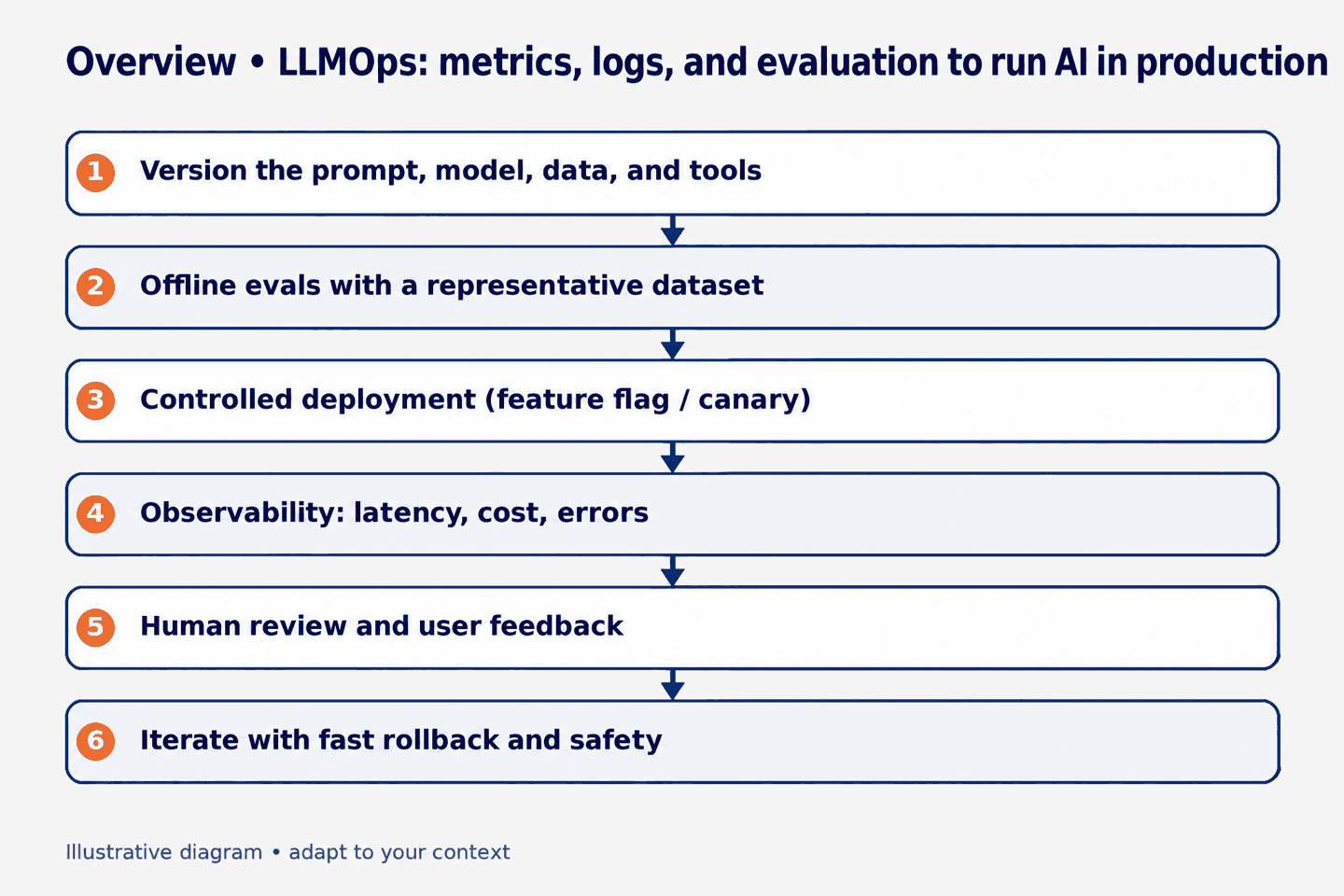
- Versioning: prompt, model, RAG base, retrieval/rerank configs
- Per-request tracing (latency per step + cost)
- Safe logs (IDs, redaction, retention)
- Dashboards: latency, cost, errors, quality, security
- Alerts for cost outliers and quality drops
- Offline evals + weekly sampling with human review
- Rollout process (canary/feature flag) and fast rollback
- Adversarial tests (prompt injection, sensitive data, tool misuse)
References
- Google Cloud: What is LLMOps?
- OpenAI: Working with evals (includes the platform discontinuation notice, checked on November 11, 2026)
- OpenAI Evals (GitHub)
Once AI is already in pilot or production, the next step is to treat quality, cost, logs and risk as operations. See the LLMOps for generative AI page and the AI governance and security page.