Índice do artigofaltam 2 min de leitura
One-to-one integration does not scale.
MCP exists to reduce the "N×M" problem of connecting agents to tools and data.
Anyone who has tried to build an "internal assistant" knows the problem: each agent needs to talk to several sources (docs, database, Git, CRM, tickets). Without a standard, you end up in a scenario where every integration becomes its own project.
The Model Context Protocol (MCP) emerged as an open standard for creating secure, reusable connections between AI applications and data sources or tools. Anthropic launched MCP in November 2024 and described it as a standard for two-way connections between data sources and AI tools.
Since December 9, 2025, the protocol no longer belongs to a single vendor: Anthropic donated MCP to the Agentic AI Foundation (AAIF), a directed fund of the Linux Foundation co-founded by Anthropic, Block and OpenAI, with support from Google, Microsoft, AWS, Cloudflare and Bloomberg. According to the announcement, the protocol's governance model stays the same: maintainers keep prioritizing community contribution and transparent decisions. For anyone deciding whether to adopt it, this matters: the protocol now lives in a multi-vendor foundation and is no longer owned by a single company. On the date of the donation, Anthropic counted more than 10,000 active public MCP servers and more than 97 million monthly downloads of the Python and TypeScript SDKs.

What you will find here
- What MCP is (without buzzwords)
- How it relates to tool calling
- MCP architecture: client, server, and resources/tools
- When it makes sense to adopt (and when it is overkill)
- A security checklist to avoid creating "excessive agency"
MCP in one sentence
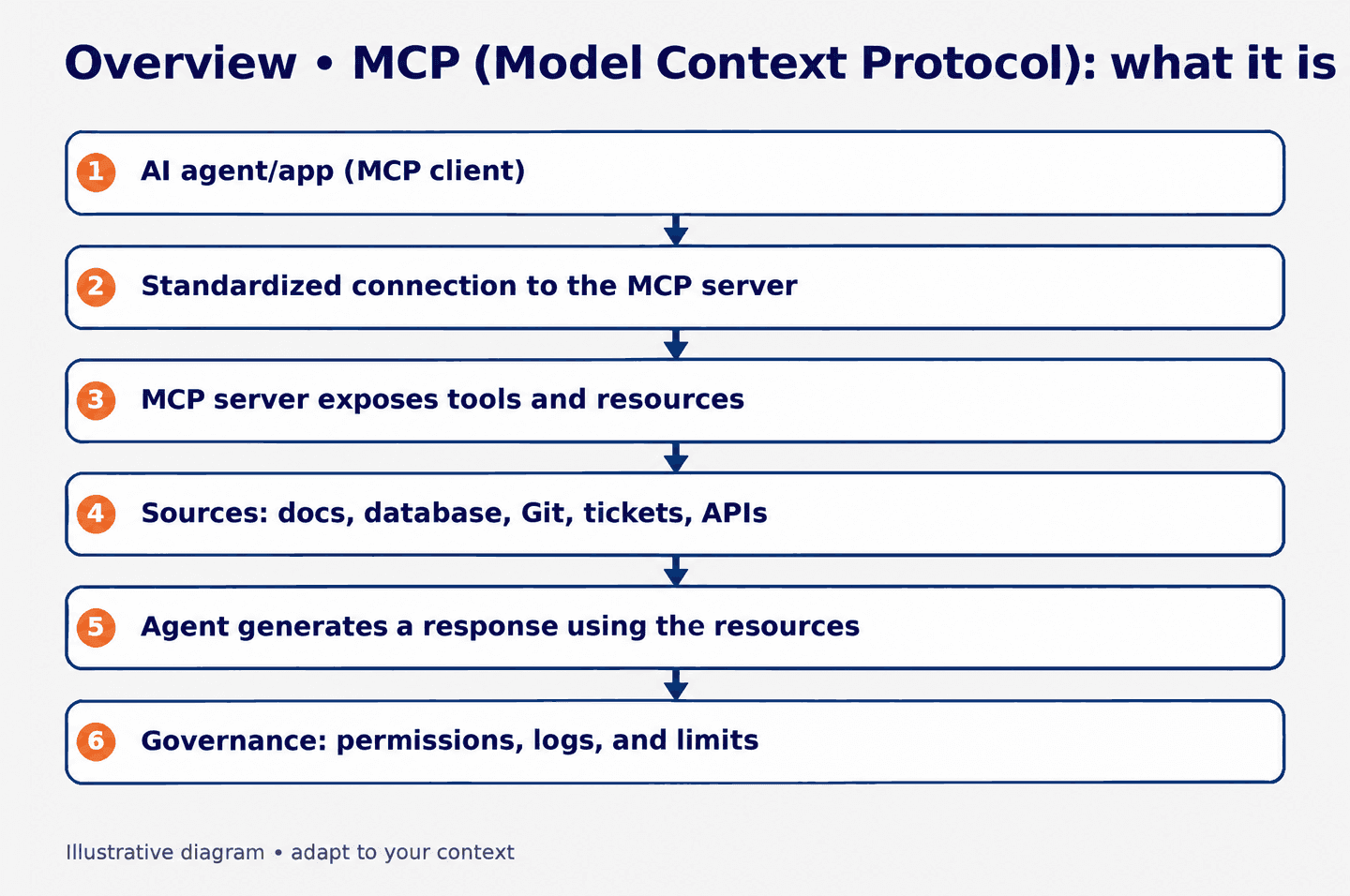
MCP is a protocol in which:
- you expose data/tools through MCP servers
- AI agents and apps act as MCP clients and connect to those servers
- integration follows a standard (instead of every client/tool pair being a one-off solution)
MCP vs tool calling: what is the difference?
They complement each other, but they are not the same thing.
Tool calling (function calling) is the mechanism by which an LLM calls a function described with a schema (usually JSON).
MCP is a standard for how to make tools and resources available in a consistent, pluggable way.
A simple way to think about it:
- tool calling: "how the model asks to execute something"
- MCP: "how I publish and connect tools/resources in an ecosystem"
If you do not yet have well-structured tool calling, start there: Tool calling: secure integration.
When to adopt MCP
MCP tends to make sense when:
- you have multiple tools and multiple agents/apps
- you need a standard way to expose resources (documents, data, actions)
- you want to swap the agent/model without rewriting every integration (the protocol sits in a foundation under the Linux Foundation, not in the hands of a single vendor)
- you want governance per "integration server" (control, logs, limits)
MCP can be overkill when:
- you have 1 app and 1 simple integration
- your case is "just RAG" over a knowledge base
- your security/observability maturity is still low
Security: MCP does not eliminate risk (it changes where the risk lives)
When you connect agents to tools, the main risk is the agent doing more than it should: through permissions, autonomy or lack of validation.
OWASP GenAI calls this "excessive agency". Some practical measures:
1) Minimize tools and permissions
- publish only what is needed
- prefer read-only tools when possible
- apply scope per user/tenant (do not use a "master account")
2) Avoid "overly open tools"
If a server exposes something like "run command" or "run free-form query", you are creating a huge attack surface.
Prefer specific operations, with strict schemas and allowlists.
3) Validation and authorization still live in the target system
Even with MCP, the rule does not change:
- authorization happens in the backend
- input validation is mandatory
- logs and auditing are part of the product
4) Observability and limits
- log calls by tool, user and context
- rate limits / budgets (to prevent abuse and cost)
- monitor errors and suspicious patterns
If you want to structure this as a discipline, see: LLMOps: metrics, logs and evals.
Adoption checklist (quick decision)
- Do I have more than 3–5 tools and more than 1 agent/app consuming them?
- Do I want a standard for publishing integrations with governance and auditing?
- Do I already have authorization, validation and logs well defined in the backend?
- Do I have the maturity to handle incidents and roll back?
If most answers are "yes", MCP can reduce rework and improve consistency.
If most answers are "no", start with well-built tool calling + RAG.
References
- Anthropic: Model Context Protocol
- Anthropic: donating MCP and establishing the Agentic AI Foundation (December 9, 2025)
- Official Model Context Protocol documentation
- Anthropic Engineering: code execution with MCP
- OWASP GenAI: Excessive Agency
If your company needs to standardize tools for agents, see how we design MCP for companies and AI agents connected to real systems.