Índice do artigofaltam 2 min de leitura
AI speeds up the draft. Authority comes from the process.
Sustainable SEO comes from useful content, not volume.
Generative AI tools have made "writing" faster, but they have also made it easier to publish dozens of pages that help nobody. That is exactly the kind of thing that tends to fail in the long run.
Google itself has published guidance saying that using automation/AI is not the problem in itself; the problem is publishing content generated at scale without value, with the main goal of manipulating rankings.

What you will find here
- An editorial process for using AI as leverage (not as a crutch)
- A checklist to avoid "thin content" and scaled content without value
- SEO best practices: intent, structure, sources and updates
- How to turn real questions into articles that rank
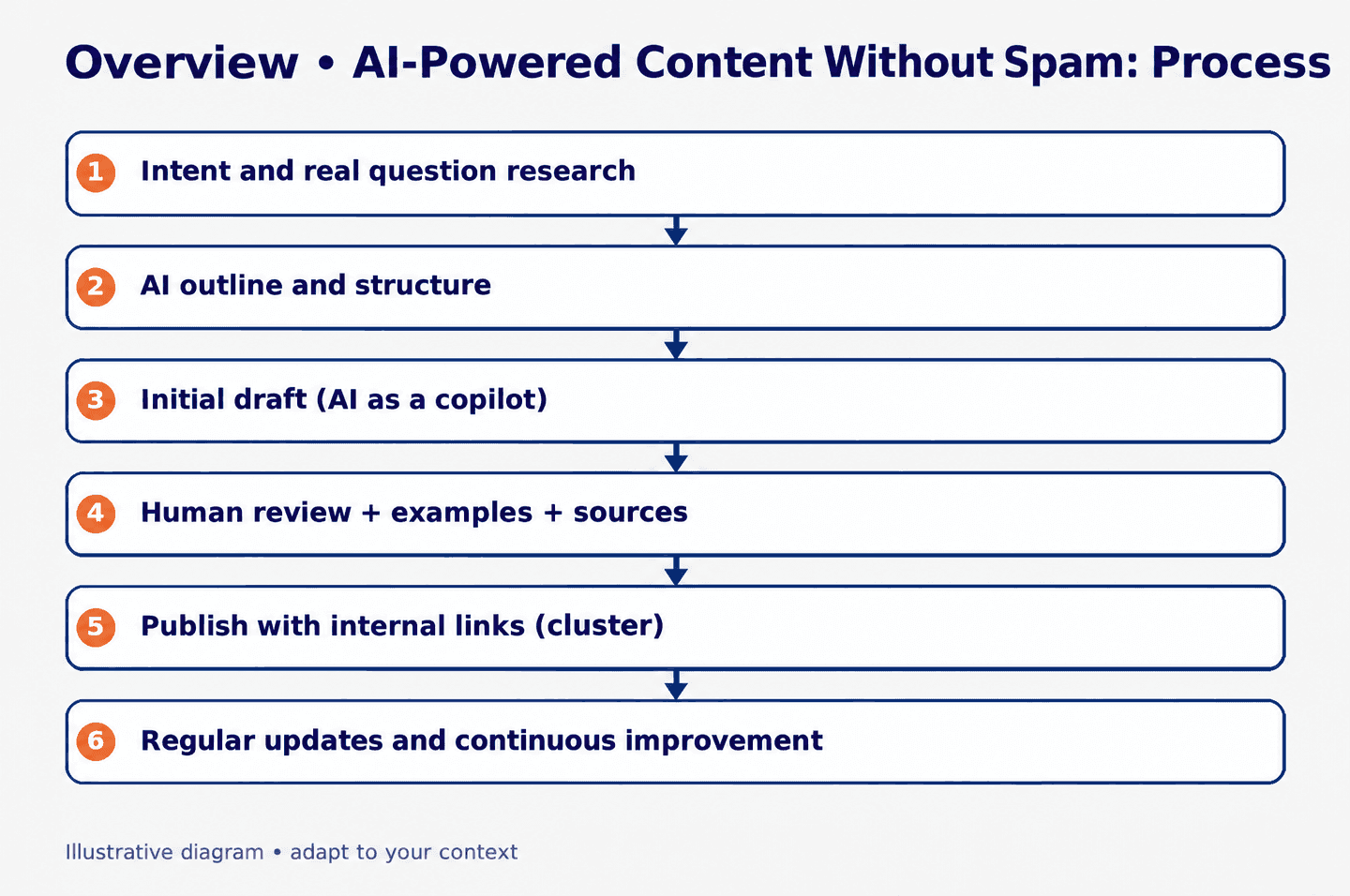
1) Start with intent (not with the tool)
Before asking "write a post about X", ask the right question:
- what real question does someone type into Google?
- what practical problem does the person want to solve?
- what decision are they trying to make?
Examples of "good" intent:
- "how to reduce generative AI costs"
- "what is prompt injection"
- "is RAG worth it?"
Notice: these are pain points and decisions, not "trends".
2) Use AI for structure, not for authority
AI is excellent for:
- suggesting a topic structure
- listing frequently asked questions
- proposing examples and analogies
- generating title variations
But authority comes from:
- hands-on experience (what goes wrong, what works)
- applicable checklists
- examples and decisions (trade-offs)
- trustworthy references (official documentation, standards, best practices)
A simple rule: if the content could have been written with no context at all, it is probably generic.
3) Have a repeatable "quality standard"
A standard that works well for technical posts:
- a clear promise in the title
- a context paragraph (the pain point)
- "what you will learn" (list)
- a simple explanation + architecture/diagram
- step by step
- common mistakes
- final checklist
- references
It's the same kind of structure you see in practical guides: it helps the reader and improves scannability.
4) Avoid what usually turns into spam
Classic signs of "weak" content:
- repeating terms without adding anything
- long text that doesn't answer the question
- no examples, data, steps or sources
- 20 nearly identical posts with only the title changed
Google has guidance on the use of AI and also reinforces policies against scaled content abuse. In other words: it's not about "using AI", it's about "delivering usefulness".
5) Updating is part of SEO (especially in AI)
In topics like AI, standards and tools change. A healthy process:
- review the most important posts every 90 to 180 days
- update references
- show a "last updated" date on the post (if it makes sense)
- create internal links to new content (cluster)
This increases the chance of keeping rankings and avoids stale content.
6) Internal linking: turn posts into a cluster
Isolated posts compete with each other. Connected posts strengthen each other.
Example of an AI cluster:
- RAG in practice
- Sensitive data in RAG
- Prompt injection
- Tool calling
- LLMOps
- Regression testing
- Reducing cost
This network helps users and helps SEO.
Final checklist (AI + SEO without the headaches)
- Topic chosen by search intent (a real question)
- Clear structure (summary, steps, common mistakes, checklist)
- Content with examples and trade‑offs (not just a definition)
- Trustworthy sources cited (official docs, standards)
- Human review (coherence, accuracy, tone, duplication)
- Avoid publishing dozens of nearly identical pages
- Internal links to form a topic cluster
- Update plan (living content)