
Índice do artigofaltam 7 min de leitura
KYC is not "a security button". It is a set of decisions. And those decisions define the cost, the complexity and the approval rate of your app.
If your project involves payments, a marketplace, service provider onboarding, withdrawals/payouts, benefits, credit or any scenario with fraud risk, sooner or later someone asks:
"Do we need KYC?"
The answer is almost never "yes" or "no". The right answer is: which level of verification makes sense for your risk, without killing conversion.

What you will find here
- What KYC (and KYB / AML) means in practice
- Which documents and evidence you can (or should not) ask for
- Verification levels: from basic to enhanced (and the impact on the funnel)
- Questions that define cost and complexity before you hire any vendor
- What to do when a user is rejected (without chaos in support)
- Responsibilities: what belongs to the client, the KYC vendor and the tech team
- Privacy (LGPD, Brazil's data protection law) and storage impacts: how to reduce risk without stalling the project
- Final briefing checklist (for you to copy and send)
1. KYC, KYB and AML in plain terms
KYC stands for Know Your Customer. In practice, it is the process of:
- identifying who the person or company signing up is;
- checking that this identity is real and consistent;
- deciding whether you accept, reject or ask for more information.
Terms that show up alongside it:
- KYB (Know Your Business): when you verify a company (CNPJ, Brazil's company tax ID, articles of incorporation, partners, ultimate beneficial owner, etc.).
- AML (Anti‑Money Laundering): controls to prevent money laundering and other regulatory risks (for example: list checks, politically exposed persons (PEP), sanctions, monitoring).
Important: not every app needs "enhanced KYC". But apps with financial transactions and payouts almost always need some level of due diligence, even if it is gradual (starts simple and "levels up" as risk and volume grow).
2. Verification levels (and where the project starts getting expensive)
A simple way to align with the team and the vendor is to think in levels.
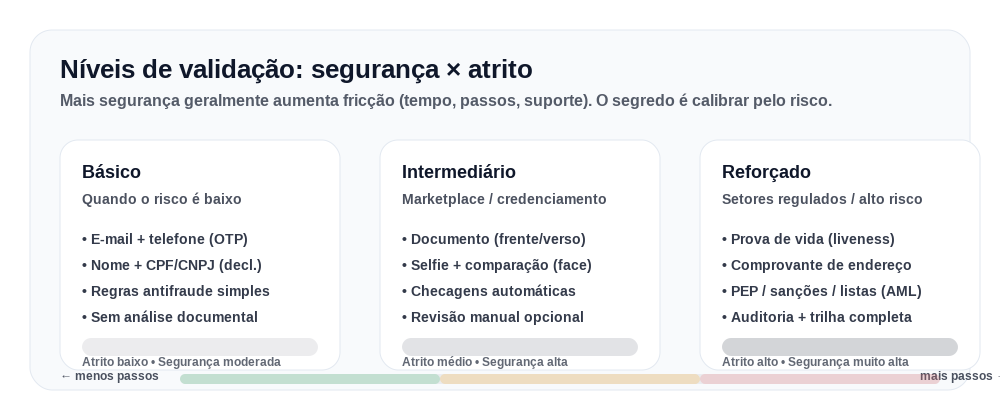
Practical table: levels vs use vs impact
| Level | What it usually includes | What it is for | Typical impact on the project |
|---|---|---|---|
| Basic | email/phone (OTP), self-declared data, simple anti-fraud rules | reduce low-effort fraud (fake sign-ups) | low cost, low friction, little support |
| Intermediate | document + selfie (face match), automated checks, exceptions sent to manual review | onboard service providers / enable withdrawals / raise limits | higher cost and integration effort, moderate support |
| Enhanced | proof of life (liveness), proof of address, lists/AML, audit trail | high risk/regulated, high ticket, compliance | more expensive, more friction, needs an internal process |
Tip: if you do not know the level, start with the question: what is the maximum loss if someone fakes an identity?
The bigger the exposure, the more verification makes sense.
3. Which documents and evidence you can ask for (and what each one solves)
The most common mistake is asking for a document "just because" and finding out later that:
- the user cannot finish (friction),
- support explodes (tickets),
- and the company starts storing sensitive data with no need (LGPD).
Below is a simple map of "evidence → reason → cost/friction".
| Evidence | What it solves | When it makes sense | Practical note |
|---|---|---|---|
| ID document (front/back photo) | documentary proof of identity | onboarding with medium/high risk | requires good capture (camera) and guidance |
| Selfie | confirms the person is the same as on the document | marketplace/fintech/withdrawal | needs rules for lighting/angle |
| Proof of life (liveness) | reduces fraud with photo/video/replay | high risk, "valuable" account | adds friction; UX tuning is critical |
| Proof of address | reduces risk of inconsistency/collection problems | credit/regulated services | the top cause of rejection if poorly designed |
| Bank details | links payment/payout | when there are withdrawals/payouts | be careful with verification and privacy |
| Company documents (KYB) | verifies the company and those responsible | B2B, marketplace of companies | usually involves legal/finance |
Golden rule: every piece of evidence must have a business reason. If there is no reason, it is extra cost and risk.
4. Design the KYC flow before you choose a vendor
KYC does not end when you "call the API". You need a complete flow: sign-up, verification, status, rejection, resubmission, review and audit.
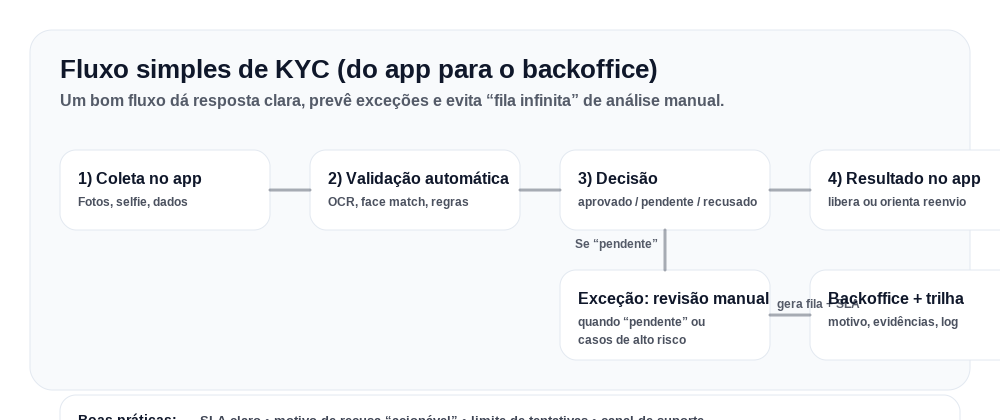
Points that usually stall the project:
- "Who decides when a case is pending?"
- "Is there manual review?"
- "What is the turnaround time (SLA) for approval?"
- "How does the user know what to do to fix it?"
- "Who handles disputes?"
If these answers do not exist, the integration becomes a "black box": it approves or rejects with no transparency.
5. Questions that define cost and complexity (decision checklist)
Below is a checklist that usually prevents 80% of the mistakes in vendor selection and flow design.
5.1 Scope and risk (defines the level)
- Which user action depends on KYC? (sign up, buy, sell, withdraw, receive commission, access sensitive data?)
- What is the maximum loss if there is fraud? (financial, reputation, chargeback, regulatory risk)
- Is KYC mandatory for everyone or only for those who reach a threshold? (e.g. only to withdraw / only above R$ X, in Brazilian reais)
- Do you need to verify a person (KYC), a company (KYB) or both?
- Does your product need additional checks (lists/PEP/sanctions) or is it "only" identity verification?
5.2 Experience and operations (defines support and funnel)
- What is the expected SLA? (instant, minutes, hours, days)
- What happens if the vendor goes down? (contingency / queue / "come back later")
- How many attempts can the user make? (and when does it become manual review?)
- Is there a support channel for "not approved"? (and who answers: you or the vendor?)
- Do you need multiple languages and documents from several countries?
5.3 Data and privacy (defines risk and architecture)
- Which data do you really need to store? (or do you only need the "result" + a token?)
- For how long do you need to retain evidence? (and why?)
- Who will have internal access to the images/documents?
- How do you handle privacy requests (LGPD), including deletion, when applicable?
- Which country/infrastructure does the data go to? (this affects contracts and governance)
5.4 Integration and product (defines engineering)
- Do you need webhooks to receive status automatically?
- Do you need a dashboard/back office to review cases?
- Which metrics will be tracked? (approval rate, rejections by reason, average time, drop‑off)
- How will the app guide the capture (camera) to reduce rejections?
- Does the flow also need to exist on the web/admin (besides the app)?
6. What to do with rejections (without an "endless dispute")
Rejection is not the problem. The problem is a rejection becoming a dead end.
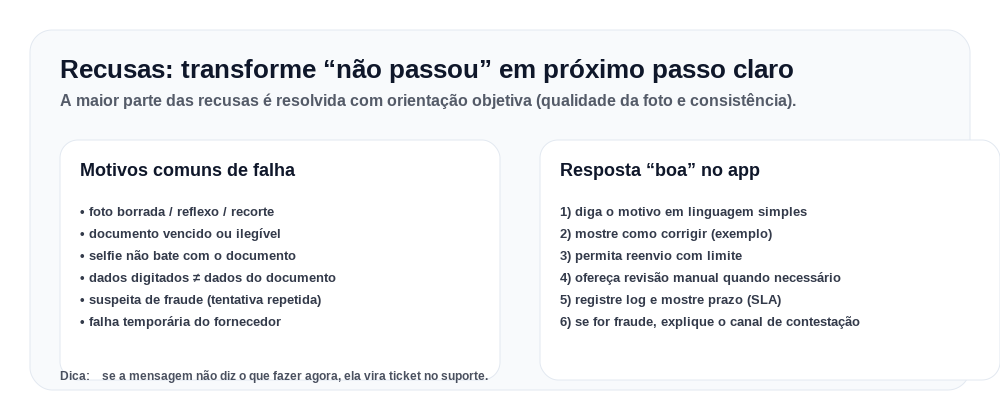
Good practices for an "actionable rejection":
- State the reason in plain language ("blurry photo", "expired document", "data does not match").
- Show how to fix it (lighting, framing, remove the cover, avoid glare).
- Allow resubmission with a limit and with feedback on each attempt.
- Have a fallback: manual review (when the user is "good" and the system is uncertain).
- Keep a log (what was sent, when, result): this reduces disputes.
- Have a clear policy for suspected fraud and a channel for disputes.
The metric you need to track: "rejection by reason".
If one reason dominates, it is not "the user's fault": it is usually bad UX or a rule that is too rigid.
7. Responsibilities (client vs vendor vs team)
The split of responsibilities needs to be clear at kickoff. Otherwise you end up in this scenario: the vendor "rejects", the user complains, the client pushes, and nobody knows who fixes it.
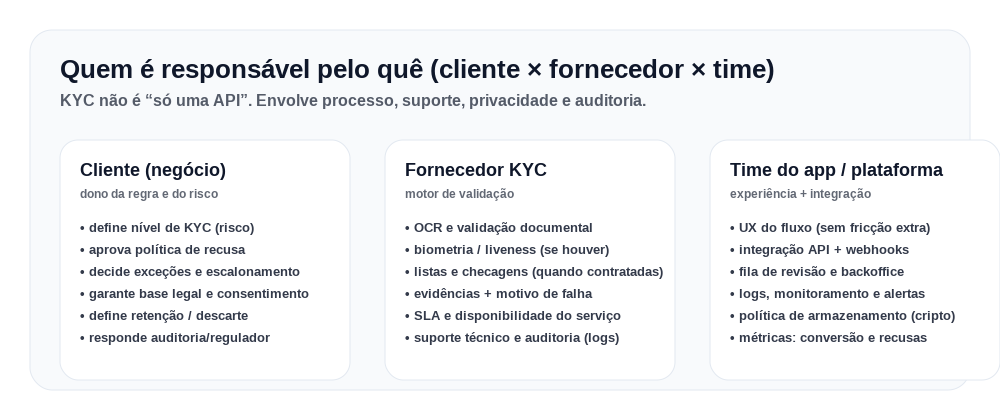
Simple summary:
- Client (business): defines level, rules, exceptions, acceptable risk, retention policy and communication.
- KYC vendor: verifies evidence, returns reason and status, offers SLA and logs.
- App/platform team: designs the flow (UX), integrations (API/webhooks), back office, monitoring and data security.
8. Privacy and storage (LGPD): how to reduce risk without stalling the project
As a general rule:
- avoid collecting what you do not need;
- protect what you collect;
- know how long you need to keep it;
- have a process to handle requests from the data subject.
In practice, this turns into architecture decisions:
8.1 Store documents "in your system" or "at the vendor"?
Two common approaches:
-
The vendor stores, you keep only a token + result
Less operational risk and a smaller attack surface, but it requires a good contract and governance. -
You store (or replicate) images/documents
Gives you more control, but increases responsibility: encryption, access, audit, retention and deletion.
There is no universal "right". There is what makes sense for your risk, your compliance and your operational capacity.
8.2 Practical LGPD checklist for KYC (without legalese)
- Can you explain (to the user) why you are asking for each piece of data?
- Does the privacy policy mention identity/document verification?
- Is internal access restricted (role and real need)?
- Is there a retention policy (period and reason) and secure disposal?
- Is data protected in transit and at rest (HTTPS, encryption, etc.)?
- Is there a plan for incidents (leaks) and for audits?
- Is there a procedure for data subject requests (access, correction, deletion when applicable)?
If you are also designing privacy/account deletion flows, this post is a good companion:
Account deletion and LGPD: how to design the flow so your app is not rejected
To prepare the store data declarations, see also: Privacy Policy, Data Safety and App Privacy: what to prepare before publishing your app.
9. Briefing template to hire KYC (copy and paste)
If you want to speed up internal alignment, copy this block and fill it in:
- Country(ies) of operation and accepted document types:
- Desired level (basic/intermediate/enhanced) and why:
- Actions that depend on KYC (e.g. withdrawal, provider onboarding, purchase):
- Expected SLA and estimated volume (per day/month):
- Attempt and resubmission rules (how many attempts / when it goes manual):
- List of extra checks (liveness, address, KYB, lists/AML):
- How status comes back to the app (webhook, polling):
- Evidence and rejection reasons (format and granularity):
- Back office: is manual review needed? Who reviews?
- Retention and storage (who keeps what and for how long):
- Privacy and security requirements (LGPD):
- Contingency (what to do if the service goes down):
Conclusion
Well-designed KYC is what reduces fraud without blocking sign-up and operations.
The secret is not "the most famous vendor", but:
- the right level for the risk,
- a complete flow (including rejection and exceptions),
- a defined internal process,
- and real care with privacy and storage.
These topics usually go hand in hand with KYC and are worth reviewing: